

Screen print vs DTF printing compares two dominant apparel decoration methods: screen printing pushes plastisol ink through mesh stencils for high-volume durability at $0.75-$2 per shirt at scale, while Direct-to-Film (DTF) printing digitally prints full-color designs onto PET film for $3-$8 per shirt with zero setup cost. The global screen printing market reached $5.87 billion in 2025, growing at 3.4% CAGR through 2035, while DTF adoption is accelerating among small-batch print shops due to its ability to handle unlimited colors and any fabric type without per-color screen fees.
Key Takeaways
- Screen printing lasts 50-100+ washes; DTF transfers last 50-100 washes with proper cold-water care and cold peel application
- DTF setup costs $0 per design; screen printing setup costs $25-$50 per color, reaching $100-$200 for a typical 4-color design
- Screen printing wins on cost per shirt for orders above 500 pieces ($0.75-$2 vs DTF’s $1.50-$4); DTF wins below 100 pieces ($3-$8 vs screen’s $8-$15)
- DTF prints on cotton, polyester, nylon, blends, and performance wear; screen printing works best on cotton and cotton-rich blends
- A Turkish garment factory replaced screen printing with DTF and achieved 40% higher throughput and 30% lower costs, according to data from our customers across 50+ countries
How Screen Printing Works
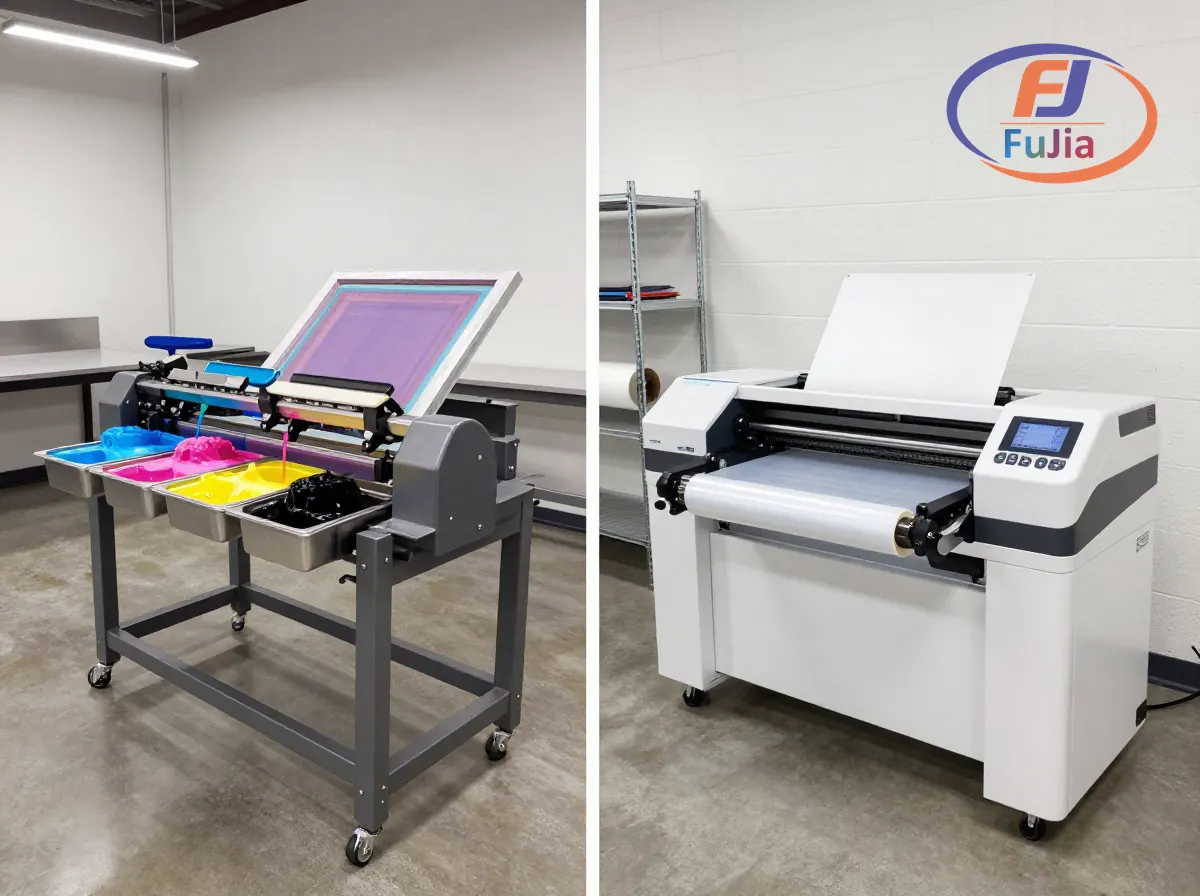
Screen printing forces plastisol or water-based ink through a woven mesh stencil (screen) onto fabric using a squeegee. Each color in a design requires a separate screen, created by coating a mesh frame with photo-sensitive emulsion, exposing it to UV light at 350-420 nanometers through a film positive, and washing away unexposed areas. The resulting stencil allows ink to pass only where the design appears, according to technical documentation on screen printing from Wikipedia. For a complete overview, see the Fujia DTF printer lineup guide.
After ink application, prints cure at approximately 150 degrees Celsius (300 degrees Fahrenheit) in a conveyor dryer to permanently bond the ink to fabric fibers. A properly cured plastisol print achieves the industry durability standard of 50-100+ wash cycles, verified through ASTM testing protocols. The U.S. screen printing market sees garment printing accounting for over 50% of all commercial screen print revenue.
How DTF Printing Works
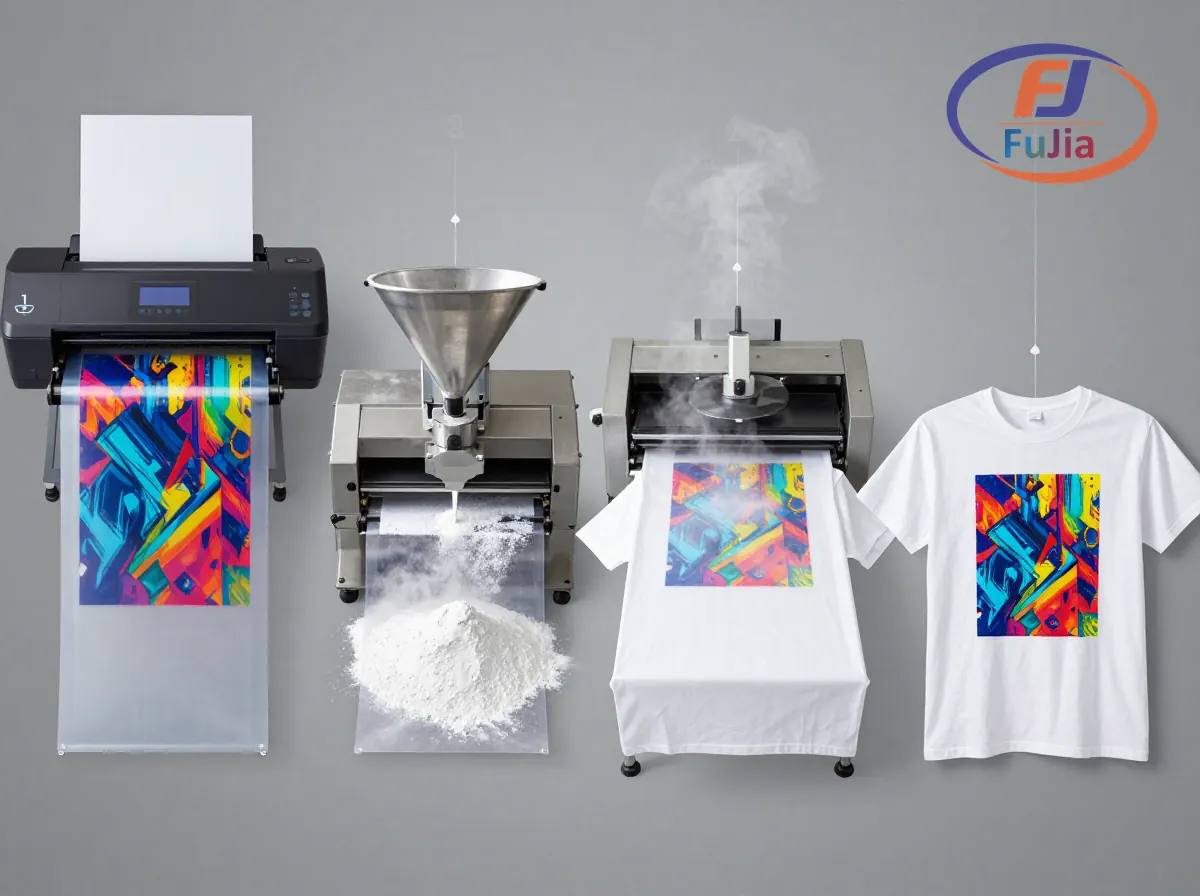
DTF printing uses a modified inkjet printer to deposit CMYK ink plus a white underbase onto PET film. After printing, a thermoplastic polyurethane (TPU) adhesive powder is applied to the wet ink, excess powder is shaken off, and the film passes through a curing oven to melt the powder. The printed transfer is then heat-pressed onto fabric at 160 degrees Celsius for 15 seconds and cold-peeled, leaving a full-color design bonded to the garment surface.
The TPU adhesive creates a flexible bond that stretches with fabric fibers without cracking, unlike rigid plastisol ink layers. DTF transfers achieve wash durability of 50+ heavy machine washes with color fastness rated Grade 4-5 on the AATCC grayscale, matching screen printing longevity for most commercial applications. The Fujia Print A1 DTF 4-Head printer uses Epson I3200 printheads with Honson mainboard, Leadshine servo motor, and THK silent guide rail transmission to maintain print quality across 12-hour continuous production runs at 27 square meters per hour.
Screen Print vs DTF: Head-to-Head Comparison
| Factor | Screen Printing | DTF Printing | Winner |
|---|---|---|---|
| Wash durability | 50-100+ washes | 50-100 washes | Screen (slight edge) |
| Crack resistance | Moderate (ink can crack on stretch) | Excellent (TPU flexes with fabric) | DTF |
| Setup cost | $25-$50 per color/screen | $0 (digital file) | DTF |
| Cost per shirt (1-50 pcs) | $8-$15 | $3-$8 | DTF |
| Cost per shirt (500+ pcs) | $1.50-$3 | $2-$5 | Screen |
| Cost per shirt (2,000+ pcs) | $0.75-$2 | $1.50-$4 | Screen |
| Color count | 1-6 (each adds a screen) | Unlimited (digital, no extra cost) | DTF |
| Fabric compatibility | Cotton, cotton-rich blends | Cotton, polyester, nylon, blends, spandex | DTF |
| Design detail | Bold graphics, spot colors | Photographic, gradients, fine text (down to 0.5pt) | DTF |
| Minimum order | 24-48 pieces typical | 1 piece | DTF |
| Turnaround | 7-14 days | Same-day to 48 hours | DTF |
| Hand feel | Soft (water-based) to thick (plastisol) | Slightly rubbery, soft-medium | Screen (water-based) |
Cost Breakdown: When Does Each Method Win?
The financial break-even between screen printing and DTF depends on three variables: order quantity, color count, and design complexity.
Small orders (1-50 pieces): DTF wins decisively. A 4-color design on 20 shirts costs $100-$200 in screen setup alone, adding $5-$10 per shirt before ink touches fabric. DTF has zero setup cost, keeping per-shirt cost at $4-$6 regardless of color count.
Medium orders (50-500 pieces): DTF maintains a cost advantage but the margin narrows. At 200 pieces with a 4-color design, screen printing costs $4-$8 per shirt (setup amortized across more units) while DTF costs $2.50-$6 per shirt.
Large orders (500+ pieces): Screen printing takes the lead. Once screens are burned and registered, the run charge drops to $0.75-$2 per shirt for simple 1-2 color designs. DTF consumables (PET film, TPU powder, white ink) keep per-unit cost at $1.50-$4 regardless of volume.
The break-even point typically falls around 500 units for single-color designs and 100 units for multi-color designs, based on aggregate data from our customers across 50+ countries. For a print shop running 200 transfers per day on a Fujia Print A1 DTF printer, monthly profit reaches approximately $3,600 with a 1.5-month payback period.
Real Case: Screen to DTF Migration
A Turkish garment factory in Istanbul replaced screen printing minimums of 200+ pieces per design with DTF printing, achieving 40% higher throughput and 30% lower production costs while cutting delivery time from 7 days to 2.5 days. Small-batch orders now account for 60% of the factory’s revenue, a segment previously unprofitable under screen printing’s setup-cost economics. The factory’s A1 dual-head DTF printer (65cm width, dual Epson I3200 printheads) produces 4-6 square meters per hour at 6-pass resolution, with file-to-finished-print turnaround under 30 minutes.
This case illustrates the core DTF advantage over screen printing: eliminating setup costs opens business models that screen printing cannot serve profitably. Print-on-demand, custom one-offs, team jerseys in multiple colorways, and limited-edition drops all become viable when per-design fixed costs are zero.
Fabric Compatibility and Versatility
Screen printing excels on cotton and cotton-rich blends where plastisol ink penetrates fibers and cures into a durable layer. On synthetic fabrics like 100% polyester, screen printing requires special additives (Nylobond) to prevent dye migration and cracking, adding cost and complexity.
DTF transfers bond to virtually any fabric through the TPU adhesive layer, which melts into fiber structures regardless of material composition. DTF prints successfully on 100% cotton, 100% polyester, cotton-poly blends, nylon, spandex, and performance fabrics without pretreatment or special additives. This universal compatibility eliminates the fabric testing phase that screen printers must complete for each new substrate.
The one area where screen printing outperforms DTF on fabric interaction is breathability. Water-based screen printing inks soak into fibers, leaving no surface film and allowing air circulation through the printed area. DTF transfers sit on the fabric surface as a thin polymer layer, reducing breathability slightly in the printed region. For activewear where moisture wicking matters, screen printing’s water-based option may be preferable.
When to Choose Screen Printing
Screen printing remains the better choice when: – Order quantity exceeds 500 pieces of the same design – The design uses 1-3 solid spot colors (Pantone matching required) – Maximum durability for heavy-use workwear or uniforms is the priority – Breathability and soft hand feel on cotton garments matter – Specialty effects are needed: puff ink, metallic, glitter, flocking, or glow-in-the-dark
When to Choose DTF Printing
DTF printing is the better choice when: – Order sizes are small (1-100 pieces) or variable – Designs contain photographic elements, gradients, or more than 4 colors – The garment substrate is polyester, nylon, or a performance blend – Fast turnaround (same-day or next-day) is required – Print-on-demand or custom personalization is the business model
For shops considering in-house DTF production, the Fujia Print A1 DTF 4-Head printer offers 650mm print width at 27 square meters per hour with automatic white ink circulation that prevents titanium dioxide precipitation. Read our DTF printer buying guide for setup details, or explore the complete DTF printer collection for configurations from A3 desktop to A1 industrial.
Does DTF last longer than screen printing?
No, screen printing generally lasts slightly longer than DTF when both are properly applied. Screen printing plastisol ink bonds directly with fabric fibers and survives 50-100+ wash cycles before showing visible wear, verified through ASTM industrial wash testing. DTF transfers also achieve 50-100 wash cycles with proper care (cold water, inside-out washing, air drying), but the TPU adhesive layer gradually thins over time rather than maintaining full opacity like plastisol ink. The practical difference is small: both methods will outlast the garment itself under normal wear conditions. DTF does outperform screen printing in crack resistance because the TPU adhesive flexes with fabric movement, while plastisol ink can crack when stretched repeatedly. For a Turkish garment factory running DTF production, prints maintained Grade 4-5 color fastness (AATCC scale) after 50+ heavy machine washes.
Which is better screen printing or DTF printing?
Neither method is universally better; the right choice depends on order quantity, design complexity, and fabric type. Screen printing wins for bulk orders of 500+ pieces with simple 1-3 color designs, where per-unit cost drops to $0.75-$2. Screen printing also wins when specialty effects (puff, metallic, glitter) or maximum breathability on cotton garments are required. DTF printing wins for orders under 100 pieces, designs with photographic detail or more than 4 colors, and garments made of polyester, nylon, or performance blends. DTF also wins when fast turnaround matters: a DTF transfer goes from digital file to finished garment in under 30 minutes, while screen printing requires 2-4 hours of setup per design. Most modern print shops operate both methods, using DTF for small runs and complex designs, and screen printing for high-volume simple work.
Is DTF replacing screen printing?
DTF is not replacing screen printing entirely but is capturing market share in specific segments. DTF adoption has grown rapidly among small print shops, Etsy sellers, and print-on-demand businesses that previously could not justify screen printing setup costs for orders under 50 pieces. The global screen printing market still reached $5.87 billion in 2025 and is projected to grow at 3.4% annually through 2035, indicating continued demand. However, DTF is displacing screen printing in three areas: small-batch custom apparel (under 100 pieces), multi-color short runs (4+ colors on small quantities), and printing on synthetic fabrics (polyester, performance wear). For high-volume uniform programs and promotional products at 2,000+ pieces, screen printing remains dominant due to its unbeatable per-unit economics at scale. The two technologies are converging into complementary roles rather than one replacing the other.
What are the disadvantages of screen printing?
Screen printing has five main disadvantages compared to DTF and other digital methods. First, high setup costs: each color requires a separate screen at $25-$50 each, meaning a 4-color design costs $100-$200 before printing begins, making small orders cost-prohibitive. Second, minimum order quantities: most screen printers require 24-48 pieces minimum to amortize setup costs. Third, limited color complexity: each color needs its own screen and precise registration, making photographic images and gradients impractical without expensive simulated process separations. Fourth, slow turnaround: screen preparation, exposure, registration, and cleanup take 2-4 hours per design, compared to DTF’s 15-30 minute setup. Fifth, fabric limitations: plastisol screen printing works best on cotton and cotton-rich blends; synthetic fabrics like polyester and nylon require special additives and may still produce dye migration or cracking issues. For high-volume runs of simple designs, these disadvantages are offset by screen printing’s low per-unit ink cost and proven durability.
Conclusion
Screen printing and DTF printing serve different production volumes and design needs. Screen printing delivers the lowest per-unit cost at 500+ pieces with proven 100+ wash durability, while DTF eliminates setup costs and handles unlimited colors on any fabric for orders of 1 to 500 pieces. Explore Fujia Print DTF printers for in-house transfer production, or read our DTF printing overview to learn how the technology works in detail.
