

The Prestige DTF printer line from DTF Station is the most complete dealer-branded range in DTF, running from a $2,000-class A4 converted desktop up to a $25,680 XL2 production bundle. This review maps every model’s real specs, quantifies the XL2 against a factory-direct 24-inch machine costing well under half as much, and flags the consumables warranty clause buried in the terms.
Key Takeaways
- Prestige is DTF Station’s house brand, spanning eight models: A4 (8.26″), R1, R2, R2 Pro, L2 (18″), XL2 (24″), XL4, and the 36.6-inch X6.
- The A4 is an Epson L805 conversion rated at 70 pieces per day; everything above it runs on Hosonsoft boards, the same board family inside most Chinese-built DTF machines.
- The flagship XL2 bundles at $25,680 (list $27,448) with a 24-inch shaker oven, neoStampa RIP, onsite training, and starter consumables.
- A critical warranty clause: using non-DTF Station ink, film, or powder voids coverage, which locks owners into branded consumables.
- A factory-direct 24-inch comparison point: Fujia’s A1 4-head runs 27 m²/h at 4-pass with Honson, Leadshine, and THK transmission for under $10,000, with a 12-month warranty and no consumables lock-in.
What Is the Prestige DTF Printer Line?
Prestige is the house DTF brand of DTF Station, a US-based distributor and integrator rather than a factory, and the lineup is the widest single-brand range in the category with eight models stepping from desktop to industrial width. The A4 starts the range at 21 cm (8.26 inches) using a converted Epson L805 engine rated around 70 pieces per day; the R1 and R2 move to 13-inch roll systems on dual Epson F1080 and XP600 heads respectively; the R2 Pro upgrades to dual i1600 heads at roughly 180 pieces per 8-hour day; and the L2, XL2, XL4, and X6 climb through 18-inch, 24-inch, and 36.6-inch widths on dual, quad, and six Epson i3200 configurations.
Here’s the thing about this structure: the dealer-assembled nature of the line explains both its strengths and its pricing. DTF Station specifies the configurations, bundles the finishing equipment, writes the training program, and staffs the support channels, which is real value for buyers who want one throat to choke; the machines themselves are built in China on Hosonsoft boards, the same board family that runs through most Epson-head Chinese DTF printers, including factory-direct brands. The honest truth about this structure: buyers pay for curation, integration, and service rather than for proprietary hardware, and whether that premium makes sense depends entirely on how much integration value a shop places on its first purchase.
The lineup’s internal logic is genuinely good, which is why it dominates US dealer search results. Each step solves the previous tier’s actual constraint, width first, then head count, then color gamut, rather than shuffling near-identical machines with new suffixes.
Prestige DTF Printer Prices in 2026
Pricing splits into printer-only and bundle figures, and the bundles are where DTF Station’s integration shows: the XL2 package at $25,680 (list $27,448) includes the L24R 24-inch shaker oven, neoStampa RIP software, onsite training valued at $2,750, two 24-inch film rolls, inks, powder, cleaning supplies, and a first-month software membership.
| Model | Width | Heads | Printer price (2026) | Notes |
|---|---|---|---|---|
| Prestige A4 | 21 cm (8.26″) | Epson L805 (converted) | ~$2,000-2,500 | desktop, 70 pcs/day |
| Prestige R1 | 33 cm (13″) | 2× Epson F1080 | ~$4,000-5,000 | 1.25 m²/h |
| Prestige R2 | 33 cm | 2× Epson XP600 | ~$5,500-7,000 | 2.5-3.5 m²/h @6-pass |
| Prestige R2 Pro | 33 cm | 2× Epson i1600 | ~$8,000-10,000 | ~180 pcs/8h, built-in cutter |
| Prestige L2 | 45 cm (18″) | 2× Epson i3200 | ~$13,000-15,000 | 5.5 m²/h @6-pass |
| Prestige XL2 | 60 cm (24″) | 2× Epson i3200 | $19,362 printer only | 80-100 sq ft/h |
| Prestige XL2 bundle | 60 cm + oven | 2× Epson i3200 | $25,680 (list $27,448) | complete production package |
Two things stand out in these numbers. The A4 tier is a converted desktop printer, functional for prototyping and gift-volume work but structurally a hobby engine, so buyers should understand that “Prestige quality” at the entry point means L805 economics rather than production engineering. At the top, the XL2 bundle’s $25,680 is a genuinely complete package, and comparing it against printer-only figures from other brands is apples to oranges; the fair factory-direct comparison includes a shaker, oven, RIP, and training as well, which is the comparison the section below runs.
Engineering: WIMS, Auto-Cleaning & the Hosonsoft Board
The XL2’s maintenance automation is the line’s strongest technical argument. WIMS, the White Ink Management System, stirs white ink on a timer to fight sedimentation; passive auto-cleaning runs every 4 hours while the printer sits on; active auto-cleaning pauses production at set intervals for head maintenance; auto-wet capping seats the head in cleaning solution while idle; and a head strike sensor plus automatic film sensing protect against the two most common mechanical failures. That stack directly addresses the daily-maintenance burden that drives most DTF downtime, and for a shop without a dedicated operator it is worth real money.
The board-level reality is less exotic than the marketing suggests. Prestige machines from the R1 upward run Hosonsoft mainboards, the same Chinese board ecosystem inside most factory-direct Epson-head machines, including Fujia’s line where the board pairs with a Leadshine servo motor and THK silent guide rail in the transmission. That said, this is not a knock on Prestige; it is proof the DTF industry has consolidated on a mature control platform. Most small shops will never touch the board, so the premium is better read as integration, training, and service rather than secret electronics.
Where the engineering argument hits its limit is the warranty’s consumables clause. Prestige coverage terms void the warranty when owners run non-DTF Station ink, film, or powder, which converts the machine into a consumables subscription at branded prices; the 1-year printer warranty and 6-month, up-to-two-printhead coverage are only as durable as a buyer’s willingness to stay inside that ecosystem. Shops comfortable with that lock-in get a coherent, supported system; shops that want to shop consumables on price should weigh the clause before purchase, because it is the single biggest long-term cost differentiator in the Prestige math.
Prestige XL2 vs Factory-Direct 24-Inch Machines
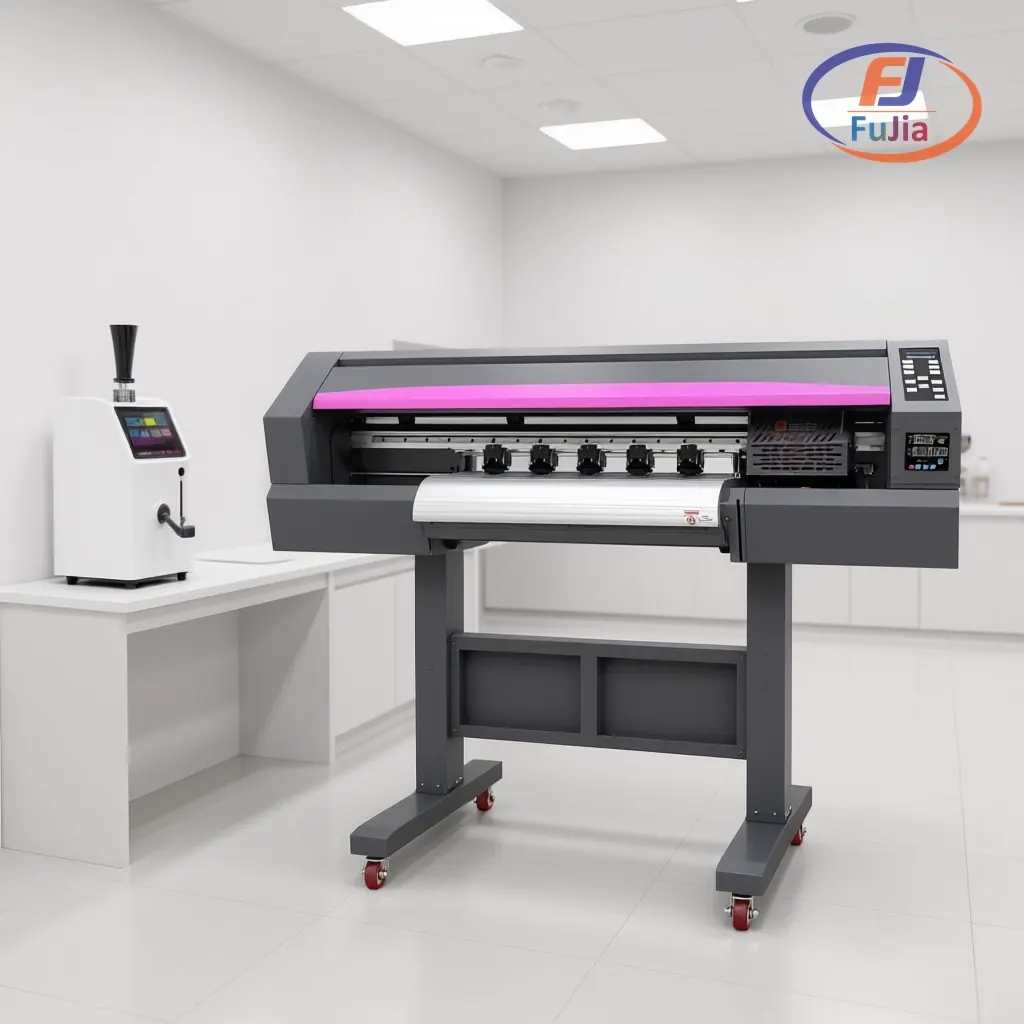
The XL2 is the Prestige most buyers are actually researching, so the comparison that matters runs it against a factory-direct 24-inch-class machine with published specs, Fujia’s A1 4-head, at dealer-verified configurations.
| Factor | Prestige XL2 (bundle) | Fujia A1 4-head (factory-direct) |
|---|---|---|
| Max print width | 23.62 in (60 cm) | 650 mm (25.6 in) |
| Printheads | 2× Epson i3200 | 4-5× Epson i3200 |
| Speed | 80-100 sq ft/h (7.4-9.3 m²/h) | 27 m²/h @4-pass |
| Resolution | not published | 720×2400 dpi @8-pass |
| White ink system | WIMS timed stirring | auto circulation, outage-proof |
| Transmission | Hosonsoft board | Honson board + Leadshine servo + THK rail |
| Warranty | 1 yr printer, 6 mo heads (≤2) | 2 yr, parts in 48h |
| Consumables lock-in | yes, brand-required for warranty | no |
| Complete setup price | $25,680 with oven/RIP/training | under $10,000 + shaker/oven |
The throughput-per-dollar difference is structural, not marginal. The XL2’s two i3200 heads move 7.4-9.3 m²/h at rated speed while the factory-direct 4-head reaches 27 m²/h at 4-pass, roughly triple the rate for under half the bundle price, and both machines feed the same class of shaker and press. A Turkish garment factory running Fujia’s dual-head 60 cm platform logged 40% throughput gains and 30% cost reductions with delivery windows collapsing from 7 days to 2.5, while small-batch work grew to 60% of revenue; that order profile, high-mix apparel at production volume, is precisely where the 4-head math compounds. The XL2 argues back with onsite training valued at $2,750 and a single-vendor support stack, and for a first-time owner without technical staff that package has genuine worth; the factory-direct counter is a 3-day remote onboarding program, lifetime engineer chat, and 48-hour parts dispatch that together replace the onsite visit at a fraction of the price. Shops weighing the two paths line by line will find the full factory-direct lineup on our DTF printers page, and financing comparisons live in our DTF printer financing guide.
Which Prestige Model Fits Your Shop
Volume decides the entry point, and the data from our customers across 50+ countries backs that ordering. Under 30 pieces daily, the R2 Pro at roughly 180 pieces per 8-hour day covers demand with a 13-inch footprint and a built-in cutter, and it is the strongest compact option in the range; the A4 and R1 below it make sense only for prototyping, gift volume, or validating a market before committing. Between 30 and 150 daily pieces, the L2’s 18-inch width and 400-piece capacity start making sense where gang-sheet efficiency matters more than floor space.
At production volume the XL2 tier is the real decision, and the honest comparison is total-package against total-package: the $25,680 Prestige bundle against a factory-direct 4-head, shaker, oven, and press combination near $14,000-16,000 with twice the rated throughput. Shops valuing DTF Station’s training and single-vendor accountability will find the XL2 a coherent purchase; shops optimizing capacity per dollar, or wanting consumables freedom, will put the difference toward a second press.
What is the best DTF printer on the market?
The best DTF printer is the one whose capacity, service model, and consumables economics match your order book, and in 2026 that splits into two honest camps. For buyers who want single-vendor integration, onsite training, and a dealer service layer, the Prestige XL2 bundle at $25,680 is the most complete 24-inch package on the market, with WIMS white management and a full maintenance automation stack. For buyers optimizing capacity per dollar, factory-direct 4-head machines under $10,000 running 27 m²/h at 4-pass with 2-year warranties deliver roughly triple the throughput rate, and Fujia’s A1 line, built on a Honson mainboard, Leadshine servo motor, and THK guide rail, is the reference point in that camp. Both paths produce sellable transfers; the differentiators are service shape and consumables freedom, so decide those before comparing spec sheets.
Is owning a DTF printer worth it?
For shops with consistent order flow above roughly 20-30 pieces daily, yes: $0.40-0.80 per-transfer consumables against $3-8 resale yields 40-70% margins that recover a $13,500-25,000 investment in months at 50 prints per working day. Ownership also removes outsourcing MOQs and turnaround queues, which is what converts same-day delivery from a marketing claim into a standard practice, and one Turkish factory we supplied cut delivery windows from 7 days to 2.5 while lifting throughput 40% after bringing printing in-house. The honest cost of ownership is maintenance discipline, daily white ink checks and capping wipes of 3-5 minutes, plus consumables policy: on machines like the Prestige line, third-party consumables void warranty coverage, so budget branded supplies as a fixed cost.
Who has the best quality DTF prints?
Print quality in DTF is a system property, not a brand property, and it ranks in this order: RIP color management, film and powder pairing, press temperature and time discipline, and only then printhead count. Every serious 2026 machine runs Epson i3200-class heads at 720×2400 dpi, so resolution differences between Prestige, Mimaki, and factory-direct brands are effectively zero at the head level; what separates quality shops is a choke-controlled white underbase, fresh powder at correct melt, and 160°C for 15 seconds with proper cold peel. Durability evidence beats marketing claims: a properly tuned system holds grade 4-5 color fastness across 50+ machine washes regardless of badge. The practical test is to send the same design file to the two or three printers on your shortlist and judge the washed transfers side by side on your own fabric.
What is the best DTF printer for beginners?
The best beginner printer is the cheapest machine that removes workflow friction without buying dead capacity, and that answer has moved downmarket. For learning mechanics and validating local demand, the Prestige A4 or R1 works, but both are constrained platforms, a converted L805 desktop and a 13-inch single-class roll unit, that most shops outgrow within a year. The stronger beginner position is an A3 or 24-inch 2-head DTF machine in the $4,000-11,500 range from a factory that includes onboarding: Fujia’s 3-day remote program covers hardware, RIP and ICC setup, and the first production print, with a lifetime engineer chat behind it, so a beginner gets professional results without hiring an operator. Volume decides the upgrade trigger: two consecutive weeks of turned-away orders is the signal to move from 13-inch to 24-inch, or from 2-head to 4-head, not before.
Verdict
The Prestige DTF printer line is the most coherently assembled dealer brand in the category, with a model for every tier and an XL2 bundle that genuinely delivers a turnkey 24-inch production package at $25,680. The two honest trade-offs are throughput per dollar, where factory-direct 4-head machines under $10,000 run roughly triple the rate, and the consumables warranty clause that locks owners into branded supplies. If integration and onsite training are worth that premium to your shop, buy with confidence; if capacity per dollar leads, the factory-direct comparison above makes the alternative case, and our DTF printers lineup is the place to run it.
Sources
- Wikipedia: Direct-to-film printing: process background for the DTF workflow referenced throughout.
- Epson PrecisionCore: the printhead platform behind the i3200, i1600, and F1080 heads across the Prestige range.
- Wikipedia: Inkjet printing: inkjet technology background for the printhead architecture discussion.
