

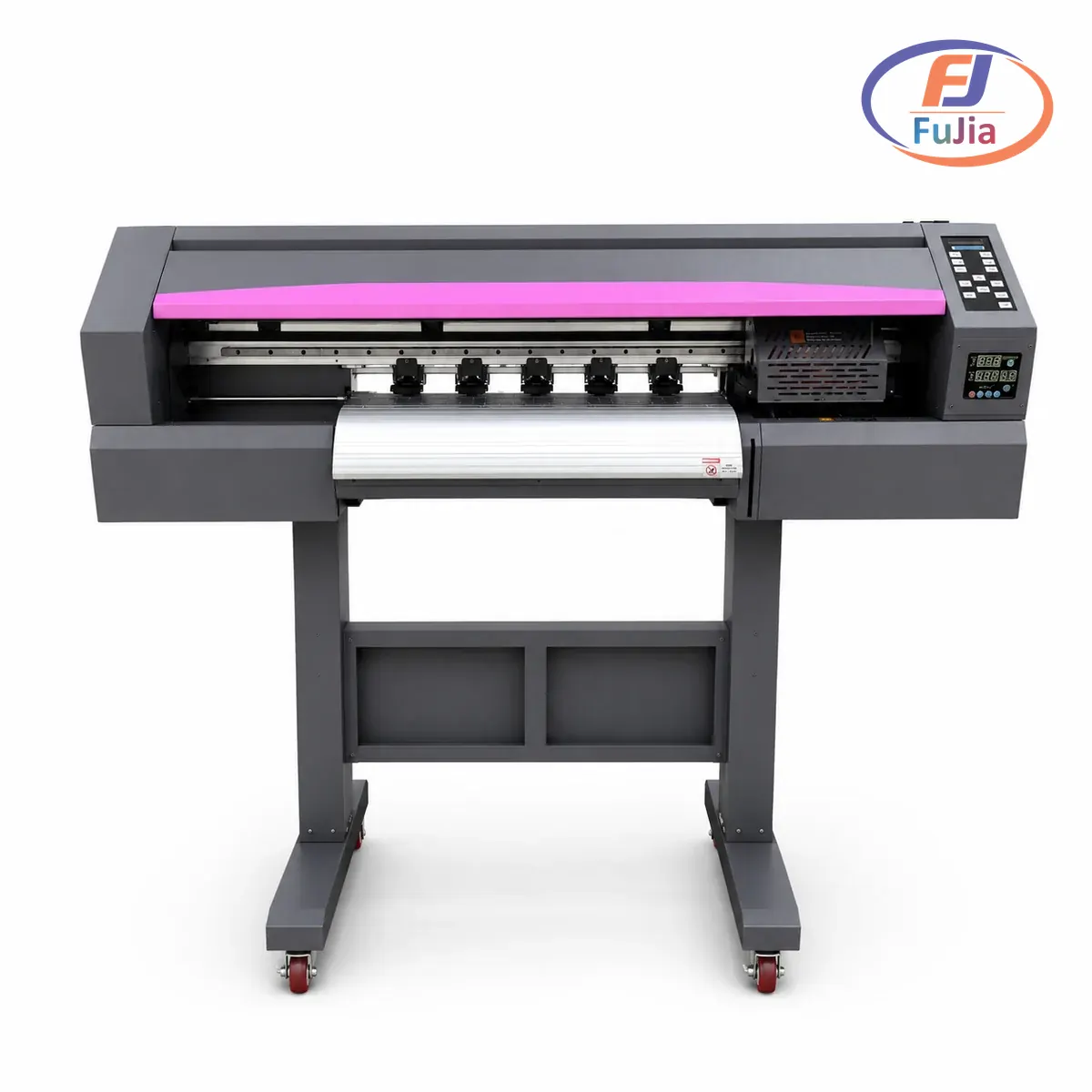
The Mimaki DTF printer line is the premium Japanese entry in direct-to-film printing, priced from $11,995 MSRP for the TxF150-75 (down to $8,495 in promotions) up to $20,995 for the 63-inch TxF300-1600. This review covers what the TxF series engineers into that price, real 2026 street pricing, and a head-to-head against factory-direct machines that cost less while printing faster. Mimaki earns real credit here; the question is whether those credits matter at your order volume.
Key Takeaways
- Mimaki entered DTF with the TxF150-75, a 31.5-inch (800 mm) single-station printer at $11,995 MSRP, with dealer promotions dropping it to $8,495-11,695 in 2026.
- The TxF300-75 adds a second printhead at $15,995 MSRP, and the TxF300-1600 extends width to 63.4 inches (1,610 mm) with speeds up to 108 sq ft/h at $20,995 MSRP.
- Signature engineering includes degassed ink packs that prevent nozzle dropout, MCTv2 white ink circulation running up to the damper, and OEKO-TEX ECO PASSPORT certified PHT50 ink.
- Against factory-direct 60 cm machines with 4 printheads running 27 m²/h under $10,000, Mimaki trades throughput and price for Japanese build quality and service infrastructure.
- Ink is a lock-in consideration: PHT50 certified ink is the documented-safe choice, and generic ink swapping voids the exact reliability the premium buys.
Who Makes Mimaki Printers?
Mimaki Engineering is a Japanese industrial inkjet manufacturer, publicly traded and decades deep into wide-format printing before DTF existed, selling through regional subsidiaries like Mimaki USA and a dealer network that handles installation and service. The TxF series, launched as Mimaki’s first DTF line, applies that industrial heritage to a category previously dominated by Chinese-built Epson-head machines, and the brand carries weight precisely with shops that want a service contract behind every machine.
That heritage shows up in engineering choices rather than spec-sheet numbers, and here’s the thing: those choices target exactly the two failures that kill cheap DTF printers. Mimaki approached DTF as an ink delivery reliability problem, having watched the category struggle with nozzle dropout and white pigment sedimentation, and its answers, degassed ink packs and circulation running all the way to the damper, are component-level solutions rather than marketing features. In my view this is the correct read of what actually breaks DTF printers, and it is why the brand commands its premium among buyers who have already lost weeks to clogged heads on cheaper machines.
The consideration cuts the other way too: Japanese engineering priced in yen, sold through dealer service networks, carries a cost structure that factory-direct Chinese manufacturers simply do not carry. The rest of this review is about quantifying that gap honestly.
Mimaki DTF Printer Models & Prices
Mimaki publishes MSRP and runs frequent instant-rebate promotions, so both numbers matter when comparing quotes. Dealer pricing from DTFonestop and Google Shopping listings lands close to the promotional MSRP, which makes the table below a realistic budget rather than wishful figures.
| Model | Width | Heads | MSRP | 2026 promo / street |
|---|---|---|---|---|
| TxF150-75 | 31.5 in (800 mm) | 1 | $11,995 | $8,495-11,695 |
| TxF300-75 | 31.5 in (800 mm) | 2 | $15,995 | $9,995-14,995 |
| TxF300-1600 | 63.4 in (1,610 mm) | 2 | $20,995 | $14,995+ |
Three pricing patterns deserve attention. First, the TxF150-75’s promo floor of $8,495 puts Japanese engineering near Chinese 2-head pricing during promotion windows, which is the best value moment this line offers. Second, the TxF300-1600 is the only sub-$25,000 DTF option covering 63-inch roll width, a format Epson-head Chinese machines only reach with dual 60 cm units working in tandem. Third, head count drives price harder than width: the step from TxF150 to TxF300 costs $4,000 for one additional printhead, and our guide to printhead economics explains why that matches the component math. Based on data from our customers across 50+ countries, buyers who time purchases to Mimaki’s promotion calendar save 15-30% over MSRP, which is real money at this tier.
Engineering Highlights: Where Mimaki Earns the Price
The degassed ink pack is the least visible and most consequential feature. Ink foams and carries dissolved air, and air bubbles reaching a piezo head cause nozzle dropout, the defect where thin lines drop out of prints until a cleaning cycle recovers them; Mimaki degasses ink at the pack level so air never enters the supply line. Standard DTF systems manage this with dampers and filters, which work until they do not, and the difference shows up as cleaning cycles per day over a machine’s life.
MCTv2 white circulation is the second standout. White pigment settles continuously, and most DTF systems circulate white ink through a loop; Mimaki’s version runs the circulation all the way up to the damper sitting above the printhead, eliminating the stagnation pocket where sediment actually forms. Fujia’s A1 line takes a complementary approach with an auto power-off circulation system that keeps white moving even during outages, protecting the head in regions with unstable power; the two designs answer different failure modes, and both are genuinely engineered responses rather than checklist features. Mimaki rounds out the package with a three-stage heater controlling ink spread and drying on film, plus a refined pinch roller system for stable film feeding.
The ink story closes the loop. PHT50 heat transfer pigment ink carries OEKO-TEX ECO PASSPORT certification, meaning the formulation is tested free of harmful chemicals for skin-contact clothing, which matters for customers selling into childrenswear or regulated markets. The trade-off is ecosystem lock-in: certified Mimaki ink costs more per liter than generic Epson-head ink, and swapping to cheap third-party ink forfeits exactly the reliability the machine was bought for, so buyers should budget certified ink as a running cost of the platform rather than an avoidable expense.
Mimaki vs Factory-Direct Alternatives
The comparison that actually matters for most buyers pits Mimaki’s TxF150-75 against 60 cm factory-direct machines built on the same Epson i3200 heads the whole industry uses. Published specs make the trade-offs concrete.
| Factor | Mimaki TxF150-75 | Mimaki TxF300-75 | Fujia A1 4-head |
|---|---|---|---|
| Max width | 800 mm (31.5 in) | 800 mm (31.5 in) | 650 mm (25.6 in) |
| Printheads | 1 | 2 | 4-5 Epson i3200 |
| Speed | not published | not published | 27 m²/h @4-pass |
| Resolution | 720/1440 dpi | 720/1440 dpi | 720×2400 dpi @8-pass |
| White ink system | MCTv2 to-damper circulation | MCTv2 | auto circulation, outage-proof |
| Transmission | unspecified | unspecified | Honson board + Leadshine servo + THK rail |
| Price | $11,995 ($8,495 promo) | $15,995 ($9,995 promo) | under $10,000 |
The throughput gap is the headline. Mimaki does not publish m²/h figures for the TxF150-75, but a single-head 800 mm machine in this class runs roughly half the throughput of a 4-head 650 mm system, and the factory-direct machine undercuts the TxF150-75’s MSRP while nearly doubling head count; a buyer paying $11,995 for one head versus under $10,000 for four is paying a brand premium measured in doubled capacity, whatever the service argument; our DTF printer wholesale guide shows what that factory tier looks like line by line. Where Mimaki legitimately wins is the 63-inch TxF300-1600, since Chinese manufacturers do not currently field a single 1,600 mm DTF unit at $20,995, and shops needing that width have few alternatives at any price.
The customer profile behind each choice differs more than the spec sheet suggests. One of our customers, a mixed e-commerce seller running DTF for apparel alongside UV DTF for labels, consolidated two suppliers into one and cut delivery times by five days once order volume justified a dedicated 60 cm production machine; that order profile, high volume at commodity margins, is where the factory-direct economics win decisively. Shops running contract work where a service contract, certified-skin-safe ink documentation, and a Japanese brand name on the invoice justify billing premium rates will see the Mimaki premium returned in ways a spreadsheet cannot capture. Our HTVRont and Roland reviews cover the brand spectrum below Mimaki for buyers mapping the full market.
What Buyers Say
Real owner feedback concentrates in dealer channels and a few industry threads, including a Reddit owner discussion on the TxF300-75 that reflects the platform’s production reputation. The consistent themes in public owner commentary are print stability over long runs, which validates the degassed ink and circulation engineering, and the standard friction points of any premium ecosystem: certified ink pricing, dealer-dependent service scheduling, and a RIP workflow that differs from the AcroRIP-style tools common on Chinese machines. Nothing in the public record suggests systemic hardware failures, which at this price tier is the baseline expectation rather than a differentiator.
The ink ecosystem is the recurring cost topic. PHT50 certified ink protects the OEKO-TEX claim and the head reliability, and it prices above generic alternatives, so owners effectively subscribe to Mimaki chemistry as a running cost; shops that opt out of certified ink to save on consumables should understand they are self-insuring against the exact failures the engineering prevents. Buyers calculating total cost of ownership should model certified ink consumption at their real coverage levels rather than comparing per-liter prices across brands.
How much does a Mimaki printer cost?
The DTF line spans three price points in 2026. The TxF150-75 lists at $11,995 MSRP with promotions bringing it to $8,495-11,695 through dealer rebates; the dual-head TxF300-75 lists at $15,995 with promo pricing from $9,995; and the 63-inch TxF300-1600 lists at $20,995 with promotions to $14,995. Dealer street prices track promotional MSRP closely, so quotes far below these ranges deserve scrutiny on warranty and ink authenticity. Beyond the printer, budget certified PHT50 ink, film, and powder as running costs, and remember that Mimaki promotions rotate quarterly, so timing a purchase to the rebate calendar is worth 15-30% of MSRP at this tier.
What printer is best for DTF transfers?
The best DTF printer matches head count to weekly volume, because head count drives both speed and price across every brand. Under roughly 100 prints weekly, a 2-head 60 cm machine from any reputable factory covers demand. Above that, 4-head machines running 27 m²/h at 4-pass keep gang sheets feeding the press continuously, and several factory-direct options deliver that under $10,000. Mimaki’s TxF150-75 competes on build refinement and certified ink rather than raw speed, and it is the right choice where service contracts and OEKO-TEX documentation are billing requirements. Fujia’s A1 4-head, built on a Honson mainboard, Leadshine servo motor, and THK guide rail, exists for buyers whose math favors throughput per dollar over badge value, and running the same artwork on both machines for a week settles the comparison faster than any review.
Is owning a DTF printer worth it?
For shops printing more than about 50 transfers per day, yes, and the payback math is short. A production-grade setup totals roughly $13,500-15,200 including a 2-head printer, shaker, and pneumatic press, while consumables run $0.40-0.80 per full-front transfer against street resale of $3-8 per transfer, so margins of 40-70% are standard and break-even arrives near 3,400 transfers, about three months at 50 prints per working day. Ownership also removes outsourcing MOQs and turnaround queues, which is what lets a shop promise same-day delivery. The honest caveat is maintenance discipline: white ink systems need daily circulation checks and capping station wipes of 3-5 minutes, and shops unable to commit that routine should budget for either an operator or a toner-based alternative.
Who makes Mimaki printers?
Mimaki Engineering Co., Ltd. is a Japanese publicly traded industrial inkjet manufacturer headquartered in Japan, producing wide-format printers across solvent, UV-LED, textile, and 3D markets since the 1970s. The Americas market is served by Mimaki USA, a regional subsidiary supported by a dealer network handling installation, training, and onsite service. The TxF DTF series is engineered in Japan with Mimaki’s own PHT50 pigment ink carrying OEKO-TEX ECO PASSPORT certification, and core DTF technologies, degassed ink packs and MCTv2 white circulation, are Mimaki developments rather than rebadged components. In practical terms, buying Mimaki means buying the manufacturer’s service infrastructure alongside the hardware, which is precisely what the price premium funds.
Verdict
Mimaki’s TxF series is the most thoughtfully engineered DTF platform in its price class, and the degassed ink pack, to-damper white circulation, and certified ink are real answers to the category’s real failure modes, available from $8,495 at promotion. The honest trade-off is capacity per dollar: $11,995 buys one printhead while factory-direct 4-head machines under $10,000 deliver roughly double the throughput, so the premium buys service infrastructure and documentation, not speed. Match the choice to your billing model, and if volume per dollar leads your math, our DTF printers ship factory-direct with the transmission and support details Mimaki leaves unpublished.
Sources
- Mimaki: manufacturer reference for the TxF series engineering and company background.
- Wikipedia: Direct-to-garment printing: digital textile printing context for the DTF category.
- OEKO-TEX ECO PASSPORT: certification standard behind the PHT50 ink safety claims.
