

DTF printing outperforms heat transfer vinyl in color complexity, fabric compatibility, and wash durability, while HTV wins on startup cost and special finishes like glitter and reflective. For businesses producing multi-color designs or varied fabric types, DTF delivers lower per-shirt cost at scale. For simple one-color logos on cotton, HTV remains the cheaper entry point.
Key Takeaways
- DTF handles photographic full-color designs with no weeding; HTV requires cutting, weeding, and layering for each color.
- DTF transfers survive 50 or more wash cycles on cotton; HTV typically lasts 30 to 40 washes before cracking begins.
- DTF startup costs USD 2,000 to 15,000; HTV setups cost USD 300 to 1,500 for a cutter and heat press.
- DTF works on cotton, polyester, nylon, and blends; HTV works best on cotton and cotton-poly blends only.
- Per-shirt consumable cost runs USD 1.50 to 3.00 for DTF versus USD 0.50 to 2.00 for HTV.
What Is DTF vs HTV?
DTF (direct-to-film) printing uses an inkjet printer to deposit CMYK and white ink onto a PET transfer film, which is then coated with adhesive powder, cured, and heat-pressed onto fabric. The process produces full-color, photographic-quality prints without cutting or weeding, and the white ink underbase enables vibrant designs on dark garments. For a broader comparison of DTF against direct-to-garment printing, see our DTF vs DTG analysis.
HTV (heat transfer vinyl) uses a vinyl sheet, typically polyurethane (PU) or polyvinyl chloride (PVC), that is cut into shapes using a cutting plotter, weeded to remove excess material, and heat-pressed onto fabric. Each color requires a separate vinyl layer, meaning multi-color designs involve multiple cutting, weeding, and pressing cycles. HTV excels at solid-color logos, text, and numbers on sports jerseys and uniforms.
The fundamental difference: DTF is a digital printing process that renders any design in one pass. HTV is a physical material process where each color is a separate layer applied individually.
(TOC triggers here)
Side-by-Side Comparison
| Feature | DTF | HTV |
|---|---|---|
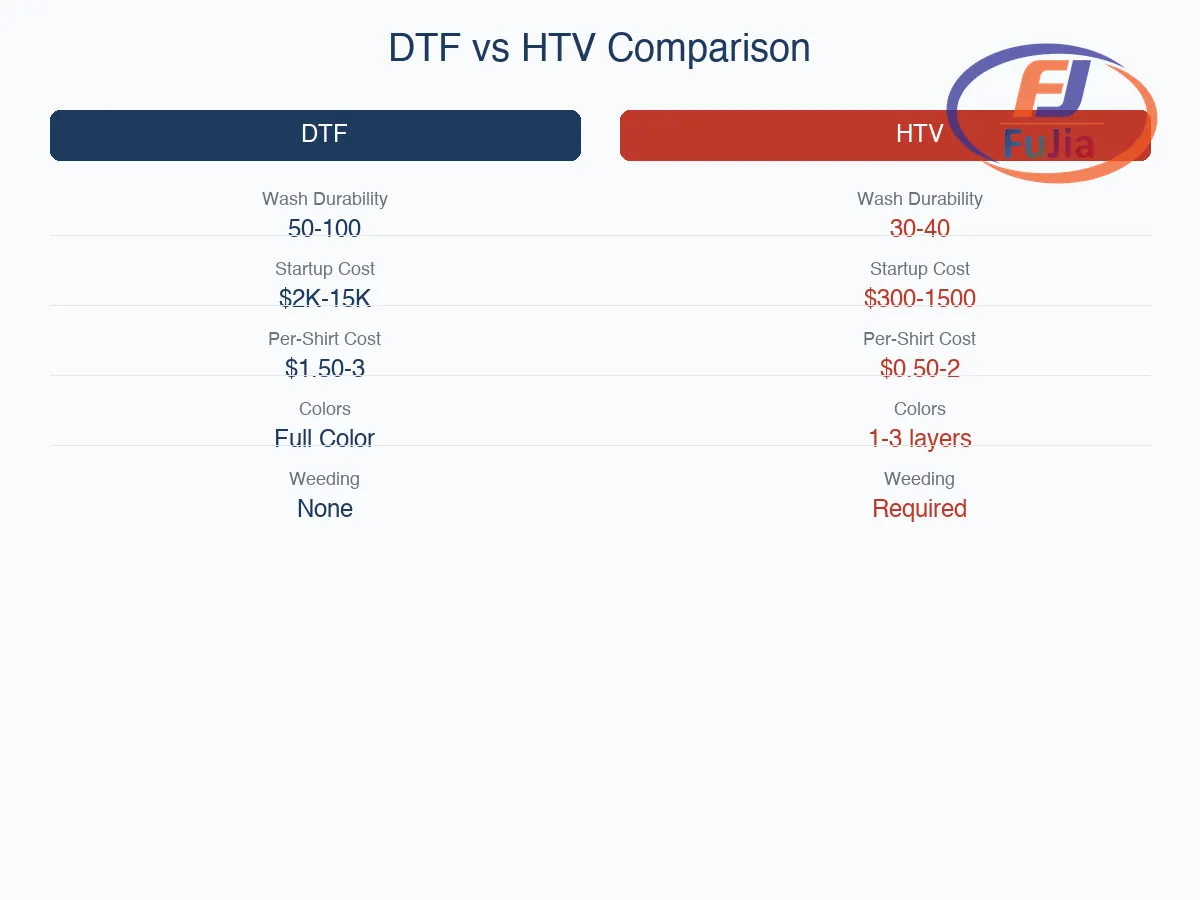
| Color capability | Full color, gradients, photos | 1-3 solid colors per layer |
| Setup cost | $2,000-$15,000 | $300-$1,500 |
| Per-shirt cost | $1.50-$3.00 | $0.50-$2.00 |
| Wash durability | 50-100 washes (cotton) | 30-40 washes |
| Fabric range | Cotton, polyester, nylon, blends | Cotton, cotton-poly blends |
| Dark garments | Yes (white ink underbase) | Limited (special vinyl needed) |
| Weeding required | No | Yes, per color |
| Production speed | Faster for multi-color | Faster for single-color |
| Special finishes | Standard matte/gloss | Glitter, flock, holographic, reflective |
| Hand feel | Soft, flexible | Thicker, stiffer (especially PVC) |
DTF: Strengths and Limitations
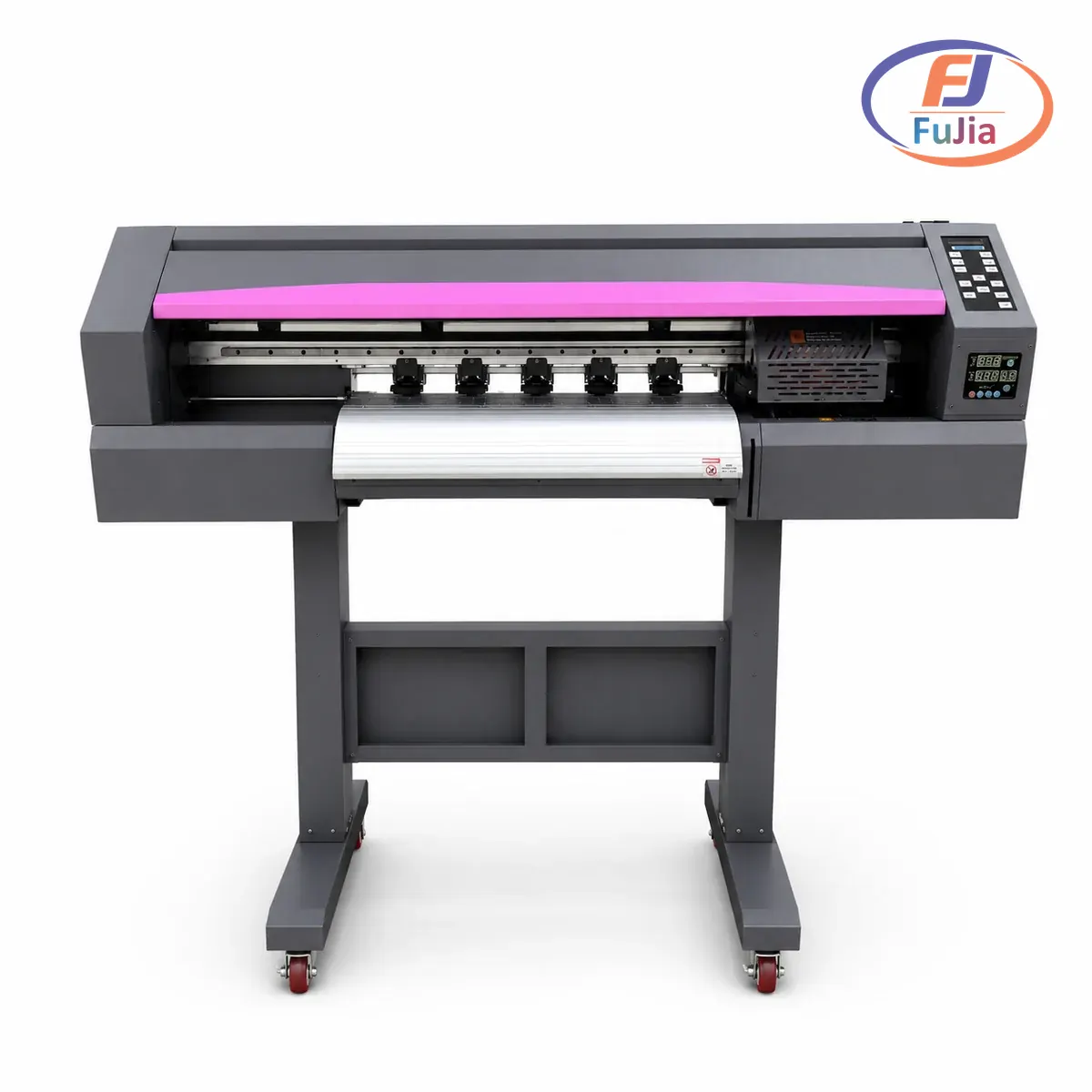
DTF printing dominates when design complexity and fabric versatility matter. A single DTF printer running Epson I3200 printheads produces up to 27 square meters per hour at 4-pass resolution, translating to roughly 100 to 150 full-size transfers per hour. Fujia’s A1 DTF 4-Head printer, using Honson mainboard with Leadshine servo motor and THK silent guide rail, sustains 12-hour continuous production runs without quality drift, as documented in the Turkish garment factory case where throughput increased 40 percent after switching from screen printing.
DTF transfers bond to fabric through hot-melt adhesive powder that penetrates fiber structures, creating a flexible layer that stretches with the garment. This bonding mechanism enables DTF to work on cotton, polyester, nylon, denim, canvas, and blended fabrics without pre-treatment. The white ink underbase layer ensures color vibrancy on dark or black garments, which HTV cannot achieve without specialty opaque vinyl.
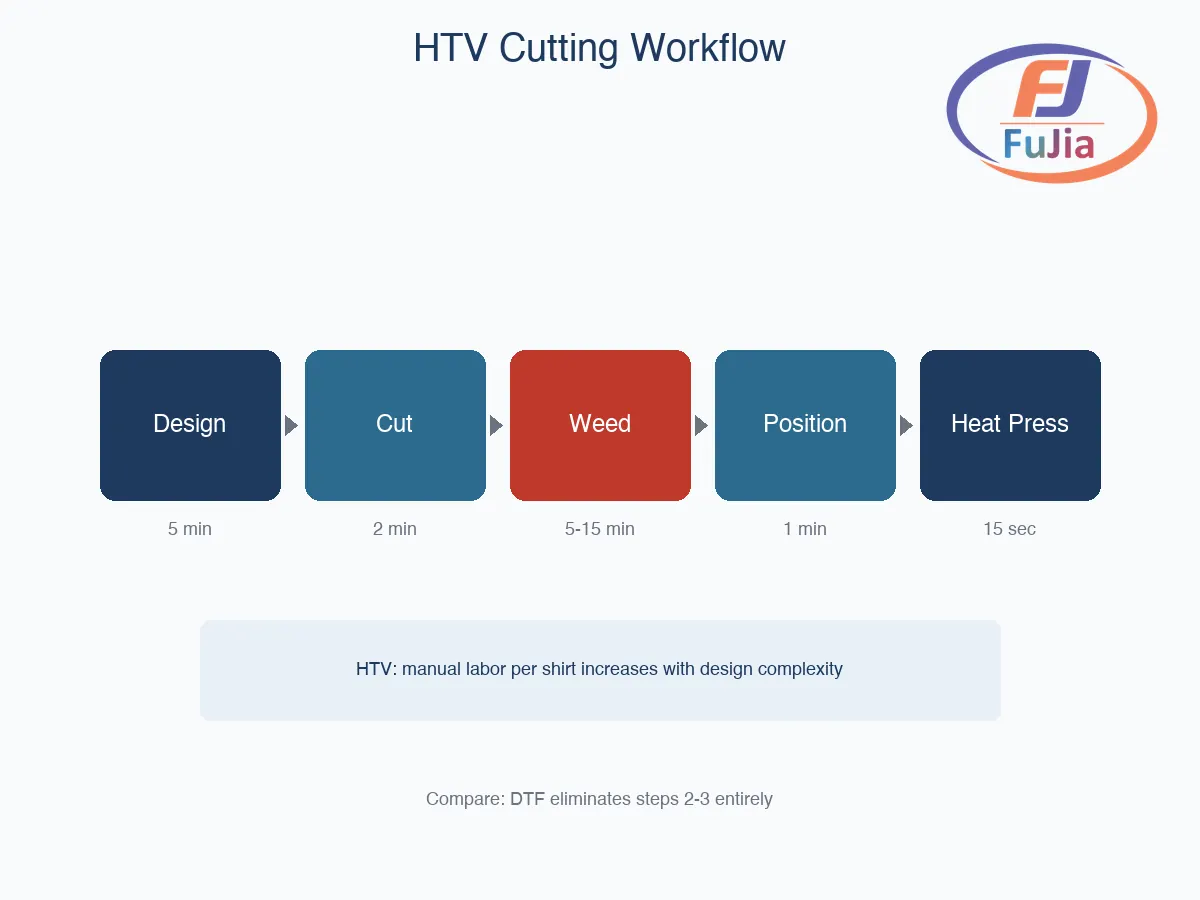
DTF requires no weeding. Designs print directly from digital files to film, eliminating the manual labor of removing excess material. This advantage compounds as design complexity increases: a 10-color gradient design takes the same time to print as a single-color logo on DTF, while HTV would require 10 separate cutting and weeding cycles.
The main DTF limitation is startup cost. A complete DTF setup requires a printer, powder shaker, curing oven, and heat press, totaling USD 2,000 to 15,000 depending on printer width and printhead configuration. Powder management and white ink circulation require daily maintenance of 3 to 5 minutes. DTF also lacks specialty finishes like glitter, holographic, or reflective that HTV offers natively.
HTV: Strengths and Limitations
HTV excels at simplicity, cost, and specialty finishes. A basic HTV setup requires only a vinyl cutter (such as a Cricut or Silhouette) and a heat press, costing USD 300 to 1,500 total. HTV rolls cost approximately USD 15 to 25 per 50cm by 25m roll, and per-shirt vinyl consumption runs USD 0.50 to 2.00 depending on design size and color count.
PU-based HTV, at 85 to 100 micrometers thick, provides a soft hand feel suitable for apparel. PVC-based HTV, at 150 micrometers, offers higher opacity and durability but feels stiffer on fabric. Both types apply at 150 to 165 degrees Celsius for 8 to 15 seconds, similar to DTF transfer parameters.
HTV’s signature advantage is specialty finishes. Glitter HTV embeds reflective particles in a polyurethane base. Flock HTV creates a velvet-like texture using nylon fibers. Holographic HTV produces prismatic effects. Reflective HTV contains glass beads for safety apparel. These finishes are impossible to replicate with standard DTF printing without post-application overlays.
HTV’s primary limitation is color complexity. Each color requires a separate vinyl layer, cut, weeded, and pressed individually. A three-color design takes three times the labor of a single-color design. Multi-layer HTV also builds thickness, making the print stiffer and more prone to cracking at layer boundaries. Complex or photographic designs are effectively impossible with HTV.
Cost Breakdown: DTF vs HTV
Understanding true cost requires looking beyond material price to include labor, setup, and break-even analysis.
| Cost Factor | DTF | HTV |
|---|---|---|
| Equipment startup | $2,000-$15,000 | $300-$1,500 |
| Material per shirt | $1.50-$3.00 (film+ink+powder) | $0.50-$2.00 (vinyl) |
| Labor per shirt (multi-color) | $0.10-$0.30 (automated) | $1.00-$3.00 (manual weeding) |
| Break-even point | 200+ shirts/month | Viable from 1 shirt |
| Scaling cost | Drops with volume | Linear (labor-bound) |
Based on aggregate data from our customers across 50+ countries, HTV wins on cost for orders under 20 shirts with simple 1 to 2 color designs. Above 20 shirts, or for any multi-color design, DTF produces lower total cost per shirt because automated printing eliminates the weeding labor that dominates HTV production time. Region matters too: developed markets with higher labor costs see faster DTF payback because the weeding labor savings are more significant.
Wash Durability Head-to-Head
Wash durability is where DTF and HTV diverge most clearly in long-term performance.
| Method | Wash Cycles (Cotton) | Wash Cycles (Polyester) | Failure Mode |
|---|---|---|---|
| DTF | 50-100 | 30-50 | Gradual fading |
| HTV (PU) | 40-50 | 25-35 | Edge lifting, cracking |
| HTV (PVC) | 30-40 | 20-30 | Cracking at stress points |
DTF transfers meet ISO 105-C06 color fastness standards, maintaining Grade 4 to 5 on the AATCC grayscale after 40 to 60 wash cycles at 40 degrees Celsius. Fujia’s apparel printing application data confirms DTF transfers surviving 50 or more heavy machine washes on cotton with cold-water cycling. The adhesive powder creates a flexible bond that stretches with fabric movement, reducing the cracking that plagues vinyl layers.
HTV durability depends heavily on material type and application quality. PU vinyl, being thinner and more elastic, outlasts PVC vinyl by 10 to 20 wash cycles. Improper temperature or insufficient pressure during application causes premature edge lifting. Multi-layer HTV designs fail faster than single-layer because layer boundaries create stress concentration points where cracking initiates.
Which Should You Choose?
| If you need… | Choose | Why |
|---|---|---|
| Full-color photographic prints | DTF | HTV cannot reproduce gradients or photos |
| Dark garment printing | DTF | White ink underbase makes colors pop on black |
| Multi-color designs (3+ colors) | DTF | No layering, no weeding per color |
| Variable fabrics (nylon, blends) | DTF | HTV struggles on synthetic fabrics |
| Simple 1-color logos | HTV | Lower cost, no printer investment needed |
| Sports jerseys (names, numbers) | HTV | Clean, bold text with specialty finishes |
| Glitter, holographic, reflective | HTV | These finishes are HTV-exclusive |
| Under 20 shirts per order | HTV | Lower setup cost wins on small runs |
| Over 50 shirts per order | DTF | Automated printing lowers per-unit cost |
Which lasts longer, DTF or HTV?
DTF lasts longer than HTV in wash testing. DTF transfers on cotton garments withstand 50 to 100 wash cycles before significant fading occurs, compared to 30 to 40 wash cycles for HTV on the same fabric. The durability difference comes from how each method bonds to fabric. DTF uses hot-melt adhesive powder that melts into fiber structures, creating a flexible mechanical bond that stretches with the garment. HTV uses a heat-activated adhesive layer on the vinyl backing that bonds to the fabric surface, creating a more rigid connection that cracks under repeated flexing. On polyester fabrics, the gap narrows: DTF survives 30 to 50 washes versus HTV at 25 to 35 washes. Proper application matters for both methods. DTF requires accurate temperature (150 to 165 degrees Celsius) and pressure (3 to 4 kilograms per square centimeter). HTV requires clean weeding and sufficient dwell time (8 to 15 seconds). Poor application cuts HTV durability in half regardless of material quality.
Is a Cricut a DTF printer?
A Cricut is not a DTF printer. Cricut machines are cutting plotters designed for HTV (heat transfer vinyl) and adhesive vinyl, not inkjet printing. A Cricut cuts shapes from vinyl sheets using a motorized blade, which are then weeded and heat-pressed onto fabric. DTF printing requires an inkjet printer with CMYK and white ink channels that deposits liquid ink onto PET transfer film, followed by powder application and curing. These are fundamentally different processes: Cricut is subtractive (cuts away material), DTF is additive (deposits ink). A Cricut setup costs USD 200 to 400 for the machine plus a heat press, making it an entry point for HTV-based custom apparel. DTF requires dedicated printing equipment starting at USD 1,500 to 2,000 for desktop models and USD 5,000 to 15,000 for industrial A1 configurations. Some businesses use both: Cricut for simple vinyl names and numbers, DTF for complex multi-color artwork.
What are the disadvantages of DTF?
DTF printing has three main disadvantages compared to HTV. First, startup cost: a complete DTF setup (printer, powder shaker, curing oven, heat press) costs USD 2,000 to 15,000, while an HTV setup (cutter plus heat press) costs USD 300 to 1,500. Second, daily maintenance: DTF printers require 3 to 5 minutes of daily maintenance including nozzle checks, capping station cleaning, and white ink circulation to prevent pigment settling. HTV equipment needs only periodic blade replacement. Third, environmental impact: DTF uses single-use PET film that generates plastic waste, while HTV vinyl is also single-use but generates less total waste per simple design. DTF also lacks specialty finishes (glitter, holographic, reflective) that HTV offers. White ink management is a recurring operational challenge: titanium dioxide in white ink settles if circulation stops, causing printhead clogs that require flushing with cleaning solution.
Does vinyl last longer than DTF?
Vinyl does not last longer than DTF. DTF transfers outlast HTV by 20 to 60 wash cycles depending on fabric type and vinyl material. On 100 percent cotton, DTF achieves 50 to 100 wash cycles while PU-based HTV achieves 40 to 50 cycles and PVC-based HTV achieves 30 to 40 cycles. On polyester, DTF achieves 30 to 50 cycles versus HTV at 25 to 35 cycles. The common misconception that vinyl outlasts DTF comes from early DTF formulations (pre-2020) that had adhesion issues. Modern DTF systems using properly formulated adhesive powder and correct curing parameters produce transfers that exceed HTV durability across all fabric types. HTV appears more durable in one scenario: simple single-color designs on cotton-poly blends where the vinyl layer is thin and the design has no intricate edges to lift. Even in this scenario, DTF matches rather than trails HTV longevity.
Conclusion
DTF printing wins for businesses producing multi-color designs, printing on diverse fabrics, or scaling beyond 50 shirts per order. HTV remains the better choice for simple logos, specialty finishes, and low-volume personalization. For factory-direct DTF printer pricing that fits your production volume, explore our DTF printer lineup.
Sources
- Grand View Research: Direct to Film Printing Market Size & Outlook: Global DTF market data confirming industry growth and adoption trends.
- ScienceDirect: Polyethylene terephthalate film strain-optical behavior (Polymer, 2019): PET material thermal properties referenced for DTF transfer film temperature stability analysis.
- ISO 105-C06:2010 Textiles – Colour fastness to domestic and commercial laundering: International standard governing wash durability testing methods referenced for DTF and HTV comparison.
