

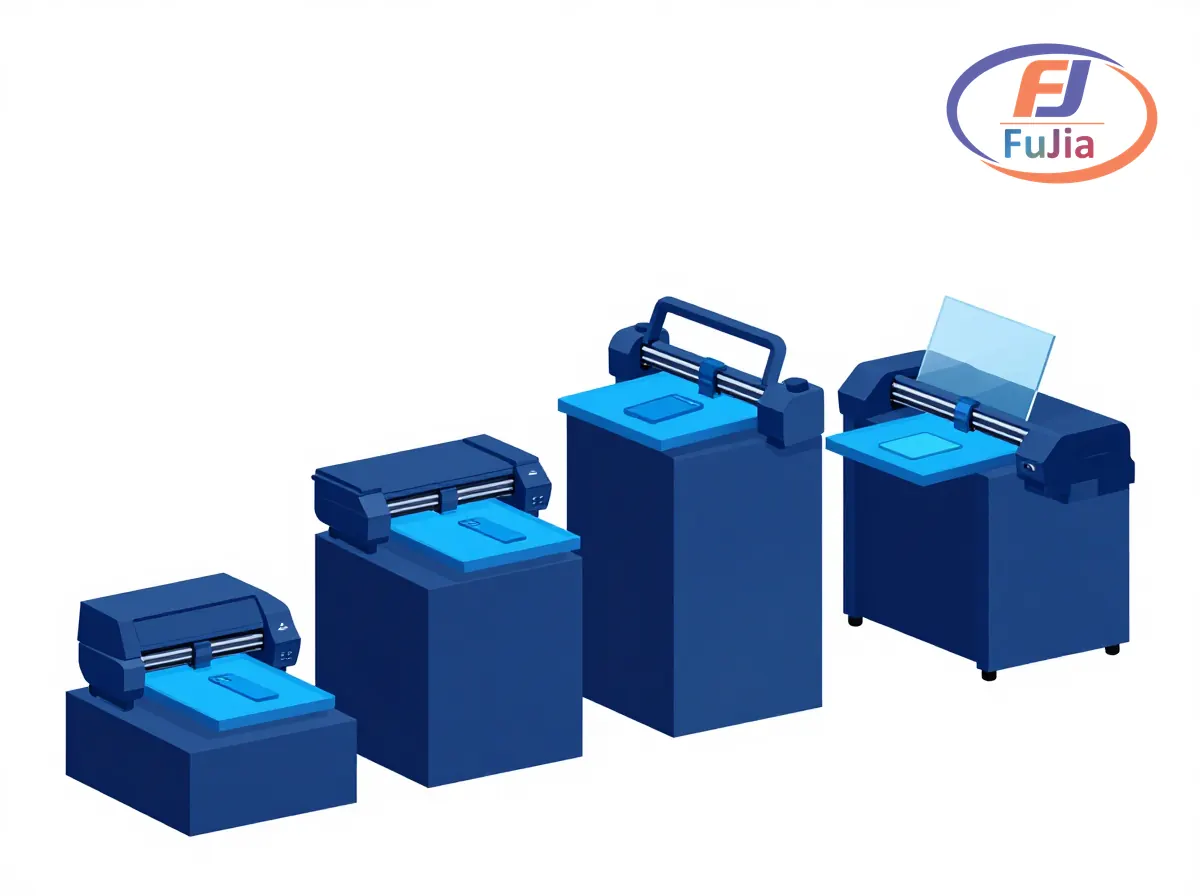
An affordable UV printer in 2026 means one of four price tiers: converted A4/L800-class units near $1,500-3,000, compact craft machines like the xTool O1 at $2,000-3,000, A3 flatbeds at $3,000-8,000, and A1 production flatbeds from $15,000, and the failures concentrate at the bottom tier where printhead, cooling, and ink system get cut first. This guide prices each tier with real market figures, names the five specs that decide whether a cheap UV printer is a bargain or a liability, and maps which substrates and order profiles each tier actually serves. Cheap exists in UV printing; good-and-cheap only exists above a specific line, and this page shows where that line sits.
Key Takeaways
- Four 2026 tiers: converted A4/A5 units ($1,500-3,000), compact craft machines like the xTool O1 ($2,000-3,000), A3 flatbeds ($3,000-8,000), and A1 production flatbeds from $15,000.
- The five specs that separate working machines from liabilities: printhead class, UV-LED lamp cooling, ink circulation for white, varnish channel presence, and height sensing for curved objects.
- XTool’s O1 has pulled craft-market attention near $2,000-3,000, but its cylinder jig approach and consumable ecosystem differ fundamentally from flatbed production machines.
- CMYK + White + Varnish is the six-channel standard that enables the premium jobs: spot gloss varnish alone commands 30-50% higher per-unit pricing on awards and signage work.
- Fujia’s UV line spans A2 (4050/4060) through the 6090 A1 flatbed, whose 60×90 cm bed fits 12 phone cases per cycle with auto height detection up to 180 mm.
The Four 2026 Price Tiers
| Tier | Typical machines | 2026 price | Print bed | Realistic duty |
|---|---|---|---|---|
| Converted A4/A5 | Achi-class L800-head units | $1,500-3,000 | small flat objects | phone cases, cards, hobby |
| Compact desktop | XTool O1 class | $2,000-3,000 | small + cylinder jig | crafts, personalized gifts |
| A3 flatbed | Chinese A3 UV, entry Epson V1070-class | $3,000-8,000 | 30×50 cm | small shops, promo products |
| A2/A1 production | Fujia 4050/4060/6090 class | $8,000-15,000+ | 40×50 to 60×90 cm | daily production, multi-product |
The bottom tier deserves its reputation and its warnings in equal measure. Converted A4 units print real UV output and price like a used car, but they typically run single heads with minimal ink circulation, passive or underpowered LED cooling, and height sensors omitted entirely, so every curved object, every white-ink-heavy job, and every long run tests the corners that were cut. They are real printers and legitimate learning platforms, and they fail as production machines because the corners are structural, not cosmetic. Most small shops will outgrow one within two quarters of steady orders.
The middle tiers are where affordable becomes genuinely useful. A3 flatbeds at $3,000-8,000 serve phone case sellers, award decorators, and promotional product shops at 50-200 pieces daily, and the A2 class adds the bed size and build that make UV a primary revenue line rather than a side capability.
The Five Specs That Decide Everything
| Spec | Entry tier (converted) | Mid tier (A3) | Production tier (A2/A1) |
|---|---|---|---|
| Printhead | Epson L800 photo class | XP600 | Ricoh GEN5 / Epson i3200 |
| Lamp cooling | passive / small fan | basic air | water-cooled UV-LED |
| White ink circulation | often absent | pump system | full circulation + stirring |
| Varnish channel | no | optional | CMYK+W+V standard |
| Height sensing | none | fixed focus | auto, up to 180 mm |
Printhead class first, because it prices every future consumable: converted units reuse Epson L800-class photo heads, mid-tier machines run XP600 heads, and production flatbeds move to Ricoh GEN5 or Epson i3200 industrial heads whose firing durability is measured in years of daily duty rather than months. Lamp cooling second: water-cooled UV-LED lamps hold stable curing temperature through long runs while air-cooled units drift hot and shorten lamp life. White ink circulation third, since UV white pigment settles as aggressively as DTF white and a pump-less system is a clog on a timer.
Varnish channel fourth, and it is the most underrated revenue spec in the category: a 6-channel CMYK + White + Varnish machine prints spot gloss and matte finishes that command 30-50% higher per-unit pricing on awards, signage, and premium promo work, so the varnish channel effectively pays rent. Height sensing fifth: automatic focus across objects up to 180 mm thick is what lets one bed print wine glasses, phone cases, and wood blocks in the same day without shimming and praying. Fujia’s 6090 bundles all five at the production tier, with a 60×90 cm bed holding 12 phone cases or 6-8 wine glasses per cycle and a materials database of 300-plus tested substrates.
Which Tier Fits Which Order Profile
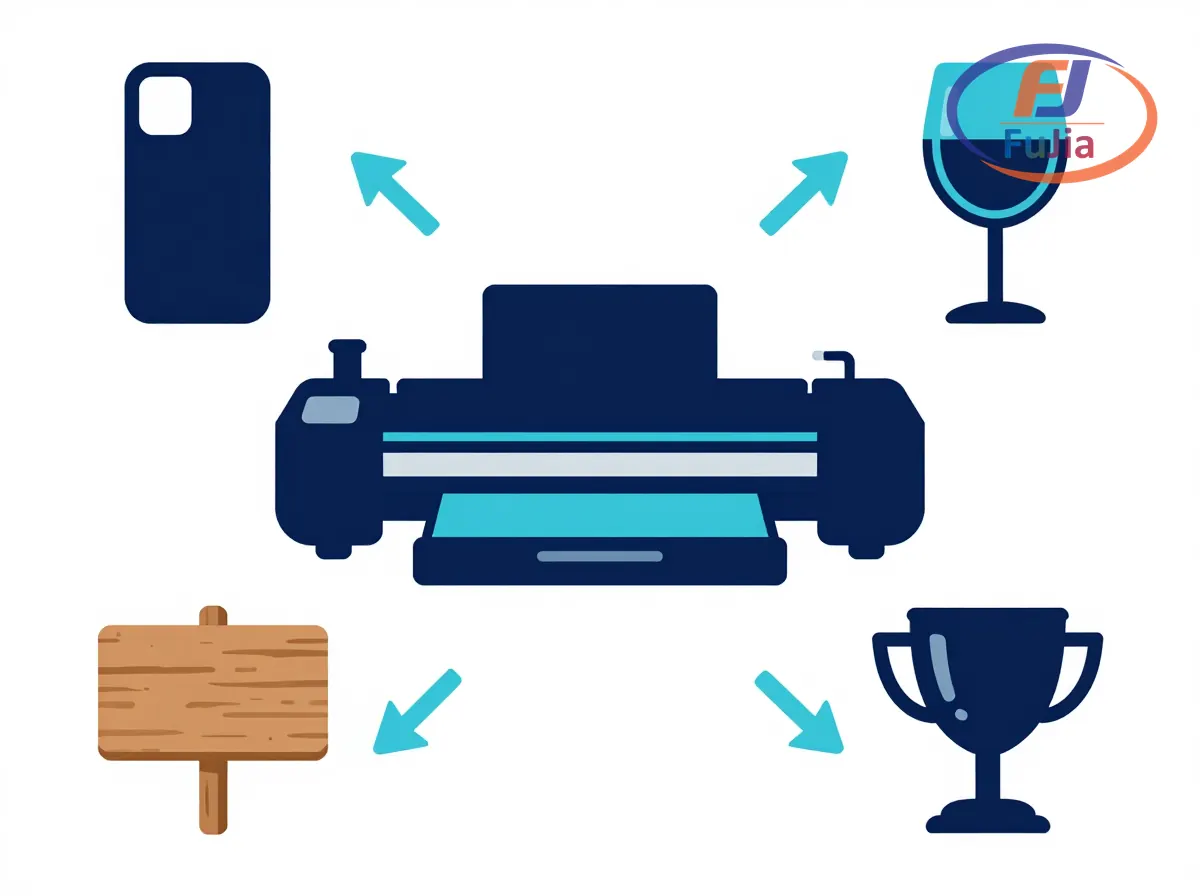
Work decides the tier, not ambition. Phone cases and small flat goods under 100 pieces weekly sit comfortably in the converted or compact tier, where the O1’s cylinder jig and $2,000-3,000 entry price genuinely fit the craft market. Promotional product shops running daily mixed substrate work need the A3 tier’s build and the varnish channel, because promo buyers pay for finish quality; the product categories that feed these machines are cataloged on our promotional products page. Awards, signage, and multi-product production belong at A2 or A1, where bed size, industrial heads, and water-cooled curing turn UV into a primary revenue line, and that is where the per-cycle math compounds: one 6090 cycle decorating 12 phone cases replaces a dozen single-case passes on a desktop unit.
Our UV printers lineup maps the full configuration range, and the best UV printer picks at each width pair with it. One customer outcome anchors the production tier: a Kenyan glassware workshop we supplied runs an FJ-6090 for custom gifts, lifted daily output 50% from 200 to 300 pieces, cut waste from 15% to 9%, and compressed turnaround from 5-7 days to 1-2, results that came from bed capacity and curing stability a converted A4 physically cannot deliver. Volume decides, and the tier ladder exists because each rung’s costs and capabilities are real.

What is the best budget UV printer?
The best budget UV printer is the one whose tier matches your orders: XTool’s O1 near $2,000-3,000 for craft personalization with cylinder support, an A3 flatbed at $3,000-8,000 for small promo shops needing bed capacity and varnish, or a converted A4 unit near $1,500 strictly as a learning platform. The honest rule is that budget buys the tier, and the five specs, head class, lamp cooling, white circulation, varnish, height sensing, tell you which corners each tier cuts. We recommend choosing the cheapest tier that includes the specs your actual orders require, never the cheapest tier that exists.
Are UV printers worth it?
Worth it when your products are rigid, dark, or premium-finished, because UV prints directly on glass, acrylic, metal, wood, and phone cases with instant LED curing and a tactile varnish option that no transfer process matches. Not worth it as a garment machine, since DTF and DTG own fabric entirely. Nor at craft volume on an expensive tier, because bed capacity you cannot feed is depreciating metal. Here’s the thing about the sweet spot: rigid-substrate demand at 50-plus pieces daily, where UV’s per-unit economics and finish premiums compound quickly, and below that line the machine is a hobby with a payment plan.
How much does an UV printer cost?
Four tiers cover the 2026 market: converted A4/A5 units at $1,500-3,000, compact craft machines like the xTool O1 at $2,000-3,000, A3 flatbeds at $3,000-8,000, and A2 to A1 production flatbeds at $8,000-15,000-plus. Add consumables to any quote: UV ink runs richer than textile ink, and the varnish channel adds a separate supply line. The honest comparison is cost per finished piece at your volume, where higher-tier machines’ speed and per-cycle capacity often undercut the cheap tier’s labor cost.
What is the cheapest UV DTF printer?
UV DTF, the inkjet-printed AB film that hand-transfers to hard surfaces, prices differently from flatbed UV: dedicated UV DTF printers start around $2,000-4,000 for A3-width units, and several A3 flatbeds convert to UV DTF duty with film feed kits. The cheapest functional setup is an A3 UV DTF printer in that $2,000-4,000 band paired with matching AB film, which suits sticker and label sellers; buyers whose real target is rigid-object printing should compare flatbed tiers instead, because UV DTF and flatbed UV solve different substrate problems despite sharing a name.
Verdict
Affordable UV printing is real at every tier and profitable at most of them, provided the five specs, head class, lamp cooling, white circulation, varnish, and height sensing, match the work. The $1,500-3,000 tier teaches and decorates flat craft goods, the $3,000-8,000 A3 tier runs a promo shop, and the $8,000-15,000-plus A2/A1 tier turns UV into a primary revenue line with per-cycle economics the cheap tier cannot touch. Price the tier your orders demand, demand the five specs at any tier above entry, and test on your own substrates before signing; to sample Fujia’s A2 and 6090 flatbeds with your files, contact Fujia Print for a test print kit.
Sources
- Epson SureColor V1070 desktop UV: desktop UV flatbed tier reference.
- XTool O1 Omni Printer: compact craft UV market reference, O1 editions and launch pricing.
- Wikipedia: Ultraviolet curing: LED curing chemistry background.
- Wikipedia: Ultraviolet: UV wavelength bands referenced in curing discussion.
