

Eco solvent vs latex resolves on three numbers: eco solvent prints at $12-25 per liter of ink with 2-3 year outdoor durability and needs ventilated shop air, while latex prints at $55-90 per liter with comparable outdoor life, cures instantly at 100-130 °C, and emits water vapor instead of fumes. Neither wins outright, because the platforms optimize different shop realities: eco solvent buys the lowest cost per square meter, latex buys environment-free operation and immediate finishing, and the right answer follows your media mix, air handling, and deadline structure. This page prices both platforms across ink, media, and operations, then matches each buyer profile to its platform.
Key Takeaways
- Ink economics: eco solvent at $12-25 per liter against latex at $55-90 per liter, with consumption near 8-15 ml per m2 keeping the eco cost edge at 40-60% per square meter.
- Outdoor durability is a tie in practice: both platforms hold 2-3 years unlaminated and 5+ years laminated under moderate UV exposure.
- Latex cures on exit at 100-130 °C and comes out of the printer ready to laminate or install, while eco solvent needs 24-48 hours of off-gassing before lamination.
- Ventilation splits the decision: eco solvent wants extracted airflow for its mild solvent vapor, and latex runs in an office corner on household power.
- We recommend eco solvent for banner-heavy production shops and latex for retail, medical, and interior environments where air quality rules disallow solvents.
The Platform Table: What Each Technology Actually Is
The platforms differ at the ink level, and everything downstream follows from that chemistry. The table maps the physics before the money:
| Dimension | Eco solvent | Latex |
|---|---|---|
| Ink carrier | glycol ether solvent | water with polymer particles |
| Cure method | evaporation + off-gas | heater at 100-130 °C |
| Ink price per liter | $12-25 | $55-90 |
| Consumption per m2 | 8-15 ml | 10-18 ml |
| Outdoor life unlaminated | 2-3 years | 2-3 years |
| Ventilation | extracted airflow advised | none beyond comfort |
| Media range | coated vinyl, banner, flex | vinyl, banner, textiles, wallpaper |
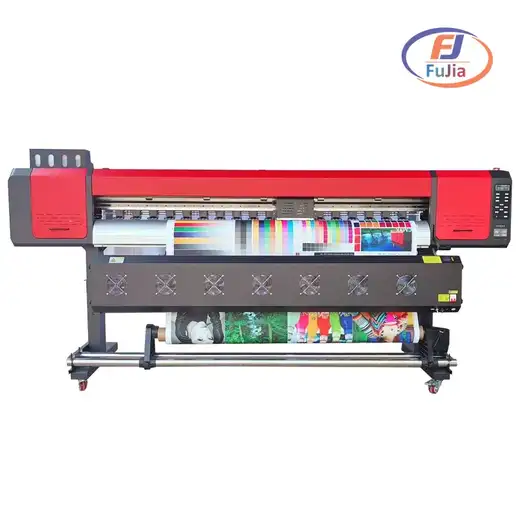
The two platforms side by side:
The chemistry explains the split: eco solvent inks carry pigment in a mild glycol ether carrier that bites into coated vinyl and evaporates slowly, which is why prints need a day or two of off-gassing before lamination traps the residual solvent. Latex inks suspend pigment in water-borne polymer that the printer’s heaters fuse into a flexible film, and the print exits dry, low-odor, and laminator-ready, per the curing physics our signage and display operations guide documents across wide-format platforms.The media table matters more than spec sheets: latex has widened its range into textiles and wallpaper where eco solvent never competed, while eco solvent holds the flex-face banner segment where its per-square economics remain untouched.
The Cost Model: Ink, Media, and the Loaded Number
The running-cost table converts sticker chemistry into shop-floor economics at a working 1,000 m2 monthly volume. Loaded cost includes ink, maintenance fluid, and power at $0.12 per kWh:
| Cost line | Eco solvent | Latex | Edge |
|---|---|---|---|
| Ink per m2 | $0.14-0.30 | $0.70-1.30 | eco 60-75% cheaper |
| Maintenance fluid | $15-30 monthly | minimal | latex simpler |
| Power per m2 | $0.01 | $0.04-0.06 | eco cheaper |
| Lamination delay | 24-48 h wait | none | latex faster to invoice |
| Loaded cost per m2 | $0.20-0.40 | $0.80-1.45 | eco wins production |
The ink economics in view:
When it comes to the cost gap, it is real but narrower than the ink prices suggest, because latex heads live longer between services and its prints skip the labor cost of off-gassing inventory. A shop running banner production at 2,000 m2 monthly saves $700-1,800 monthly on ink with eco solvent. That saving funds a part-time operator at many shops, which is why production-centric businesses stay solvent. The latex premium buys workflow compression: prints exit ready to finish, install crews leave same-day. The shop carries no off-gassing racks, per the turnaround math our product labeling cases document for deadline-driven retail work. We recommend pricing your own backlog penalty into the comparison, because a missed install deadline costs more than ink ever will.
Environment, Media Fit, and the Buyer Match
The operating-environment table settles most first-buyer decisions, because air rules and media mix eliminate one platform before economics enter:
| Buyer profile | Right platform | Deciding factor |
|---|---|---|
| Banner and fleet-graphics shop | eco solvent | ink cost at volume |
| Retail mall kiosk print | latex | air quality rules |
| Hospital and school signage | latex | odor-free requirement |
| Vehicle wrap installer | either | latex needs cast vinyl class |
| Textile and wallpaper decor | latex | media range |
| Budget-constrained startup | eco solvent | entry price from $6,000 |
The environment decision in one frame:
The air-quality line is regulatory before it is preference: malls, medical buildings, and many leased retail spaces restrict solvent vapor regardless of how mild the chemistry is, and latex exists precisely for those floors, running on standard power with no extraction. Eco solvent shops solve ventilation with extraction ducting at $500-2,000 installed, a one-time cost that disappears against per-square savings at production volume. A wrap shop we supply runs both: an eco solvent machine feeds banner and fleet work at 1,500 m2 monthly where the ink saving compounds, and a latex unit handles in-mall kiosk installs where the building management bans solvent chemistry outright, per the mixed-fleet pattern our interior signage operations document. We recommend buyers map their actual install locations first, because a single restricted venue can force the platform choice that spreadsheets alone would flip.
Which is better, a latex printer or an eco-solvent printer?
Neither platform is universally better, and the answer follows your operating constraints: latex printers win where air quality rules, immediate finishing, or textile and wallpaper media matter, while eco solvent printers win on running cost at $0.20-0.40 versus $0.80-1.45 loaded per square meter. Outdoor durability is effectively a tie at 2-3 years unlaminated. Production banner shops with ventilation choose eco solvent for the 60-75% ink saving, and retail, medical, or mall-based operations choose latex because solvent vapor is disallowed on those floors regardless of economics.
Is eco solvent cheaper to run than latex?
Eco solvent is 60-75% cheaper to run than latex on ink, at roughly $0.14-0.30 per square meter against $0.70-1.30, and it also draws less power because latex heaters run at 100-130 °C during printing. The full accounting narrows the gap: latex needs less maintenance fluid, skips the 24-48 hour off-gassing inventory that eco solvent prints require before lamination, and its workflow compression saves labor on deadline work. At banner-production volumes the eco saving compounds to $700-1,800 monthly per 2,000 m2, which is why cost-driven production shops stay on solvent and deadline-driven environments pay the latex premium deliberately.
How long do eco solvent prints last outdoors?
Eco solvent prints last 2-3 years outdoors unlaminated under moderate UV exposure, and 5 or more years with UV-protective lamination, which matches latex durability in the same conditions. Longevity depends more on media class and lamination than on which platform printed the graphic: cast vinyl with matching laminate outlasts calendar banner stock on either chemistry. Harsh environments such as high-altitude sun, marine salt air, or south-facing fleet panels cut unlaminated life toward the low end of the range. Fleet graphics shops laminate everything for exactly that reason, and the lamination decision matters more than the ink decision ever will.
What is eco-solvent ink used for?
Eco-solvent ink is used for outdoor and long-term indoor graphics on coated vinyl, banner material, and flex substrates: vehicle wraps, fleet markings, storefront signage, trade-show banners, and floor graphics are its core applications. The mild glycol ether chemistry bonds to vinyl coatings with less odor than legacy hard-solvent inks, which keeps it viable in ventilated shops near occupied spaces. It remains the production standard for banner and fleet work because its cost per square meter runs 60-75% under latex at equal outdoor durability, and that saving is decisive at the volumes those applications run.
Verdict
Eco solvent vs latex is a shop-fit decision more than a quality decision: eco solvent holds the production economics at $0.20-0.40 loaded per square meter and 2-3 year outdoor life, latex holds the environment, the instant-finishing workflow, and the wider media range from wallpaper to textiles. Ventilation rules and install venues eliminate one platform for many buyers before cost math begins, and where both are legal, monthly volume decides: banner-heavy shops bank the solvent ink saving, deadline-and-environment shops buy the latex workflow. Price your media mix and your air before your ink, and the platform picks itself. For platform quotes matched to your media list, contact Fujia Print for factory-side pricing.
Sources
- Wikipedia: Latex ink technology: water-borne polymer ink chemistry.
- HP Latex printing guides: latex cure and media specifications.
- Eco solvent ink safety data overview: ventilation and vapor handling.
- Fujia Print signage operations: fleet economics across both platforms.
