

Digital textile printing machines for sale span $14,000-30,000 entry roll-to-roll polyester units, $30,000-80,000 dual-system machines that print cotton with reactive ink, and $90,000-plus production platforms with integrated fixation, alongside DTG garment printers at $4,500-20,000 on the same market’s shelves. The market sells three different businesses under one category name, and the buyer who matches machine class to business model avoids both underbuying and showroom regret. This guide tours the classes, the sales channels, and the inspection protocol that protects a five-figure purchase.
Key Takeaways
- Roll-to-roll polyester machines start at $14,000-30,000, dual-system reactive platforms run $30,000-80,000, and production units exceed $90,000.
- DTG garment printers share the market at $4,500-20,000, printing finished shirts rather than yardage.
- Sales channels are authorized dealers, factory-direct exporters, trade shows, and the used market at 40-60% of new.
- The inspection protocol is ink-system-first: circulation, head condition, and calibration prints on your own fabric.
- We recommend matching machine to signed orders, not to showroom capability, and financing against real monthly capacity.
The Machine Classes on the Market
| Class | Price band | Prints | Business it serves |
|---|---|---|---|
| roll-to-roll polyester | $14,000-30,000 | decor, banners, sportswear | sublimation-focused shops |
| dual-system reactive | $30,000-80,000 | cotton fashion yardage | apparel producers |
| production platform | $90,000-plus | volume with fixation | contract textile houses |
| DTG garment | $4,500-20,000 | finished shirts | garment decorators |
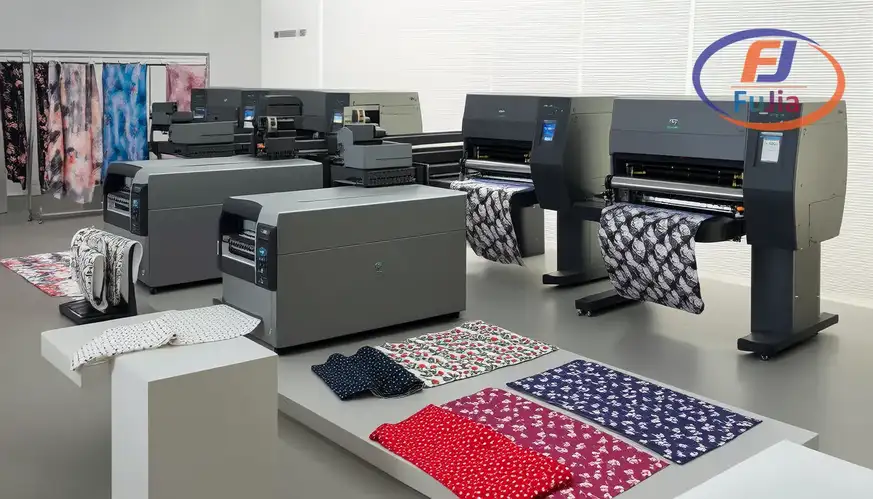
The class table is the market map, and each row is a different business wearing the same category name. Roll-to-roll polyester machines feed the sublimation economy, printing transfer paper and direct polyester for decor and sportswear at the category’s entry price. Dual-system machines add reactive ink for cotton fashion yardage, and the steam fixation step they require is the price of the cotton business. Production platforms integrate fixation and run contract volumes, and DTG sits on the same showroom floor printing finished garments for decorators who never touch a roll, per the class logic our textile printing guides document across the industry, alongside the promotional products programs that these machines supply.
The buyer’s first question is therefore about the product, not the printer: yardage or garments, polyester or cotton, sampling or contract volume. The machine class follows the answer, and every showroom conversation that skips it ends in a machine sized for someone else’s business.
New Versus Used: The Channels Compared
| Channel | Price | Risk profile | Support |
|---|---|---|---|
| authorized dealer | full retail | lowest | installation and service |
| factory-direct exporter | 20-35% under | mid | remote plus courier |
| trade show floor | retail, show pricing | low | dealer-grade |
| used market | 40-60% of new | highest | none, self-serve |
The channel table prices the same machines four ways, and the differences are support structures rather than hardware. Authorized dealers carry installation, training, and the service contract that first-time textile buyers genuinely need, while factory-direct exporters trade that layer for the discount that second-machine buyers monetize. Trade shows concentrate both channels with floor pricing, and the used market serves experienced operators at 40-60% of new with head-condition risk transferring to the buyer. We recommend the dealer route for first machines and the exporter discount at the second, the same escalation pattern our India market guide documents for UV flatbeds.
Used textile machines deserve their inspection section, because ink systems are the part that ages invisibly. Circulation pumps, dampers, and lines carry pigment history that meter readings hide, and a used roll printer’s calibration state matters more than its click count. The used route rewards operators who can evaluate ink systems themselves and prices that skill at a 40-60% discount, while punishing everyone else at full price.
The Inspection Protocol That Protects the Purchase
| Test | What it reveals | Pass looks like |
|---|---|---|
| ink circulation demo | system engineering | loops running, agitated cartridges |
| calibration print | head and feed health | banding-free yard at full width |
| your-fabric test | color on your material | density matching the proof |
| wash test | fixation quality | 5 cycles at 40 °C intact |
| support probe | vendor depth | written answer within a day |
The inspection table runs on your fabric with your designs, and the calibration print at full width is where used machines confess: banding at the edges, feed drift across the yard, and head-strike scars are all visible in a meter of output. The wash test converts fixation claims into laundry data at 5 cycles and 40 °C, and the support probe prices the relationship before the invoice.The protocol costs an afternoon and a few meters of fabric, and it prevents the used-machine regret stories that fill owner forums, per the inspection discipline our printer reviews guide prescribes for every five-figure purchase.
Documentation completes the audit before any money moves. The machine’s service history, head replacement records, and ink brand history tell you what the circulation system has been drinking, and a seller who cannot produce records is selling a machine they never maintained. Parts availability is the last document: the head model, the damper part numbers, and the vendor’s shipping promise for consumables belong in the purchase conversation, because the cheapest machine to buy and the cheapest machine to run are different machines. Audit the documents, then negotiate the price.
Financing and the Business Math
| Metric | entry roll class | dual-system class |
|---|---|---|
| machine cost | $14,000-30,000 | $30,000-80,000 |
| ink per meter | $1-3 | $2-5 |
| service billing | $8-25 per meter | $15-40 per meter |
| break-even volume | 800-2,500 meters | 1,500-4,000 meters |
The financing table converts sticker into monthly arithmetic, and equipment loans at 11-16% APR against the machine itself are standard products at both classes. An entry roll machine at $20,000 financed over 36 months runs about $650-720 monthly, which a modest service book of 100-150 meters monthly services comfortably at the margins the table shows. The dual-system class follows the same math at triple the volume, and the honest financing test is the same at both tiers: quote the EMI against signed or contracted orders, not against showroom optimism. When it comes to textile printing economics generally, the machine is the fixed part. The design pipeline that keeps it fed is the variable that decides everything.
The sale conversation ends with the same advice every time on this market: buy the machine your orders prove, at the support level your skills need, after the inspection your objects require. A case we supply anchors the pattern, an apparel startup that sampled through local services, verified demand across two seasons, and bought its dual-system machine against contracted reorders rather than forecasts, with the break-even arriving a month early because the order book, not the brochure, was doing the arithmetic, per the demand-first logic our sourcing guides document across equipment purchases.
How much do digital textile printers cost?
Digital textile printers cost $14,000-30,000 at the roll-to-roll polyester entry tier, $30,000-80,000 for dual-system machines that print cotton with reactive ink, and $90,000-plus for production platforms with integrated fixation, while DTG garment printers share the market at $4,500-20,000. Running costs add $1-5 per meter in ink by class, and used machines trade at 40-60% of new with ink-system risk transferring to the buyer. The class follows the business: polyester decor and sportswear at the entry tier, cotton fashion at the mid tier, and contract volume at the top. The landed number with support included is the number that ranks the purchase.
What is the best digital fabric printing machine?
The best digital fabric printing machine is the class matched to your product: roll-to-roll polyester for decor and sportswear, dual-system reactive for cotton fashion yardage, DTG for finished garments, each verified by a calibration print on your own fabric and a support probe answered in writing within a day. Best is a business-model match rather than a model ranking, because machines within a class share heads and architecture while their support desks differ completely. The five-part inspection, circulation, calibration, your-fabric color, wash test, and support probe, converts shortlists into verdicts. Buy the machine your signed orders prove, and the ranking question answers itself.That ordering, product first, proof second, brand last, is what separates satisfied owners from showroom stories.
What is the cost of a digital printing machine?
A digital printing machine for textiles costs $14,000-30,000 at entry roll-to-roll, $30,000-80,000 at dual-system cotton, and $90,000-plus at production platforms, with DTG alternatives at $4,500-20,000 for garment decorators. Budget the first-year lines beyond the sticker: ink at $1-5 per meter, a calibration and sampling stock of your own fabrics, and the power and space the class requires. Financing at 11-16% APR converts the tiers into $650-2,200 monthly against the machine itself, and the honest test quotes that payment against contracted orders. The full pricing ladder for the UV side of the market sits in our flatbed pricing guide for cross-reference.
How much does a 20×30 inch digital printing machine cost?
A 20×30 inch format sits at the A3-plus width band, covered by DTG garment printers at $4,500-20,000 for finished shirts and by entry roll-to-roll machines at $14,000-30,000 for transfer and narrow yardage work, with dedicated 20-inch roll platforms starting near the $15,000 class. The format question is a width question, and width prices upward from the A3 desktop class into the roll tiers, with fabric chemistry deciding which tier serves. Buyers whose regular work fits 20×30 inches should price the DTG route for garments and the entry roll route for fabric, per the width-pricing logic our price map guide documents across every format.
Verdict
Digital textile printing machines for sale carry three businesses on one market: polyester roll-to-roll at $14,000-30,000, reactive cotton at $30,000-80,000, and production platforms above $90,000, with DTG at $4,500-20,000 for the garment decorators among the buyers. Match the class to signed orders, buy the support level your skills need, inspect ink systems and calibration prints on your own fabric, and finance against real monthly capacity. The market rewards the buyer who arrives knowing the product, and the showroom forgives no one else. For textile printing support on your own designs either side of the purchase, contact Fujia Print with your fabric plans.
Sources
- Wikipedia: Digital textile printing: technology overview.
- Wikipedia: Reactive dye: cotton chemistry.
- AATCC: wash durability standards.
- Fujia Print apparel cases: textile program examples.
