

A UV printer for small business lets a 1-5 person shop print full-color graphics directly on phone cases, tumblers, acrylic signs, and wood, with ink that cures the instant the UV-LED lamp hits it. The right pick in 2026 depends on what you print on, how many pieces per day you ship, and whether you need flatbed only or flatbed-plus-roll versatility.
Key Takeaways
- A UV printer for small business replaces outsourcing whenever daily volume tops roughly 20-30 decorated pieces, because per-unit ink cost lands at $0.02-0.05 per phone case versus $2-4 outsourced.
- The 2026 desktop market splits into three price bands: entry $1,399-2,400 (xTool O1 Omni, GratKit, Procolored A5), prosumer $2,100-3,500 (eufyMake E1, Longer dual-head, A3 flatbeds), and light-industrial $7,995-17,895 (Epson V1070, Roland TrueVIS).
- Substrate reach matters more than raw speed: a 60×90 cm flatbed fits 6-8 wine glasses or 12 phone cases per cycle, which is why flatbed bed size is the single most important spec for small shops.
- Payback typically lands in 2-6 months for custom gift, label, and promotional product shops running 200-800 finished pieces per day.
- Fujia Print’s A1 6090 UV flatbed ($7,000-12,000 factory-direct range) covers the light-industrial band with a 300+ tested substrate database and 6-color CMYK+White+Varnish printing, which is the same configuration used by the Kenya glassware workshop that cut waste from 15% to 9% in three months.
What a UV Printer for Small Business Actually Does
A UV printer for small business is a flatbed or hybrid inkjet printer that jets UV-curable ink onto a substrate, then cures each layer instantly with a UV-LED lamp mounted on the printhead carriage. Unlike eco-solvent or water-based ink, UV ink sits on top of the material and polymerizes under ultraviolet light, so it bonds to glass, metal, ceramic, wood, plastic, and leather without pre-treatment or post-drying racks. The technology is explained in more depth in our UV printing machine overview.
The mechanism matters for small operations because it removes three cost centers at once: no screens or plates to burn (vs offset and screen), no dryers or ventilation ducts (vs solvent), and no per-substrate setup beyond loading the file. A small shop can load a new design in roughly 30 seconds and run a one-off without paying the $150-400 setup fee that screen printers charge per color.
UV printing is one of several digital printing methods covered on our site; for flatbed specifics, see the UV flatbed printer guide.
UV Printer for Small Business: 2026 Price Bands and Specs
The 2026 small-business UV printer market breaks into three price tiers, and the spec that changes most between them is printhead count, not print resolution. Resolution across all tiers sits in a narrow 720×1200 to 1440×1440 dpi band. The real differences are bed size, ink system, and whether the machine supports white ink and varnish for premium textured effects.
| Tier | Price range | Examples (2026) | Bed / width | Printheads | Daily volume sweet spot |
|---|---|---|---|---|---|
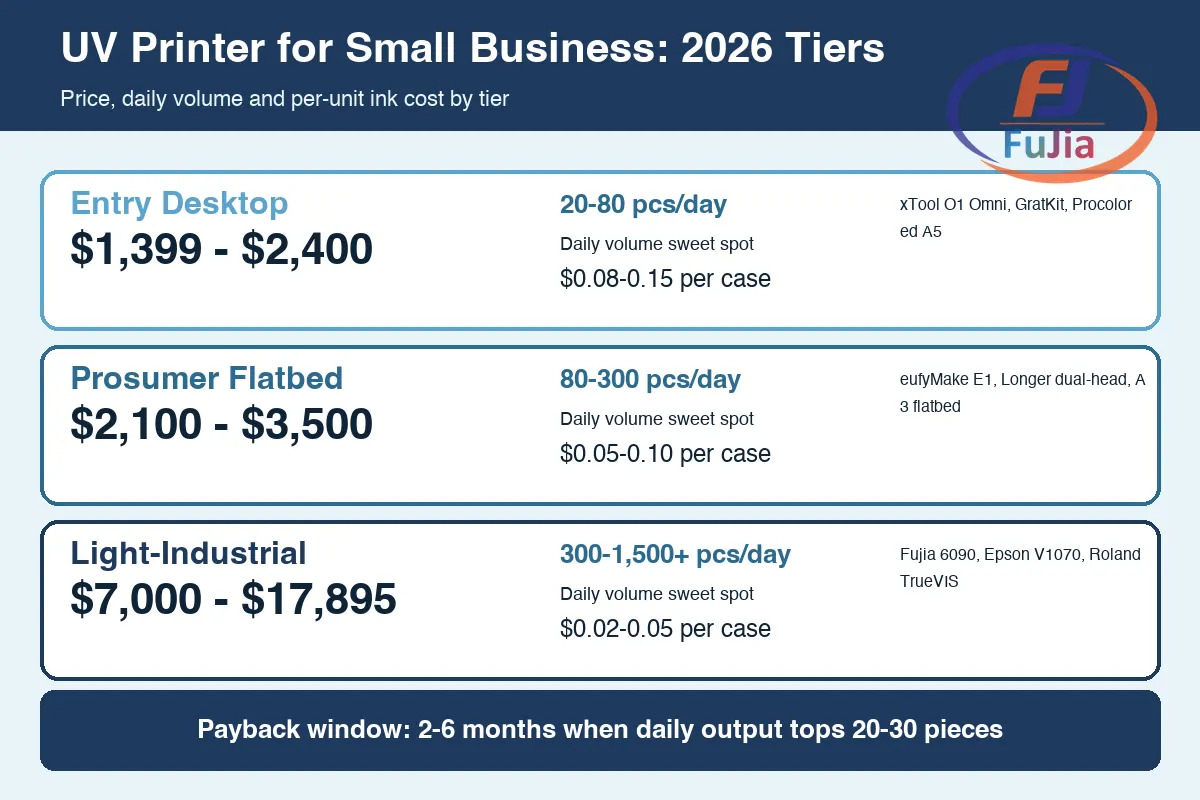
| Entry desktop | $1,399-$2,400 | xTool O1 Omni, GratKit UV, Procolored A5 single-head | A5 to A4 (15×21 to 30×42 cm) | 1 | 20-80 pieces/day |
| Prosumer flatbed | $2,100-$3,500 | eufyMake E1, Longer ePrint dual-head, A3 UV flatbed | A3 (approx. 30×42 cm) | 1-2 | 80-300 pieces/day |
| Light-industrial flatbed | $7,000-$17,895 | Fujia 6090, Epson V1070, Roland TrueVIS | 60×90 cm or larger | 3-4 (Ricoh GEN5 / Epson I3200) | 300-1,500+ pieces/day |
Cost per piece by tier
Based on data from our customers across 50+ countries, entry desktop machines running cartridge ink cost roughly $0.08-0.15 per phone case in ink, while light-industrial flatbeds with bottled CMYK+White+Varnish drop to $0.02-0.05 per case. The gap widens fast at higher volumes: 500 cases a day on a cartridge machine runs $40-75 in ink alone, while the same volume on a flatbed runs $10-25. Varnish adds texture and commands 30-50% higher per-unit pricing on retail goods, which is why the promotional product case study on our site reports 75% margin on phone case decoration.
Speed expectations
Desktop single-head printers complete a full-color phone case in 60-90 seconds. Dual-head A3 flatbeds cut that to 30-45 seconds. Light-industrial 4-head flatbeds like the Fujia 6090 hit 4-8 m²/hour, which translates to under 15 seconds per phone case when the bed is loaded with 12 pieces in a batch. The Kenya glassware workshop runs a 6090 and lifted daily output from 200 to 300 finished pieces while dropping waste from 15% to 9% inside the first quarter.
Which UV Printer Fits Which Small Business
The right machine maps to the product, not the budget alone. A shop printing promotional tumblers has different bed, ink, and throughput needs than one printing phone cases or short-run product labels.
| Small business type | Typical substrate | Recommended tier | Bed size minimum | Ink configuration |
|---|---|---|---|---|
| Custom phone case shop | TPU and acrylic cases | Prosumer or light-industrial | 30×42 cm (A3) | CMYK + White |
| Personalized gift studio | Tumblers, glassware, wood plaques | Light-industrial flatbed | 60×90 cm | CMYK + White + Varnish |
| Promotional product distributor | Metal pens, USB drives, keychains, bottles | Light-industrial + UV DTF option | 40×50 cm or larger | CMYK + White + Varnish |
| Short-run product label maker | Roll labels, small runs under 3,000 pieces | A2 hybrid flatbed-roll | 40×60 cm | CMYK + White |
| Sign and display shop | Acrylic, PVC foam board, wood | Light-industrial or eco-solvent wide-format | 60×90 cm or 1.6 m roll | CMYK + White + Varnish |
Detailed product-line options live on our UV printers pillar page. For sign and display work that also needs outdoor vinyl, see our signage & display printing solutions.
UV Printer for Small Business: Buying Checklist
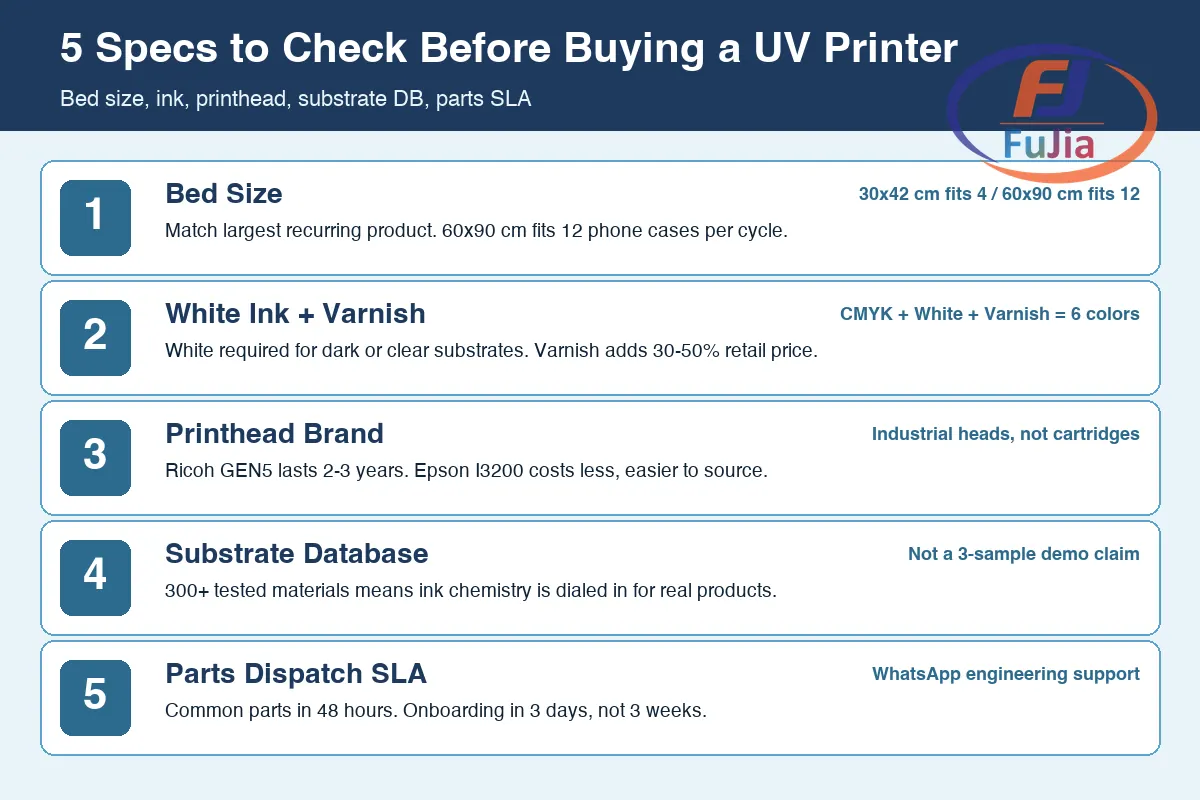
Picking a machine that fits means checking five specs before price. These are the decision points that separate a productive purchase from an expensive paperweight.
- Match bed size to your largest recurring product. A 30×42 cm A3 bed fits four phone cases per cycle. A 60×90 cm bed fits 12. If the best-selling product is a 40 cm wooden plaque, an A3 machine cannot print it at all.
- Confirm white ink and varnish channels. White ink is required for dark or clear substrates like black phone cases and transparent acrylic. Varnish adds tactile texture and raises retail price 30-50%. Single-head cartridge printers often skip one or both.
- Check printhead brand and replacement cost. Ricoh GEN5 and Epson I3200 are the two mainstream industrial heads. Ricoh costs more per head but lasts 2-3 years in continuous production. Epson I3200 costs less and is easier to source in emerging markets.
- Verify the substrate database, not the marketing claim. Ask the supplier how many substrates they have tested with their ink formulation. A 300+ entry database means the ink chemistry is dialed in for real materials, not just promotional copy.
- Ask for parts dispatch SLA and remote onboarding time. Common parts should ship within 48 hours. Onboarding for a new operator should take 3 days, not 3 weeks, when the supplier’s engineering team actually answers WhatsApp.
How much does a UV printer for small business cost in 2026?
A UV printer for small business in 2026 costs between $1,399 for an entry desktop like the GratKit UV and $17,895 for a Roland TrueVIS UV printer and cutter combo. The middle band, where most productive small shops land, runs $2,100 to $3,500 for machines like the eufyMake E1 at $2,199 and the Longer ePrint dual-head at $2,374. Light-industrial flatbeds like the Fujia 6090 and Epson SureColor V1070 sit at roughly $7,000 to $9,000 factory-direct, and the higher price buys a 60×90 cm bed, 3-4 Ricoh or Epson printheads, and a 6-color CMYK+White+Varnish ink system that supports textured and premium-finish work. When comparing prices, factor in ink: cartridge-based machines cost $0.08-0.15 per phone case in ink, while bottled-ink flatbeds run $0.02-0.05 per case. Over a year of 100 cases a day, that ink gap is worth $2,000-3,500, which often erases the upfront savings of a cheaper machine. Based on data from our customers across 50+ countries, the sweet spot for a shop planning to grow past 100 finished pieces per day is the $7,000-9,000 light-industrial band.
What can a small business print with a UV printer?
A small business can print on glass, acrylic, metal, wood, ceramic, leather, plastic, PVC foam board, and dozens of substrates that no other desktop technology can handle in a single pass. Common products include custom phone cases, personalized tumblers and wine glasses, promotional pens and USB drives, acrylic signage, wooden plaques, ceramic tiles, golf balls, and short-run product labels. The Kenya glassware workshop that runs a Fujia 6090 UV flatbed prints on wine glasses, bottles, and decorative glassware, lifting daily output from 200 to 300 finished pieces while cutting material waste from 15% to 9% in the first quarter. The promotional product case on our site covers a phone case brand that expanded from 12 to 40+ SKUs in 60 days and reached 8,000+ finished cases per month at 75% margin. A capable UV flatbed carries a 300+ tested substrate database, which means the ink chemistry has been validated across hundreds of real materials rather than three or four demo samples. Shops in humid tropical climates should confirm that the ink and curing profile are tuned for the local temperature and humidity, because UV-LED cure behavior shifts slightly with ambient conditions.
How long does a UV printer take to pay for itself?
A UV printer for small business typically pays for itself in 2 to 6 months when the shop is already outsourcing decoration or buying finished custom goods at wholesale. The Brazil creative studio case on our site covers an A3 desktop DTF printer that hit 5.5 month payback, and UV printer economics are comparable or faster because per-unit ink cost is lower and the substrate range is wider. The math works like this: a shop buying 50 custom phone cases per day from a supplier at $4 each and reselling at $15 spends $200 per day on product. Bringing the same work in-house on a $2,199 prosumer machine drops per-case cost to roughly $0.50 in ink and $0.30 in blank case, or $0.80 total, which is $160 saved per day. At that rate, the machine is paid off in 14 days of printing. Real-world payback stretches to 2-6 months because most shops ramp volume gradually and mix in lower-margin products. Based on aggregate data from our customers across 50+ countries, in-house UV printing beats outsourced screen printing on cost below roughly 3,000 identical pieces per design, and beats pad printing on every run because pad printing cannot reproduce full-color artwork at all.
What is the difference between a UV printer and a UV DTF printer?
A UV printer prints directly onto the final substrate (a phone case, a tumbler, a sign), while a UV DTF printer prints onto a flexible AB film that is then peeled and applied by hand to any surface, including curved, uneven, or heat-sensitive items that cannot go into a flatbed. UV DTF crystal labels transfer in 10-15 seconds by hand and need no heat press, which makes them ideal for bottles, irregular promotional products, and short runs of product labels where direct flatbed loading is awkward. A UV flatbed handles thick, flat, or mildly curved items up to 180 mm tall, prints in higher volume per cycle, and supports textured varnish effects directly on the finished product. Many small businesses run both: a UV flatbed for the bulk of daily output and a UV DTF printer for irregular items and low-MOQ label work. The corporate gift distributor case on our site runs exactly this combination and cut delivery from 21 days to 7 days while doubling order value. Both machines use the same family of UV-curable ink, so the chemistry knowledge transfers.
Conclusion
A UV printer for small business is a 2-6 month payback tool when the shop already decorates products at any volume past 20-30 pieces per day, and the 2026 market gives buyers a clear three-tier path from entry desktop to light-industrial flatbed. For factory-direct pricing on the Fujia Print A1 6090 UV flatbed and our full UV printer lineup, contact Fujia Print for a free sample print on your substrate.
Sources
- Ultraviolet radiation and photopolymerization overview (Wikipedia): backs the UV-LED curing mechanism and wavelength claims.
- Digital printing technology reference (Wikipedia): backs the comparison between digital UV printing and traditional screen or offset printing.
- Inkjet printing and printhead technology (Wikipedia): backs the printhead (Ricoh GEN5, Epson I3200) and ink system (CMYK+White+Varnish) specifications.
- Epson official UV printers for makers and small businesses: backs the desktop UV printer pricing and maker-tier product positioning.
- Roland DGA official printer catalog: backs the light-industrial tier price band ($17,895 Roland TrueVIS UV printer and cutter).
