

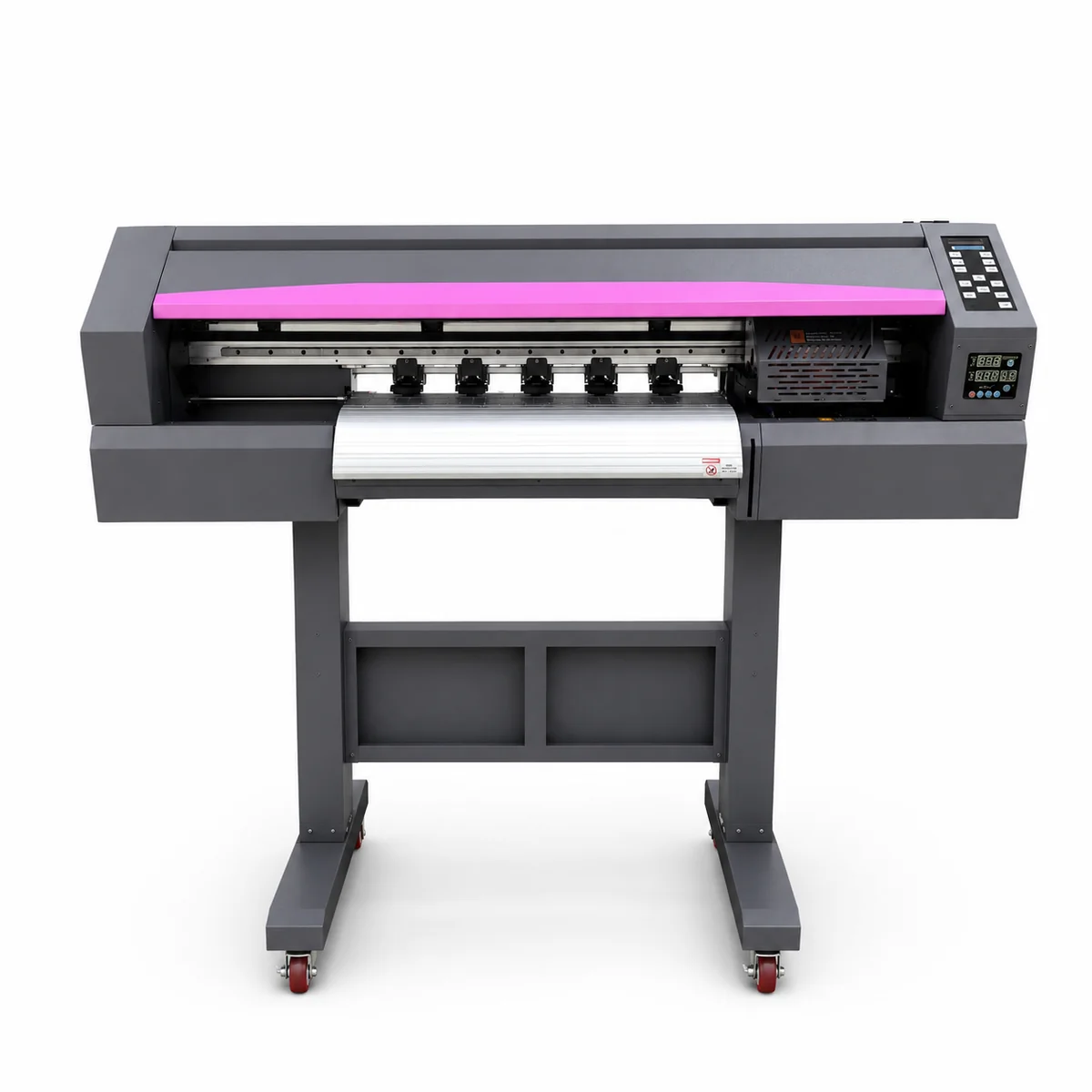
A DTF shaker machine automates the three critical steps between printing and heat pressing: applying hot-melt adhesive powder to wet PET film, removing excess powder through vibration, and curing the powder at 110-130°C to form a thermoplastic polyurethane (TPU) bond layer. Integrated shaker systems process 300-650mm wide film at 8-27 m2/hour, replacing manual powdering methods that limit production to 30-50 transfers per day. Fujia Print manufactures DTF printers with integrated shaker systems used by apparel businesses across 50+ countries.
Key Takeaways
- DTF shaker machines automate powder application, excess removal, and thermal curing in one continuous process, increasing throughput by 300-500% compared to manual methods.
- Curing temperature must stay within 110-130°C for 90-120 seconds; exceeding 140°C yellows the white underbase and reduces wash resistance by up to 60%.
- Powder recycling systems recover 85-95% of excess adhesive powder, reducing material waste by 30% and keeping the workspace cleaner.
- Horizontal shakers suit high-volume production (200-500+ transfers/hour), while vertical shakers save 60% floor space for compact shops.
- The global direct-to-film printing market is growing at a 6.0% CAGR, driven by automated shaker adoption among apparel businesses.
What Does a DTF Shaker Machine Do?
A DTF shaker machine performs three sequential operations on printed PET film before heat pressing:
1. Powder Application
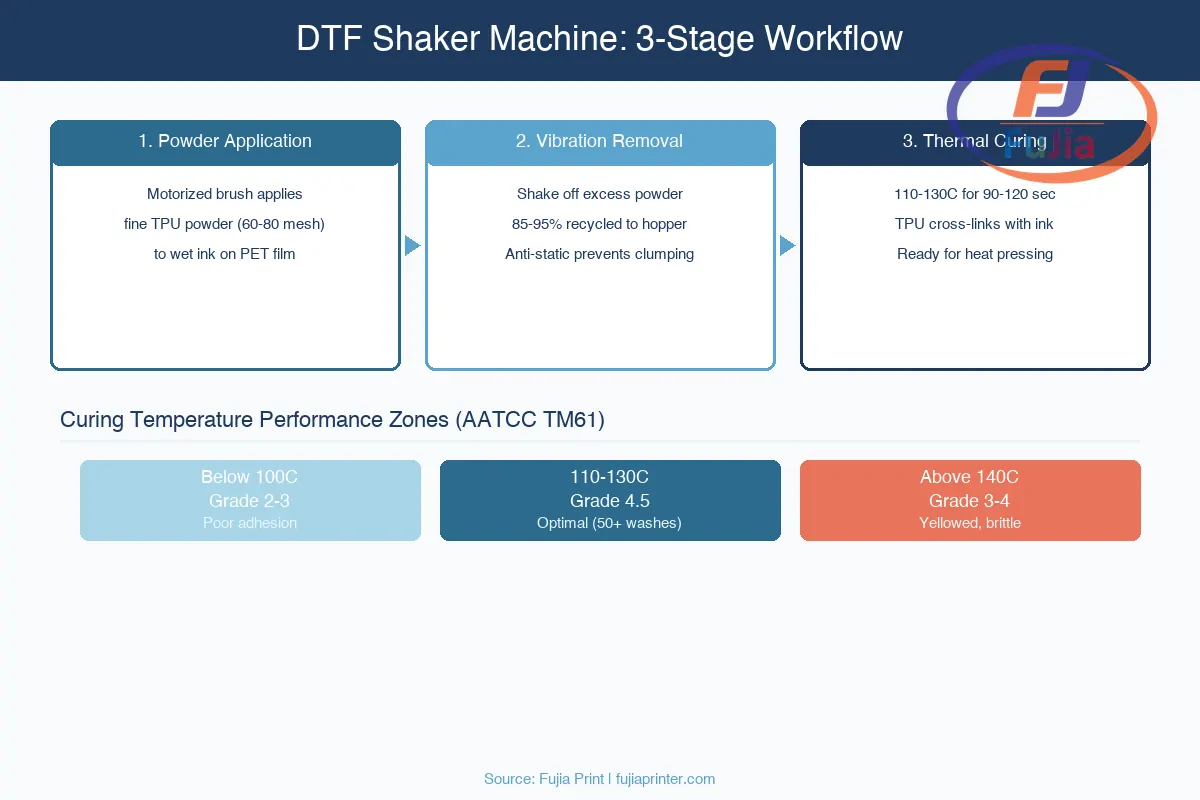
After the DTF printer deposits CMYK ink plus a white underbase onto PET film, the film enters the shaker machine’s powdering section. A motorized brush or electrostatic system distributes fine-grade TPU adhesive powder (60-80 mesh, 150-300 micrometer particle size) evenly across the wet ink surface. The powder adheres to wet ink but not to the dry film backing, creating a precise adhesive layer that matches the printed design exactly.
2. Excess Powder Removal
A vibration mechanism shakes the film to remove excess powder from non-printed areas. This step is critical because excess powder causes a stiff, plastic-like feel on the finished garment and can create unwanted background adhesion. Modern shaker machines achieve 85-95% powder recovery through integrated recycling systems that return excess powder to the hopper for reuse.
3. Thermal Curing
The film passes through a heated tunnel (infrared or convection) at 110-130°C for 90-120 seconds, melting the TPU powder into a continuous adhesive film. Research by Zhu et al. (2025) demonstrates that TPU nanocomposites enhanced with TiO2 and TGIC crosslinkers achieve optimal cross-link density at 120°C, improving adhesion strength by 30-45% compared to standard TPU at the same temperature. This finding, published in the International Journal of Adhesion and Adhesives (Vol. 139), confirms that precise temperature control during curing directly determines transfer wash durability.
Types of DTF Shaker Machines
Horizontal Shaker-Dryer (All-in-One)
Horizontal shakers combine powdering, shaking, and curing in a single conveyor-belt unit. Film feeds horizontally through the powder application station, vibration section, and heated curing tunnel. These units process film widths of 300-650mm and are the industry standard for production-grade DTF operations.
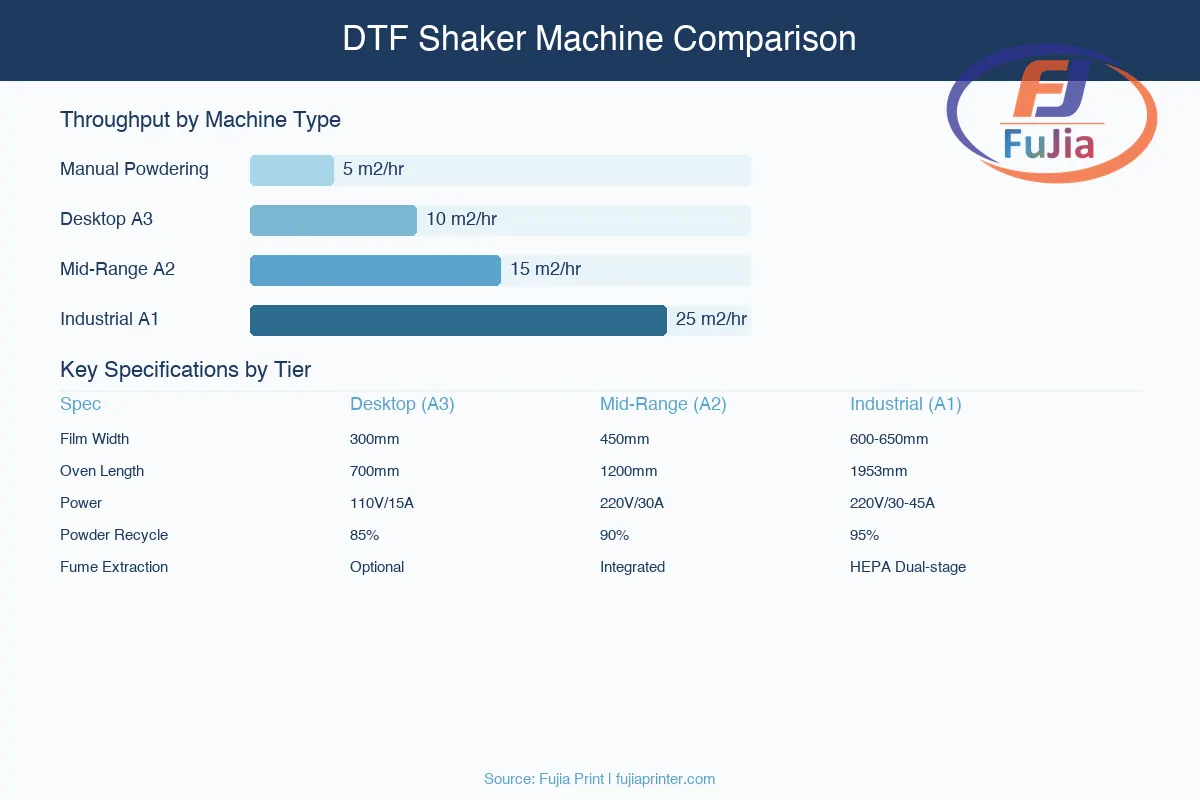
| Specification | Desktop (A3) | Mid-Range (A2) | Industrial (A1) |
|---|---|---|---|
| Film width | 300mm | 450mm | 600-650mm |
| Oven length | 700mm | 1200mm | 1953mm |
| Curing temp range | 80-150°C | 100-170°C | 100-200°C |
| Throughput | 8-12 m2/hr | 12-18 m2/hr | 18-27 m2/hr |
| Power | 110V/15A | 220V/30A | 220V/30-45A |
| Floor footprint | 0.4 m2 | 1.2 m2 | 2.0 m2 |
| Weight | 32-45 kg | 120-180 kg | 240-290 kg |
Fujia’s integrated shaker system features a 2880mm mesh belt with dual-zone temperature control at 140°C, maintaining temperature uniformity within plus or minus 2°C across the entire belt width. This precision prevents the temperature spikes that cause white ink yellowing and TPU degradation.
Vertical Shaker
Vertical shakers use a compact vertical design that occupies 60% less floor space than horizontal units of equivalent throughput. The UNINET SLIMSHAKER, for example, occupies only 12.7 square feet compared to 31.5 square feet for a standard 24-inch horizontal shaker. Vertical shakers feed film upward through the powdering and curing sections, making them ideal for space-constrained shops and home-based businesses.
Manual Powdering Station (Entry-Level)
For startups and low-volume operations, a manual powdering station consists of a powder sieve, a hand-held shaker, and a standalone drawer oven or heat press for curing. While this approach costs USD 200-600 (compared to USD 2,500-6,000 for automated shakers), it limits throughput to 30-50 transfers per day and produces inconsistent powder coverage that affects wash durability.
Critical Specifications Comparison
| Feature | Why It Matters | Industry Standard |
|---|---|---|
| Powder recycling rate | Reduces material waste and cost | 85-95% recovery |
| Curing temperature precision | Prevents TPU degradation and white ink yellowing | Plus or minus 1-2°C (PID controlled) |
| Conveyor speed range | Matches throughput to printer output | 1-5 meters/minute adjustable |
| Belt width | Determines maximum film width | 300mm (A3) to 650mm (A1) |
| Fume extraction | Removes harmful caprolactam fumes during TPU melting | Integrated HEPA filtration or exhaust port |
| Anti-static system | Prevents powder clumping and uneven coating | Ionizing bar or grounded brush |
| Heating element type | Affects curing speed and temperature uniformity | Quartz infrared or carbon fiber |
| Noise level | Operator comfort for extended production | Below 65 dB |
Curing Temperature and Wash Durability
The relationship between curing temperature and wash durability is non-linear. Testing according to AATCC TM61 (2023) reveals three performance zones:
| Curing Temperature | TPU State | Wash Grade (AATCC TM61) | Transfer Quality |
|---|---|---|---|
| Below 100°C | Insufficient melt | Grade 2-3 | Poor adhesion, peeling after 10 washes |
| 110-130°C | Optimal cross-link | Grade 4.5 | Excellent, 50+ wash cycles |
| Above 140°C | Over-cured, yellowed | Grade 3-4 | White underbase discoloration, brittle |
The optimal curing window of 110-130°C for 90-120 seconds promotes polymer cross-linking that improves scratch resistance by 40%. Below 110°C, the TPU adhesive does not fully melt, reducing wash resistance by up to 60%. Above 140°C, the white underbase layer yellows and the TPU becomes brittle, causing cracking after 20-30 wash cycles rather than the 50+ cycles achieved with proper curing.
The global custom apparel market, projected to grow from USD 5.82 billion in 2025 to USD 17.22 billion by 2034 at a 12.81% CAGR according to Fortune Business Insights, is driving demand for automated shaker systems that can maintain consistent curing quality at scale.
Integrated Shaker vs Separate Components
All-in-One Shaker-Oven Systems
Integrated systems combine the shaker and curing oven into one unit with synchronized conveyor control. Advantages include simplified operation, synchronized speed control between powdering and curing zones, and a smaller footprint than separate machines. The primary disadvantage is that if either the shaker or oven component fails, the entire system must be taken offline for repair.
Separate Shaker + Oven
Separate components allow independent upgrading and maintenance. A shop can start with a basic shaker and upgrade to a larger oven as volume grows. However, separate machines require more floor space and manual film handling between stations, adding 5-10 seconds per transfer of labor time.
Powder Recycling and Material Savings
Automated powder recycling is one of the most significant cost advantages of shaker machines over manual powdering. The system works as follows:
- Excess powder is shaken off the film in the vibration section
- A collection tray gathers the fallen powder
- An auger or pneumatic system returns the powder to the hopper
- Recycled powder is mixed with fresh powder for continuous use
With a 90% recycling rate, a shop processing 500 transfers per day (12×12 inch designs) saves approximately 1.2 kg of powder per day, equivalent to USD 6.60-12.00 daily or USD 1,400-2,600 monthly. The DTF adhesive powder market data is supported by Grand View Research analysis of the broader DTF consumables segment.
Fume Extraction and Workplace Safety
During TPU adhesive curing at 110-130°C, caprolactam and other volatile compounds are released. Prolonged inhalation exposure to caprolactam can cause respiratory irritation. Modern shaker machines address this through:
- Integrated HEPA filtration capturing 99% of particulate matter
- Activated carbon filters adsorbing volatile organic compounds
- Exhaust ports for connecting external fume extractors
- Enclosed curing tunnels that contain fumes at the source
Fujia’s integrated shaker system achieves 99% fume capture efficiency through a dual-stage filtration system, making it suitable for indoor commercial operation without additional ventilation infrastructure.
How to Choose the Right DTF Shaker Machine
Step 1: Match Shaker Width to Printer Width
The shaker machine’s film width capacity must match or exceed your DTF printer’s maximum print width. An A3 DTF printer (300mm) requires a 300mm shaker; an A1 printer (600-650mm) requires a 650mm shaker.
Step 2: Calculate Required Throughput
| Daily Volume | Shaker Type | Throughput Required |
|---|---|---|
| 30-50 transfers | Manual powdering + drawer oven | 4-8 m2/hr |
| 50-200 transfers | Desktop all-in-one (A3) | 8-12 m2/hr |
| 200-500 transfers | Mid-range all-in-one (A2) | 12-18 m2/hr |
| 500+ transfers | Industrial horizontal (A1) | 18-27 m2/hr |
Step 3: Verify Electrical Requirements
Desktop shakers (A3) operate on standard 110V/15A outlets. Industrial shakers (A1) require 220V/30-45A dedicated circuits, which may require professional electrical installation. Always verify that your facility can support the power requirements before purchasing.
What is a DTF printer shaker?
A DTF printer shaker is an automated machine that applies hot-melt adhesive powder to printed PET film, removes excess powder through vibration, and cures the powder at 110-130°C to create a transferable adhesive layer. The shaker replaces manual powdering, which is inconsistent and limits production to 30-50 transfers per day. Automated shaker machines process 300-650mm wide film at 8-27 m2/hour, achieving 85-95% powder recycling and reducing material waste by 30%. The shaker is a separate component from the DTF printer itself, though integrated all-in-one systems combine both functions. Curing temperature precision within 110-130°C is critical: below 110°C wash resistance drops 60%, and above 140°C the white underbase yellows.
Do you have to shake a DTF printer?
No, you do not shake the DTF printer itself. The term “DTF shaker” refers to a separate machine that processes the printed PET film after it exits the printer. The shaker applies adhesive powder to the wet ink on the film, vibrates to remove excess powder, and cures the powder through a heated tunnel. The DTF printer remains stationary during this process. However, some DTF ink systems, particularly white ink, require daily agitation or circulation to prevent pigment settling. Fujia’s DTF printers feature automatic white ink circulation systems that eliminate the need for manual shaking of ink bottles.
How to use a DTF powder shaker?
To use a DTF powder shaker, first print your design onto PET film using a DTF printer. Feed the printed film into the shaker machine’s entrance, ensuring the printed side faces up. Fill the powder hopper with fine-grade TPU adhesive powder (60-80 mesh). Set the curing temperature to 110-130°C and conveyor speed to achieve 90-120 seconds dwell time. The machine automatically applies powder, removes excess, cures the adhesive, and rewinds the finished film. After curing, the film is ready for heat pressing onto fabric at 150-160°C for 12-15 seconds. Clean the powder hopper and collection tray daily to prevent moisture buildup and powder clumping. The Turkey garment factory case study demonstrated that proper shaker calibration reduced reject rates by 40% and increased throughput by 40% after deploying Fujia A1 equipment with integrated shaker.
What is the best machine to make DTF transfers?
The best machine to make DTF transfers is an integrated DTF printer with a built-in or paired shaker-curing system. For production volumes of 200+ transfers per day, an A1-format system with 600-650mm film width, dual-zone temperature control, and 90%+ powder recycling delivers the lowest cost per transfer. Key specifications to evaluate include printhead type (Epson i3200-U1 recommended), curing temperature precision (within plus or minus 2°C), fume extraction capability, and powder recycling rate. Fujia’s A1 DTF system with integrated shaker achieves 27 m2/hour throughput, 99% fume capture, and Grade 4+ wash fastness, representing the production-grade standard for commercial DTF transfer manufacturing.
Conclusion
A DTF shaker machine transforms manual, low-volume powdering into an automated production process with 300-500% higher throughput, 85-95% powder recycling, and consistent Grade 4.5 wash durability. For integrated DTF production systems with precision shaker-curing, explore the Fujia DTF printer lineup or discover our apparel printing solutions.
Sources
- Zhu et al. (2025): TPU Nanocomposites for Transfer Printing: Research on TiO2 and TGIC crosslinker-enhanced TPU curing behavior at 120°C, published in International Journal of Adhesion and Adhesives, Vol. 139.
- Fortune Business Insights: Custom T-Shirt Printing Market, 2026-2034: Market size USD 5.82B (2025) to USD 17.22B (2034) at 12.81% CAGR, driving automated production equipment adoption.
- Grand View Research: Direct To Film Printing Market, 2025-2030: DTF equipment market at 6.0% CAGR, including shaker and curing system segment analysis.
- AATCC TM61 (2023): Colorfastness to Laundering: Accelerated laundering test standard for evaluating DTF transfer wash durability after curing.
- AATCC TM135: Dimensional Changes After Home Laundering: Standard for measuring fabric dimensional stability, relevant to DTF transfer quality assessment.
