

A DTF curing oven is a heated chamber that melts thermoplastic polyurethane (TPU) adhesive powder onto printed PET transfer film at 110-160°C for 1-4 minutes, transforming the powder from a dry granular coating into a smooth, glossy adhesive layer that bonds ink to fabric during heat pressing. The curing oven ensures uniform heat distribution across the entire film surface, preventing the hot spots and cold spots that cause peeling, cracking, and incomplete adhesion. Fujia Print manufactures DTF printers with integrated shaker and curing systems used by apparel businesses across 50+ countries, producing transfers rated at AATCC Grade 4-5 wash fastness.
Key Takeaways
- A DTF curing oven melts TPU adhesive powder onto printed film at 110-160°C (230-320°F) for 1-4 minutes until the surface develops a smooth “orange peel” texture.
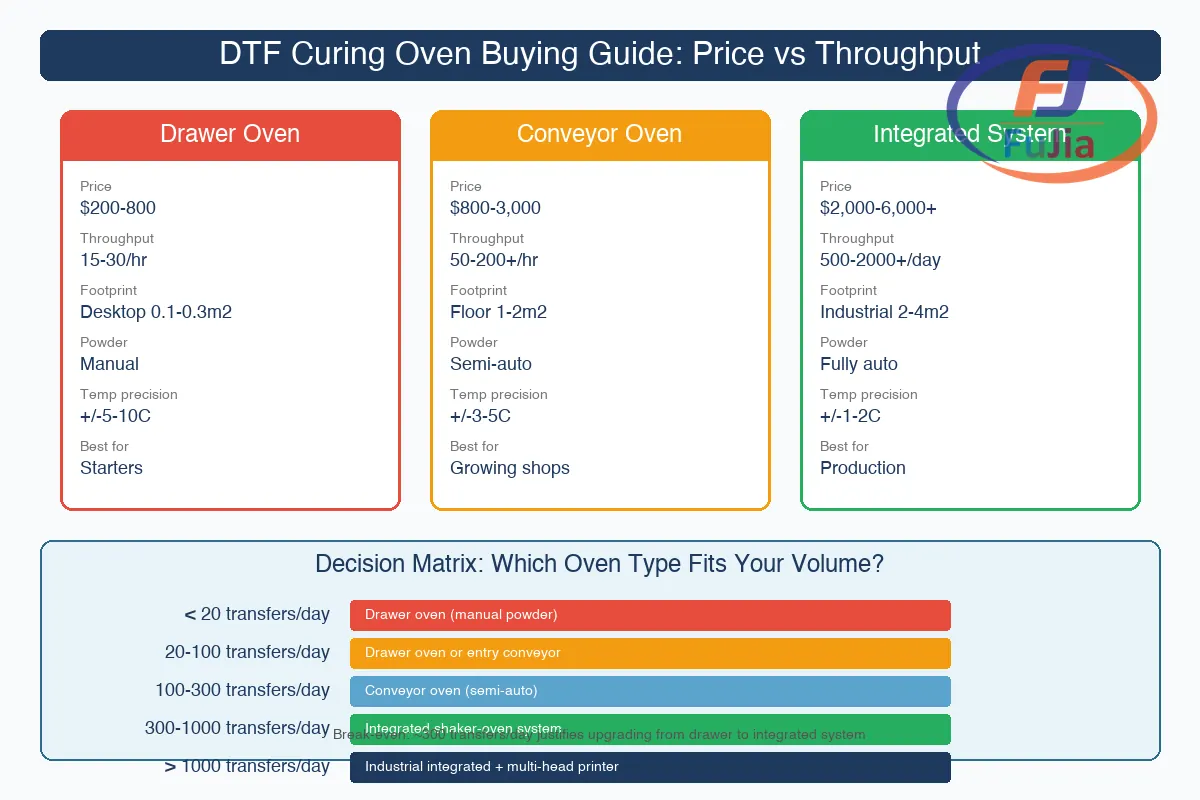
- Oven types include drawer ovens (USD 200-800), conveyor dryers (USD 800-3,000), and integrated shaker-oven systems (USD 2,000-6,000).
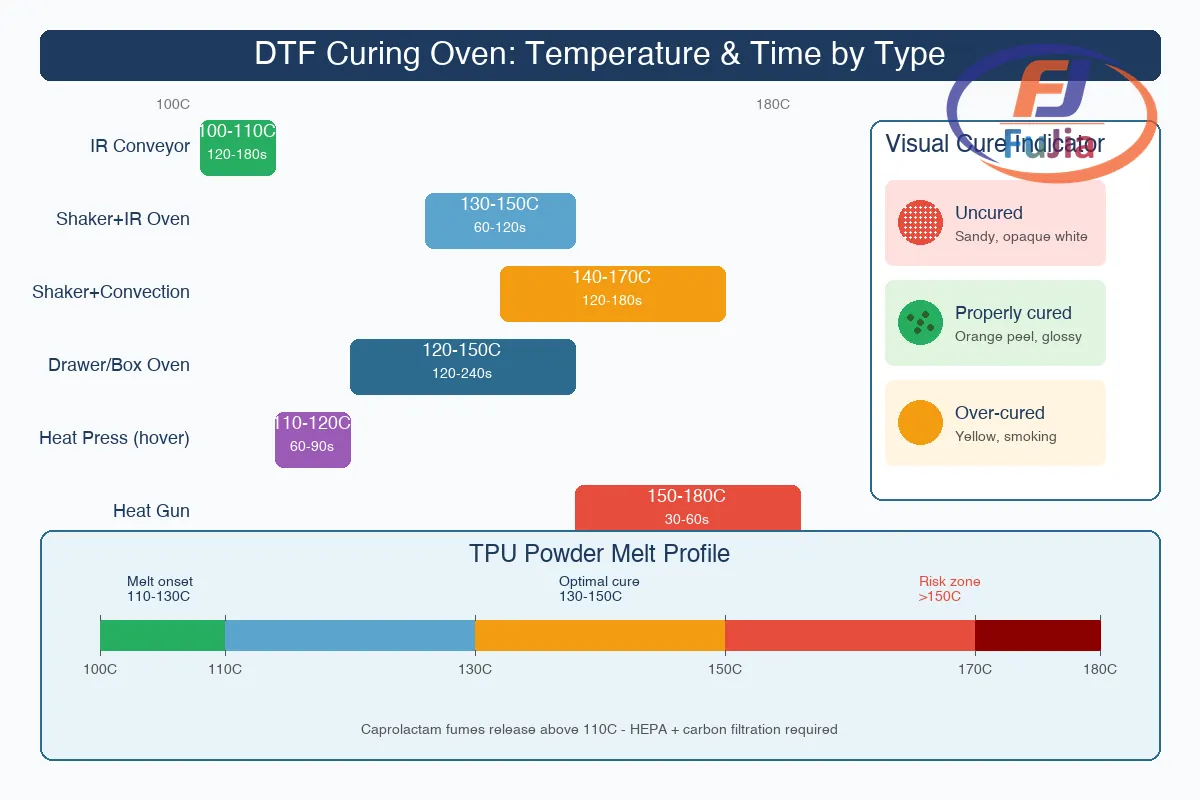
- Temperature varies by heat method: infrared conveyor 100-110°C, convection oven 140-170°C, drawer oven 120-150°C.
- Fume extraction is mandatory because TPU powder heating releases caprolactam vapors that require HEPA and carbon filtration.
- Properly cured DTF powder achieves 50-100+ wash cycle durability when pressed at 160°C for 15 seconds with cold peel.
How a DTF Curing Oven Works
The DTF curing oven performs one critical function: melting TPU hot-melt adhesive powder so it bonds with the wet ink layer on PET film. Without this step, the powder remains a dry, granular coating that cannot adhere to fabric during heat pressing.
The process begins after the DTF printer deposits CMYK ink plus a white ink underbase onto PET film, and adhesive powder is applied to the wet ink surface. The powdered film enters the curing oven, where controlled heat raises the TPU particles past their melt onset point of 110-130°C. As the powder melts, it flows into a continuous, glossy film over the ink layer, creating the adhesive bond that will later connect the transfer to the garment fabric.
The visual indicator of proper curing is the “orange peel” texture: the surface transitions from opaque white granules to a smooth, slightly bumpy, translucent layer with a uniform sheen. If the surface remains grainy or sandy, the powder is under-cured and needs more time. If the film curls, yellows, or smokes, the temperature is too high and the powder is over-cured.
Research published in the International Journal of Adhesion and Adhesives (Zhu et al., 2025) demonstrates that TPU hot-melt adhesives crosslinked with TGIC achieve higher bond strength and water resistance than pure TPU, which directly impacts the curing temperature window and final transfer durability. Crosslinked TPU nanocomposites maintain adhesive integrity through repeated wash cycles, validating the importance of precise curing temperature control.
DTF Curing Oven Temperature and Time Guide
Temperature and dwell time vary significantly based on the heat transfer method. The TPU powder itself melts at the same temperature regardless of equipment, but the efficiency of energy delivery to the powder surface determines the required setpoint.
| Oven Type | Temperature Range | Dwell Time | Heat Transfer Method | Best For |
|---|---|---|---|---|
| Infrared conveyor dryer | 100-110°C (212-230°F) | 2-3 minutes | Radiant IR energy | High-volume production |
| Shaker with IR oven | 130-150°C (266-300°F) | 60-120 seconds | Radiant IR + automation | Integrated workflow |
| Shaker with convection oven | 140-170°C (284-338°F) | 2-3 minutes | Forced hot air | Roll-to-roll production |
| Drawer/box curing oven | 120-150°C (248-300°F) | 2-4 minutes | Convection or IR | Sheet-based, small batch |
| Heat press (hover method) | 110-120°C (230-248°F) | 60-90 seconds | Radiant + proximity | Low volume, testing |
| Heat gun (manual) | 150-180°C output | 30-60 seconds per area | Directed hot air | Emergency only |
Infrared systems operate at lower air temperatures because IR energy is absorbed directly by the TPU particles, delivering heat precisely where it is needed. Convection systems heat the air first, then the air heats the powder, requiring higher setpoints to deliver equivalent thermal energy within the same dwell time. This distinction explains why a convection oven reading 150°C may cure at the same rate as an IR conveyor reading 110°C.
Types of DTF Curing Ovens
Drawer/Box Curing Ovens
Drawer-style curing ovens are compact, enclosed chambers where DTF film sheets are placed flat on a drawer that slides into the heated compartment. These ovens typically support A3 (30cm), A4 (21cm), or custom film sizes up to 33x48cm. Prices range from USD 200-800 depending on chamber size and temperature control precision.
The primary advantage of drawer ovens is simplicity. They are ideal for small print shops producing 20-100 sheets daily, hobbyists, and businesses testing DTF before investing in automated equipment. The limitation is throughput: each batch requires manual loading, curing for 2-4 minutes, and unloading, limiting production to approximately 15-30 sheets per hour.
Conveyor/Inline Drying Ovens
Conveyor curing ovens use a moving belt to transport film through a heated tunnel, enabling continuous production. Infrared conveyor dryers operate at 100-110°C with belt speeds calibrated for 2-3 minute dwell times. These systems handle 50-200+ sheets per hour depending on belt width and speed.
Conveyor ovens are suited for medium-to-high volume operations processing 500-2,000+ transfers daily. Prices range from USD 800-3,000 for standalone units. The advantage is consistency: every sheet receives identical heat exposure as it passes through the tunnel at a controlled rate.
Integrated Shaker-Oven Systems
Integrated shaker-oven systems combine automated powder application, vibration-based excess removal, and curing in one continuous pass. The DTF printer feeds printed film directly into the shaker unit, which applies TPU powder, vibrates off excess, passes the film through a heated curing tunnel (typically 140°C, 60-120 seconds), and rewinds the cured film.
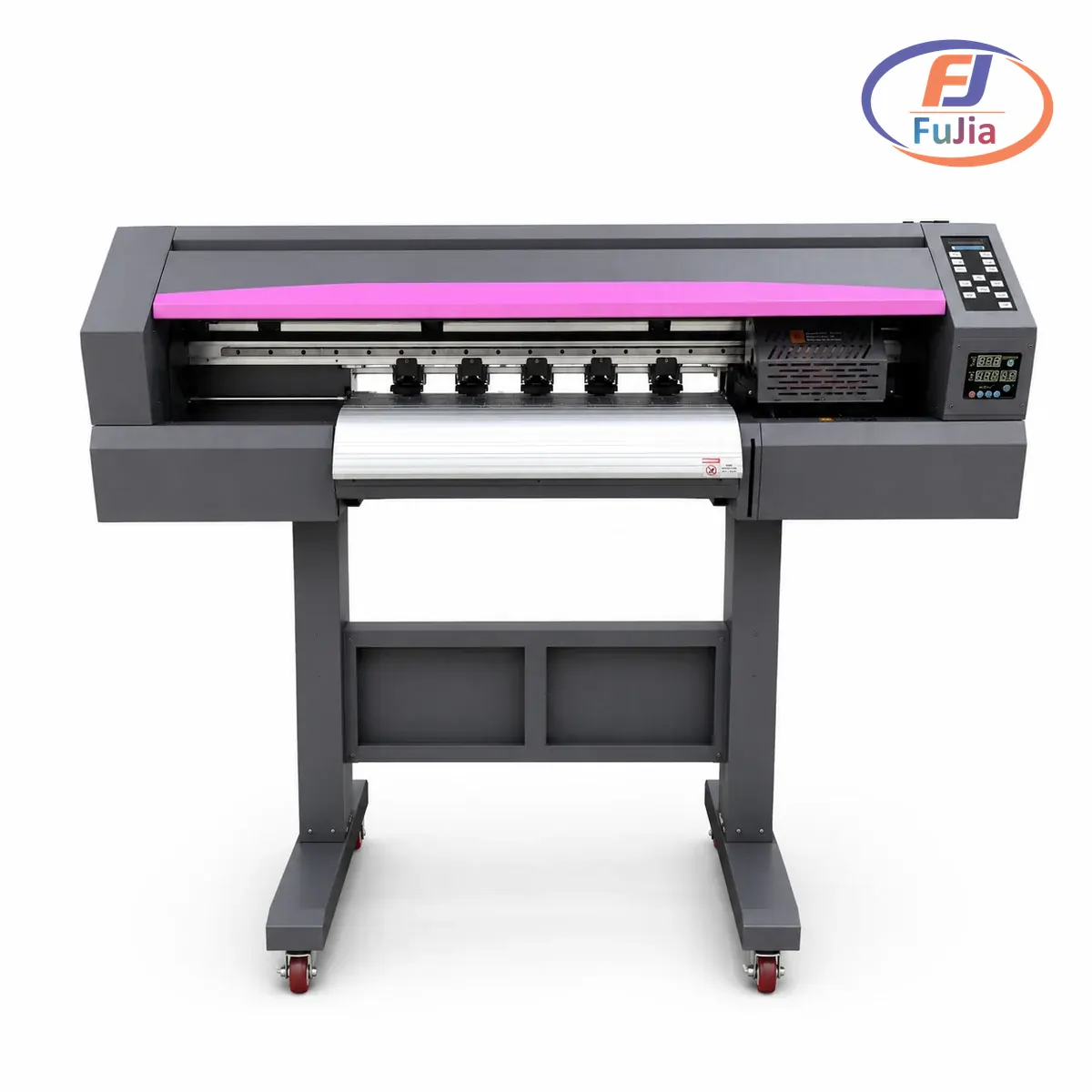
Fujia’s integrated shaker system features a 2880mm extended mesh belt with dual-zone heating that maintains precise 140°C curing temperature across the full 650mm width. The system achieves Grade 4+ wash fastness by ensuring uniform polymer melt, and includes integrated smoke purification that captures 99% of curing fumes through HEPA filtration. This configuration eliminates manual powder handling and produces 8-27 m²/hr of cured film depending on the connected printer configuration.
Fume Extraction: Why It Matters
Heating TPU adhesive powder releases chemical vapors, primarily caprolactam, along with fine particulate matter. These emissions require proper extraction for two reasons: operator health and equipment longevity.
Health and Safety
Caprolactam vapor can cause respiratory irritation with prolonged exposure. Professional curing ovens include integrated fume extraction systems with HEPA filters (capturing 99.97% of particles 0.3 microns and larger) and activated carbon filters (adsorbing VOC gases). Without extraction, oily residue from curing fumes accumulates on workshop surfaces, machinery, and electronics, creating persistent odors and potential equipment damage.
The AATCC TM135 standard for dimensional changes after laundering references the importance of controlled processing conditions in textile decoration, and the same principle applies to curing: environmental variables (temperature, airflow, ventilation) directly affect final product quality.
Regulatory Compliance
Commercial DTF operations in most jurisdictions require fume extraction to meet workplace air quality standards. Integrated shaker-oven systems with built-in smoke purification, such as Fujia’s production line, simplify compliance by handling extraction internally without requiring external filtration infrastructure.
How to Choose a DTF Curing Oven
| Factor | Drawer Oven | Conveyor Oven | Integrated Shaker-Oven |
|---|---|---|---|
| Price range | USD 200-800 | USD 800-3,000 | USD 2,000-6,000+ |
| Daily throughput | 15-30 sheets/hr | 50-200+ sheets/hr | 500-2,000+ transfers/day |
| Film handling | Manual sheet loading | Belt-fed continuous | Roll-to-roll automated |
| Footprint | Desktop (0.1-0.3 m²) | Floor-standing (1-2 m²) | Industrial (2-4 m²) |
| Powder application | Manual (separate) | Manual or semi-auto | Fully automated |
| Fume extraction | External or basic | Optional built-in | Integrated HEPA + carbon |
| Temperature precision | ±5-10°C | ±3-5°C | ±1-2°C |
| Best for | Starters, hobbyists | Growing shops | Production facilities |
Based on data from our customers across 50+ countries, the break-even point for upgrading from a drawer oven to an integrated shaker-oven system is approximately 200-300 transfers per day. Below that volume, a drawer oven with manual powder application is cost-effective. Above 300 daily transfers, the labor savings from automated powder application and the consistency gains from precise temperature control justify the higher equipment investment.
DTF Curing Common Mistakes
| Mistake | Cause | Solution |
|---|---|---|
| Grainy/sandy surface | Under-cured powder | Increase dwell time by 30-60 seconds (not temperature) |
| Yellowing film | Over-cured powder | Reduce temperature by 10-15°C |
| Oily residue on film | Excessive heat or time | Reduce time by 10-15 seconds, check ventilation |
| Film curling | Temperature too high | Lower setpoint, increase dwell time to compensate |
| Uneven curing | Hot spots in oven | Rotate film halfway, use IR thermometer to map chamber |
| Weak adhesion after press | Powder not fully melted | Extend cure time, verify oven temp with external thermometer |
| Stiff hand feel | Excess powder or over-cure | Use fine-grade powder (80-120 micron), reduce cure time |
Do you need a curing oven for DTF?
A dedicated curing oven is not strictly required for DTF printing, but it produces significantly more consistent results than alternative methods. You can cure DTF powder using a heat press in hover mode (holding the upper platen 2-3cm above the film at 110-120°C for 60-90 seconds), or with an infrared heat gun for spot fixes. These alternatives work for low-volume production and testing. For any commercial operation producing more than 20-30 transfers daily, a dedicated curing oven is strongly recommended because it provides uniform heat distribution, eliminates the risk of powder flattening that occurs with heat press contact, and enables batch processing of multiple sheets simultaneously. Integrated shaker-oven systems further automate the workflow by combining powder application and curing into one continuous pass.
How long to cure DTF in the oven?
DTF powder curing time ranges from 60 seconds to 4 minutes depending on oven type, temperature, and powder grade. Infrared conveyor dryers cure film in 2-3 minutes at 100-110°C. Drawer-style box ovens require 2-4 minutes at 120-150°C. Integrated shaker-oven systems cure in 60-120 seconds at 130-150°C with direct radiant IR energy. The reliable indicator is visual: when the white powder transitions to a smooth, glossy, translucent layer with a slight “orange peel” texture, curing is complete. If the surface still appears grainy after the recommended time, extend the dwell time by 30-60 seconds rather than increasing temperature. Always test the first few sheets when changing powder brand, film type, or equipment to establish the optimal time-temperature combination for your specific setup.
What is a DTF curing oven?
A DTF curing oven is a heated chamber designed specifically to melt thermoplastic polyurethane (TPU) adhesive powder onto PET transfer film in the direct-to-film printing workflow. The oven delivers controlled heat (110-160°C) with even distribution across the film surface, ensuring the powder melts uniformly into a glossy adhesive layer that bonds ink to fabric during subsequent heat pressing. DTF curing ovens come in three primary configurations: compact drawer ovens for sheet-based small-batch production, conveyor dryers for continuous inline processing, and integrated shaker-oven systems that combine automated powder application with curing in a single pass. Key features include precise temperature control (±2-5°C), fume extraction for caprolactam vapor removal, and airflow management to prevent hot spots that cause uneven curing.
Can you cure DTF in a convection oven?
Yes, you can cure DTF powder in a standard kitchen convection oven, but it is not recommended for commercial production. A convection oven set to 110-120°C (230-250°F) with the fan mode activated can melt TPU powder in 2-3 minutes, producing visually acceptable results for testing and prototyping. The limitations are significant: kitchen ovens fluctuate by 10-20°C, creating inconsistent curing across batches. TPU powder heating releases caprolactam vapors that contaminate cooking surfaces and pose health risks if the oven is later used for food preparation. Professional DTF curing ovens provide precise temperature control, integrated fume extraction with HEPA and carbon filtration, and airflow designed for film-based curing. For any operation beyond occasional hobby use, a dedicated DTF curing oven is the correct choice.
Conclusion
A DTF curing oven is the critical link between printed film and durable transfer, melting TPU adhesive powder at 110-160°C into the glossy layer that bonds ink to fabric through 50-100+ wash cycles. For DTF production systems with integrated shaker and curing capabilities, explore the Fujia DTF printer lineup or discover our apparel printing solutions.
Sources
- Zhu et al. (2025): TPU Nanocomposites for Transfer Printing: Research on TPU hot-melt adhesive bond strength, water resistance, and crosslinker effects on curing temperature window, published in International Journal of Adhesion and Adhesives, Vol. 139.
- AATCC TM135: Dimensional Changes of Fabrics After Home Laundering: Standard defining laundering test parameters relevant to evaluating DTF transfer durability and processing conditions.
- Grand View Research: Direct To Film Printing Market, 2025-2030: DTF market size USD 2.72B (2024) to USD 3.92B (2030) at 6.0% CAGR, with equipment innovations driving curing oven adoption.
