

The right cup printing machine depends on the cup material and your volume. A sublimation mug press is the cheapest way to print coated ceramic at home, while a UV DTF printer is the only method that prints full color onto stainless steel, plastic, and glass without any coating. This guide breaks down each method, the real machine cost, and how to pick.

Key Takeaways
- Cheapest entry: a sublimation mug press costs about $90 to $130 and prints coated ceramic only.
- Most versatile: a UV DTF printer prints on ceramic, stainless steel, plastic, and glass with no coating required.
- Best for bulk same-design runs: screen printing, at $1,500 to $2,000 for an automatic cup printer.
- Bottom line: choose by material first, then by monthly volume, then by color complexity.
- Next step: match the method to your cup type before you buy any hardware.
What a Cup Printing Machine Actually Does

A cup printing machine applies a design to a curved, often cylindrical surface. The four practical methods are sublimation heat transfer, UV DTF printing, UV flatbed printing with a rotation jig, and traditional screen printing. Each bonds ink to the cup differently, which decides which materials and run sizes it suits.
| Method | Best for | Cup materials | Color | Typical machine cost |
|---|---|---|---|---|
| Sublimation mug press | Home, gifts, small shop | Coated ceramic, polymer | Full color (light only) | $90 to $130 |
| UV DTF printer | Custom, any material | Ceramic, steel, plastic, glass | Full color + varnish | $1,500 to $4,000 |
| UV flatbed + rotation jig | Promotional, photo gifts | Flat + cylindrical | Full color + varnish | $3,000 to $8,000 |
| Screen printing | Bulk same design | Plastic, reusable cups | 1 to 4 spot colors | $1,500 to $2,000 |
Method 1: Sublimation Mug Press
A sublimation mug press is a heat press shaped for a mug. You print the design on sublimation paper with sublimation ink, wrap it around a polymer-coated ceramic mug, and press at about 180°C for 60 seconds. The ink turns to gas and bonds into the coating. It is the lowest-cost route and the standard for gift shops.
The trade-off is the coating. Sublimation only works on mugs that already carry a polyester or polymer sublimation coating, and the result is permanent but light-garment only. The dye-sublimation printing process turns the ink to gas so it bonds into that coating. Throughput is modest: one jig handles about 200 to 300 cups per 8-hour shift. Finished mugs survive 500 plus dishwasher cycles, which is commercial durability for gift use. Fujia builds the sublimation side of this workflow and the coated blanks used for it.
Method 2: UV DTF Printer
A UV DTF printer is the only cup printing machine that prints photo-real, full-color artwork onto uncoated stainless steel, plastic, and glass. It prints a design onto UV DTF AB film with a piezo inkjet printing head, then a 15-second hand transfer lays it onto the cup, where a water-cooled UV-LED lamp cures it instantly. No coating, no pretreatment, no drying rack.
Fujia’s UV DTF lineup runs CMYK plus White plus Varnish across six channels, so it handles clear and colored cups and adds a spot-gloss finish that commands higher pricing. The company has tested more than 300 substrates, and its A1 and A3 UV DTF models print 30 to 40 bottles per hour by hand. For shops that print detail and change artwork every order, UV DTF removes the per-design labor that screen printing demands. Real shops show the upside: one mug brand grew from 15 single-color SKUs to more than 60 full-color SKUs, shipping 5,000 plus mugs a month at a 70 percent margin, while a bottle labeler switched from paper labels to UV DTF crystal labels and cut minimum order from 500 to 12 per design, shortened delivery from three weeks to four days, and raised order value by 60 percent.
Method 3: UV Flatbed with Rotation Jig
A UV flatbed printer fitted with a rotation jig prints directly onto a cup laid horizontally, sweeping the printhead around the curve. Like UV DTF, it needs no coating and cures instantly under UV-LED light. It suits promotional shops that already own a flatbed and want to add drinkware without a second machine.
The limit is throughput. A flatbed rotation jig is slower per piece than a dedicated UV DTF transfer line, and very small diameters can be fiddly to fixture. For mixed flat-plus-cylindrical shops it is the efficient choice; for drinkware-only volume, a UV DTF printer is faster.
Method 4: Screen Printing
Screen printing is the legacy method for disposable and stadium cups, and for any run where the same design repeats thousands of times. An automatic cup screen printer places 1 to 4 spot colors and can output hundreds of pieces per hour. The Inkcups Revolution, for example, is rated near 600 parts per hour with 360-degree coverage.
The downside is setup. Each color needs a screen, so a multi-color photorealistic mug is slow and costly to prepare, and the minimum order is high. Screen printing wins only when the design is fixed and the quantity is large.
Cost Breakdown
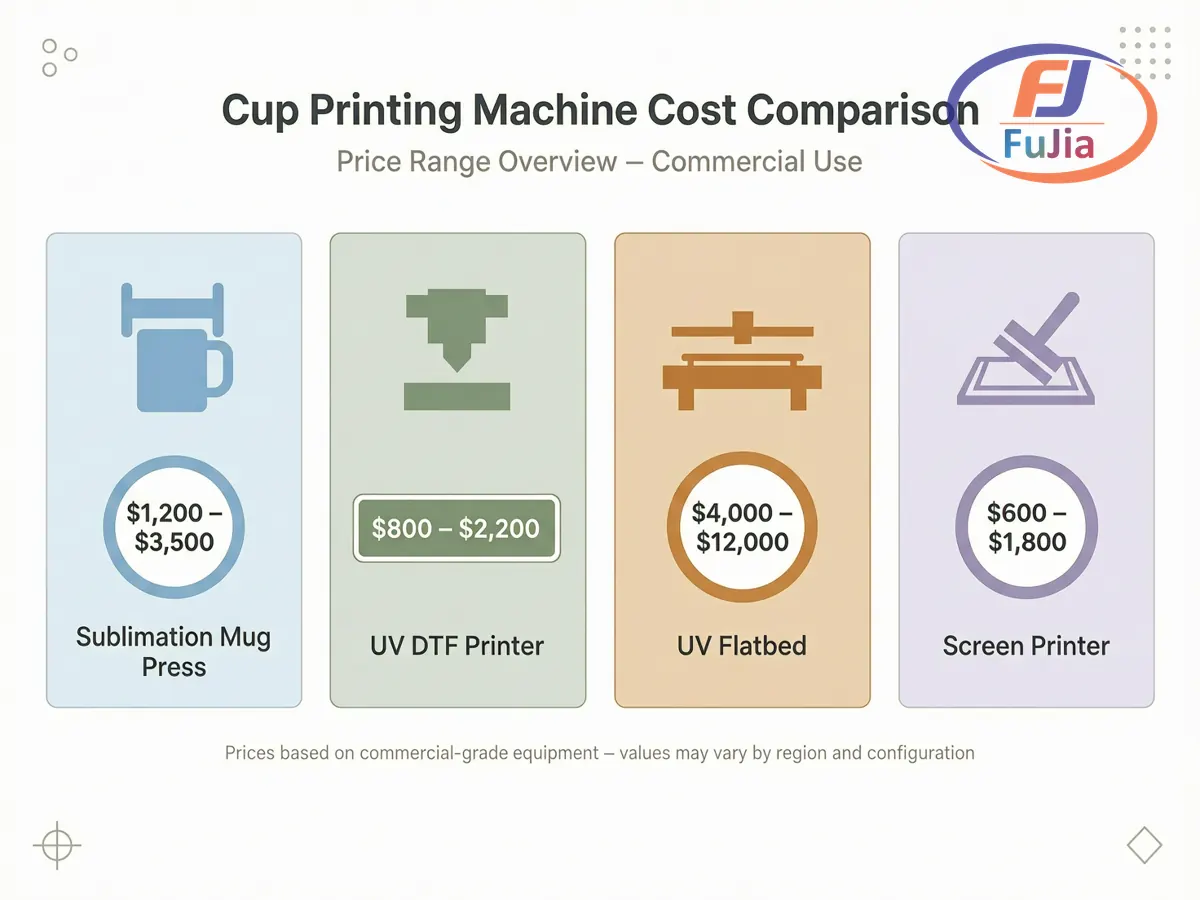
Machine price is only part of the story. The per-cup cost, throughput, and whether you need coatings decide the real economics.
| Item | Sublimation press | UV DTF printer | Screen printer |
|---|---|---|---|
| Machine | $90 to $130 | $1,500 to $4,000 | $1,500 to $2,000 |
| Consumables per cup | $0.30 to $0.80 | $0.10 to $0.40 | $0.05 to $0.20 |
| Throughput | 200 to 300 cups/shift | 30 to 40 bottles/hr | 300 to 600/hr |
| Coating needed | Yes | No | No |
| Best volume | Low, varied | Low to mid, varied | High, fixed design |
Across the 500 plus print businesses Fujia serves, shops that move past a few hundred pieces a month often find a UV DTF or UV flatbed unit cheaper per unique cup than outsourced screen printing, because there is no per-design screen cost.
How to Choose
| If you print… | Pick |
|---|---|
| Coated ceramic, gifts, low volume | Sublimation mug press |
| Steel, plastic, glass, or varied art | UV DTF printer |
| Flat plus cylindrical, promo shop | UV flatbed + rotation jig |
| One design, thousands of cups | Screen printer |
Pick a sublimation press for cheap coated-ceramic gifts, a UV DTF printer for any material and changing artwork, and screen printing only for fixed high-volume runs. For factory-direct UV DTF from a Guangzhou manufacturer operating a 3,500 m² factory since 2011 and serving 500 plus print businesses across 50 plus countries, see Fujia Print UV DTF printers or read the UV DTF vs UV flatbed comparison before you buy. Fujia backs every printer with a 12-month warranty, 48 hour parts dispatch, and a 3 day remote onboarding plan inside a lifetime WhatsApp engineering group.
What printer do I need to print on cups?
The printer depends on the cup material. For coated ceramic mugs, a sublimation mug press is enough and costs about $90 to $130. For stainless steel, plastic, or glass, where there is no sublimation coating, you need a UV DTF printer or a UV flatbed with a rotation jig, because those methods cure ink onto the surface with no coating. A UV DTF printer is the most flexible single machine: it prints full color plus white plus varnish onto ceramic, steel, plastic, and glass, and a 15-second hand transfer applies the print. If your run is one fixed design in the thousands, a screen printer is cheaper per piece. Fujia’s UV DTF models are built for this mix and ship from a 3,500 m² Guangzhou factory with a 12-month warranty.
How much is a mug printing machine?
A basic sublimation mug press runs $90 to $130, which covers the press and works with coated mugs you buy separately. A UV DTF printer for cups starts around $1,500 for an A3 desktop unit and reaches $4,000 for an A1 production model, with AB film and UV ink as ongoing consumables. A UV flatbed with a rotation jig lands near $3,000 to $8,000 because you are buying a flatbed first. An automatic screen printer for cups is about $1,500 to $2,000, as seen with commercial units such as the WM-SM350R near $1,980. Across the 500 plus print businesses Fujia serves, most small shops enter with a sublimation press and add a UV DTF printer once monthly volume passes a few hundred pieces.
What is the best way to print on cups?
The best way is the one that matches your material and volume. For coated ceramic gift mugs, sublimation at 180°C for 60 seconds gives permanent, dishwasher-safe results at the lowest cost. For any uncoated material, or for photorealistic art that changes often, UV DTF is best: it prints onto the cup in seconds with no coating and adds a varnish finish. For high-volume identical designs, screen printing is fastest at 300 to 600 cups per hour. A Fujia customer running UV DTF crystal labels on bottles cut minimum order from 500 to 12 per design and raised order value by 60 percent, which shows why UV DTF wins for varied custom work rather than fixed bulk.
Can you print on stainless steel or plastic cups, or only ceramic?
You can print on stainless steel and plastic cups, but not with sublimation, which needs a polymer coating found only on specific ceramic and polymer blanks. A UV DTF printer or UV flatbed prints directly onto bare stainless steel, plastic, and glass with no coating, using a UV-LED lamp to cure the ink on contact. Fujia’s UV DTF ink set includes white, so it prints cleanly on dark or clear cups, and the varnish channel adds scratch resistance rated 3H plus on the pencil scale, a result checked against the abrasion and hardness test methods published by measurement bodies such as NIST. Dishwasher life is shorter than sublimation, about 100 plus cycles for UV DTF versus 500 plus for sublimation, but it covers materials sublimation cannot touch, which is why UV DTF is the standard cup printing machine for steel and plastic drinkware.
