

A UV DTF transfer machine is the complete print-to-sticker station: a UV printer that lays LED-cured ink onto A film, paired with a laminator that rolls on the B adhesive layer, turning designs into peel-and-press decals for $1,500-6,000 depending on width and integration. The category exists because the sticker business runs on the pair rather than the printer alone, and buyers who price only the printer meet the lamination half of the workflow at the worst time. This guide prices the station configurations, walks the workflow, and draws the line where owning a station beats buying wraps by the design.
Key Takeaways
- Complete stations run $1,500-2,950 at desk A4-A3 width with separate laminators, and $2,550-6,000 for 2-in-1 or wide-format builds.
- The workflow is fixed: print mirrored at 1200 dpi, laminate B layer bubble-free, contour cut, weed, press onto smooth hard surfaces.
- Consumables price a finished sticker at $0.15-0.45 against $2-10 retail, and stations repay inside 6-10 weeks at craft velocity.
- White plus varnish channels are the non-negotiable spec, because opacity on glass and dark objects is the product.
- We recommend the station once sticker orders run steady weekly, and wrap services for testing the demand first.
The Station Configurations and Their Prices
| Configuration | Components | Price band | Stickers/hour |
|---|---|---|---|
| desk A4 + hand roller | printer only, manual laminate | $1,300-1,800 | 10-20 |
| desk A3 + roll laminator | printer + $200-400 unit | $1,800-2,950 | 25-50 |
| 2-in-1 integrated | print and laminate in one body | $1,600-2,550 | 20-40 |
| wide-format station | 60 cm printer + laminator | $4,000-6,000 | 60-100 |
The configuration table is the buying menu, and the rows differ by where the lamination lives. Hand rollers serve craft volumes at the lowest entry, roll laminators add $200-400 for bubble-free speed, 2-in-1 bodies integrate the roller into the printer for desk-space efficiency, and wide-format stations serve production sticker houses. White plus varnish channels appear across every serious row, because UV DTF’s product is opacity plus depth on glass, metal, and dark objects, and a station without those channels prints a different, lesser product, per the channel requirements our UV printers guides set for the whole category.
The 2-in-1 configuration deserves special attention because it changes the failure profile as well as the footprint. Integrated lamination removes the alignment step where hand-fed laminators trap bubbles, and it removes the second device from the desk, but it couples both functions to one machine’s uptime, so a station that lives on stickers should weigh redundancy before integration. We recommend the separate-laminator route for businesses where sticker output is revenue-critical, and the 2-in-1 for desks where space is the binding constraint, and the same redundancy arithmetic our printer guides apply to fleets applies to pairs. Integration saves a device and costs a fallback, and which one a desk needs is the whole choice. Redundancy is a purchase, and the desk decides whether to buy it.
The Workflow: Print, Laminate, Cut, Apply
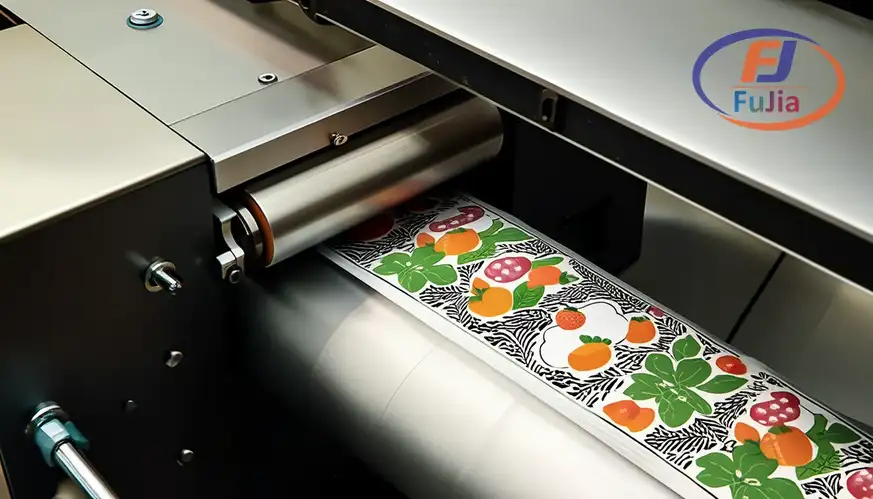
The workflow is four steps that never change order, and each step owns one failure mode. Printing runs the design mirrored onto A film at about 1200 dpi, LED curing each pass so the ink stack sits as a raised layer rather than soaking anywhere. Lamination rolls the B adhesive film over the fresh print, and trapped bubbles at this station are permanent, which is why steady roller pressure is the skill the station rewards. Cutting follows plotter or scissors conventions, weeding removes the excess film, and application presses the decal onto a cleaned hard surface with fingertip force, no heat anywhere in the chain, per the process standards our UV DTF process guide documents in full. Four steps, four disciplines, one sellable sticker.
Surface preparation is the application step’s entire quality contribution, because the B layer grips by surface contact rather than by penetration. A 70% isopropyl wipe on glass, metal, plastic, or finished ceramic takes two seconds and prevents most adhesion complaints before they exist, while dust or texture fails the contact rule no matter how well the film printed. We recommend shipping application cards with every sticker order, because the customer’s surface is the one variable the station cannot control, and the card converts complaint tickets into clean results. The wipe is two seconds of insurance on every decal that leaves the desk.
Storage is the workflow’s quiet economic advantage. Finished stickers wait on their backing for 6-12 months and apply on demand, which lets a station print best-sellers in batch ahead of seasonal peaks and fulfill custom orders same-day from the same desk. That warehousing property separates UV DTF from every direct-print method, and it is why small stations serve big seasonal curves without bigger hardware, per the storage economics our labeling guides document for decal programs. Print the season in September, and December becomes shipping rather than production. The backing paper is inventory, and the desk is a warehouse, which is a sentence no direct-print category can say.
The Economics: Station Versus Wrap Service
| Line | Own station | Buy wraps per design |
|---|---|---|
| hardware | $1,500-6,000 | $0 |
| consumables per sticker | $0.15-0.45 | $0.50-2.00 |
| design change cost | a file | an order |
| break-even | 6-10 weeks at 20-30 weekly | immediate |
The economics table frames the real decision, and the wrap service is the station’s honest competitor at the test phase: wraps deliver the same physical sticker with no hardware, at a per-design premium that only volume justifies escaping. A desk testing 10 designs buys wraps, learns which designs sell, and escapes the premium at exactly the moment weekly orders make it pinch, typically 20-30 stickers steady. The station then repays inside 6-10 weeks, and design freedom becomes a file rather than an order, which is the creative argument that outlives the spreadsheet, per the crossover logic our tumbler and mini-printer guides apply to the same decision in adjacent categories.
Consumables discipline keeps the station’s arithmetic honest after purchase. Film and ink run $0.15-0.45 per sticker, and the varnish pass adds its fraction to both cost and retail, so the RIP’s ink limits are a margin control as much as a quality control. Sticker retail spans $2-10 depending on market, craft fairs at the bottom, corporate branding at the top, and the station’s hourly capacity prices out comfortably against either. When it comes to the sticker business, the machine is the cheapest part once it runs. The design pipeline is the asset that compounds.
A seller case we supply anchors the crossover: a candle brand testing custom label stickers through a wrap service for one season, then buying a desk A3 station with a roll laminator when reorder volume passed 25 stickers weekly, recovering the hardware inside two months and cutting per-unit cost by two thirds. The two-phase path is the category’s standard success story, and the same test-then-own pattern our guides document across wrap categories is the recommendation this page exists to make.

How much does a UV DTF machine cost?
A UV DTF transfer station costs $1,500-2,950 at desk width with a separate roll laminator, $1,600-2,550 for 2-in-1 integrated bodies, and $4,000-6,000 for wide-format 60 cm production stations, with white plus varnish channels as the spec that separates real machines from toys. Consumables add $0.15-0.45 per finished sticker, and complete stations repay inside 6-10 weeks at 20-30 stickers weekly. The full cost ladder including the printer-only tiers sits in our flatbed pricing guide, and the station price is the honest one, because lamination is not optional in this workflow.
Is it worth buying a UV DTF printer?
A UV DTF printer is worth buying when sticker orders run steady at 20-30 weekly and the design catalog has proven itself through a wrap-service test, because below that volume wraps deliver the same product without hardware and above it the station’s consumables win decisively. The station at $1,500-6,000 repays inside 6-10 weeks at craft velocity, and design changes become files rather than orders, which compounds for seasonal catalogs. Worth-it fails for untested designs and single-digit weekly volumes, and the wrap-first test is the cheapest honest answer to the question.
What kind of printer do I need for UV DTF?
UV DTF needs a UV printer with LED curing, white ink capability, and A-film handling, which desk-class machines at $1,300-2,550 provide alongside the $200-400 laminator that completes the transfer station. The printer outputs the design mirrored in CMYK, white, and varnish at about 1200 dpi, and standard garment DTF printers cannot substitute because the ink chemistry, curing, and film systems differ entirely despite the shared acronym. Buyers should verify the white channel’s circulation engineering before price, per the same white-ink priority our ink guide documents. The pairing, not the printer alone, is the machine.
Can you do UV DTF with a DTF printer?
No, a standard DTF printer cannot produce UV DTF transfers, because the two technologies share only an acronym: garment DTF prints textile ink cured by melting powder adhesive under heat, while UV DTF prints UV-curable ink on AB film pairs with no heat at all. The ink systems, curing hardware, and film handling differ from the ground up, and converting one to the other is not a modification anyone performs. Shops serving both fabric and hard-goods markets run both machines side by side, and the desk UV station joins a garment DTF setup for roughly the price of its film consumables for a year. The name overlap confuses buyers, and the technology boundary is absolute. When the name says DTF, check which chemistry the machine actually runs.
Verdict
The UV DTF transfer machine is a pair rather than a printer, priced $1,500-6,000 across desk, 2-in-1, and wide-format stations, running a fixed four-step workflow whose quality lives in bubble-free lamination and wiped surfaces, and earning its hardware through consumables at $0.15-0.45 against $2-10 retail. Test demand with wraps, buy the station when weekly orders steady, verify white and varnish channels before price, and ship application cards with every order. The station converts designs into a product line, and the design pipeline is the asset that compounds. For a station-matched sample run of your own designs, contact Fujia Print with your artwork.
Sources
- Wikipedia: UV curing: LED ink chemistry.
- Wikipedia: Pressure-sensitive adhesive: B layer chemistry.
- AATCC: durability testing standards.
- Fujia Print labeling cases: sticker program examples.
