

A sublimation mug press wraps a ceramic mug in even heat at 180 °C for roughly 60 seconds per side, and the 2026 market sells that capability in four forms, clamp presses from $65.99, vacuum tumbler presses, sublimation ovens, and commercial convection units reaching $750, each with a distinct output ceiling and mug compatibility. This guide compares the four types, gives the press recipes by mug type, and prices the market with real listings, so the purchase matches the mugs you actually sell. The mug press is the simplest production machine in personalization, and it still punishes uneven heat like everything else.
\n\n\n\n
Key Takeaways
\n\n\n\n- \n\n\n
- Four press types: clamp mug presses ($65.99-168.29) for standard 11 oz mugs, vacuum tumbler presses ($93.99-168) for skinny and tapered vessels, sublimation ovens ($200-350) for batch full-wrap work, and commercial convection presses ($400-750) for production volume. \n\n\n
- The core recipe: 180 °C (356 °F) for 60 seconds per side on standard ceramic, or 120-150 seconds full-wrap in an oven at the same temperature, per the mug printing parameters proven across our drinkware workflows. \n\n\n
- Real 2026 output: a single clamp press runs 200-300 mugs per 8-hour shift at 60 seconds per side, matching the productivity our mug brand case documented at 5,000-plus mugs monthly. \n\n\n
- Mug choice matters as much as press choice: Dollar Tree mugs sublimate inconsistently because coating quality varies, and coated blanks from supply houses press predictably every cycle. \n\n\n
- The tumbler crossover is real: vacuum presses handling 11-30 oz vessels open skinny tumblers and water bottles, the fastest-growing sublimation drinkware segment. \n\n\n
The Four Press Types Compared
\n\n\n\n| Type | \n2026 price | \nMug compatibility | \nOutput ceiling | \nBest for | \n
|---|---|---|---|---|
| Clamp press | \n$65.99-168.29 | \nstandard 11 oz cylinders | \n200-300/shift | \nstarter, single-mug shops | \n
| Vacuum tumbler press | \n$93.99-168 | \n11-30 oz, skinny, tapered | \n150-250/shift | \ntumbler-heavy catalogs | \n
| Sublimation oven | \n$200-350 | \nfull-wrap, odd shapes | \nbatches of 6-12 | \nfull-wrap specialty | \n
| Commercial convection | \n$400-750 | \nstandard + tumblers | \n300+/shift | \nproduction volume | \n
Clamp presses are the industry’s workhorse: two heated elements close around a standard cylinder mug and press one side at a time, two 60-second cycles covering a full 11 oz wrap. Vacuum presses use silicone sleeves and negative pressure to hold heat against the vessel, which is what lets them handle skinny tumblers and tapered shapes that clamp jaws cannot grip evenly. Ovens trade speed for geometry: mugs rotate in heated drums for 120-150 second full-wrap cycles, six to twelve at a batch, and they are the only practical answer for full 360-degree wraps and odd-shaped blanks. Commercial convection units combine even airflow with higher throughput for shops where the mug line is a production department.
\n\n\n\nHeat evenness is the spec that separates the tiers, because sublimation dye deposits exactly where temperature reaches it. A cheap clamp with hot spots produces faded patches at the element gaps; a convection press wraps the mug in moving heated air and prints edge-to-edge density. The $65.99-168 entry tier is honest about this trade, and the fix at entry level is rotating the mug 180 degrees between the two side presses so each element covers the other’s weak zone. That rotation trick, plus consistent coating quality in the blanks, closes most of the gap between entry clamps and commercial units at craft volume.
\n\n\n\nPress Settings by Mug Type
\n\n\n\n| Mug type | \nTemperature | \nTime | \nNotes | \n
|---|---|---|---|
| Standard 11 oz ceramic | \n180 °C (356 °F) | \n60 s per side | \nthe baseline recipe | \n
| Full-wrap ceramic (oven) | \n180 °C | \n120-150 s | \nrotate-free single cycle | \n
| Inner-color mugs | \n180 °C | \n60-70 s | \nslightly longer for rim | \n
| Skinny 20 oz tumblers | \n180 °C | \n50-60 s vacuum | \nstraight walls only | \n
| Enamel camp mugs | \n180 °C | \n70-80 s | \nwatch rim heat | \n
The baseline recipe holds across 90% of mug work, and the variations are small and directional. Inner-color mugs carry a colored glaze inside that heats differently at the rim, so 60-70 seconds covers the transition zone. Enamel mugs have rolled rims that shadow heat, adding ten seconds and rewarding a tape-secured paper tightness check. Tumblers in vacuum presses run slightly shorter because the silicone sleeve transfers heat more efficiently than open clamps. We recommend pressing a test mug per new blank batch before production, because coating lots vary more than press recipes do, and a corner transfer on one sacrificial mug costs less than a case of faded returns.
\n\n\n\nPer AATCC-style wash testing on properly pressed drinkware, sublimated mug prints survive 500-plus dishwasher cycles because the dye lives inside the coating rather than on it, the durability argument that sells sublimated mugs against printed decals at every price point. The same chemistry that makes the print permanent makes process discipline non-negotiable: under-press by ten seconds and the fade shows up in the customer’s first dishwasher month.
\n\n\n\nReal Output Math and Which Press Fits
\n\n\n\nThe output arithmetic decides the tier, and it is documented on our mug and drinkware applications page in detail. A single clamp press at 60 seconds per side, plus 30-45 seconds of handling per mug, sustains 200-300 finished mugs across an 8-hour shift with one operator, which is exactly the productivity a mug brand we supply documented: the brand scaled from 15 single-color SKUs to 60-plus full-color SKUs on sublimation, shipping 5,000-plus mugs monthly at a 70% margin, and the press bench grew from one clamp unit to a convection-plus-oven line as orders justified it. That progression is the buying path: entry clamp to prove demand, vacuum press when tumblers enter the catalog, convection when the daily count clears what one press cycles.
\n\n\n\nThe mug-and-drinkware market rewards that discipline with real money: 180 °C for 60 seconds per cup, at the volumes the case documents, is a $15-25 personalized product carrying $1-2 of blank and consumables, and the UV DTF alternative for bottle decoration runs a different lane entirely at 15-second hand transfers. When it comes to press selection, it is a catalog decision disguised as a hardware decision. The vessels you plan to sell next quarter matter more than the press on sale this week. Shops serving both mugs and bottles run both processes. The honest overlap is small: ceramic drinkware belongs to sublimation presses. Curved metal bottles with premium crystal graphics belong to UV DTF, a split our mug and drinkware applications page documents from production data.
\n\n\n\n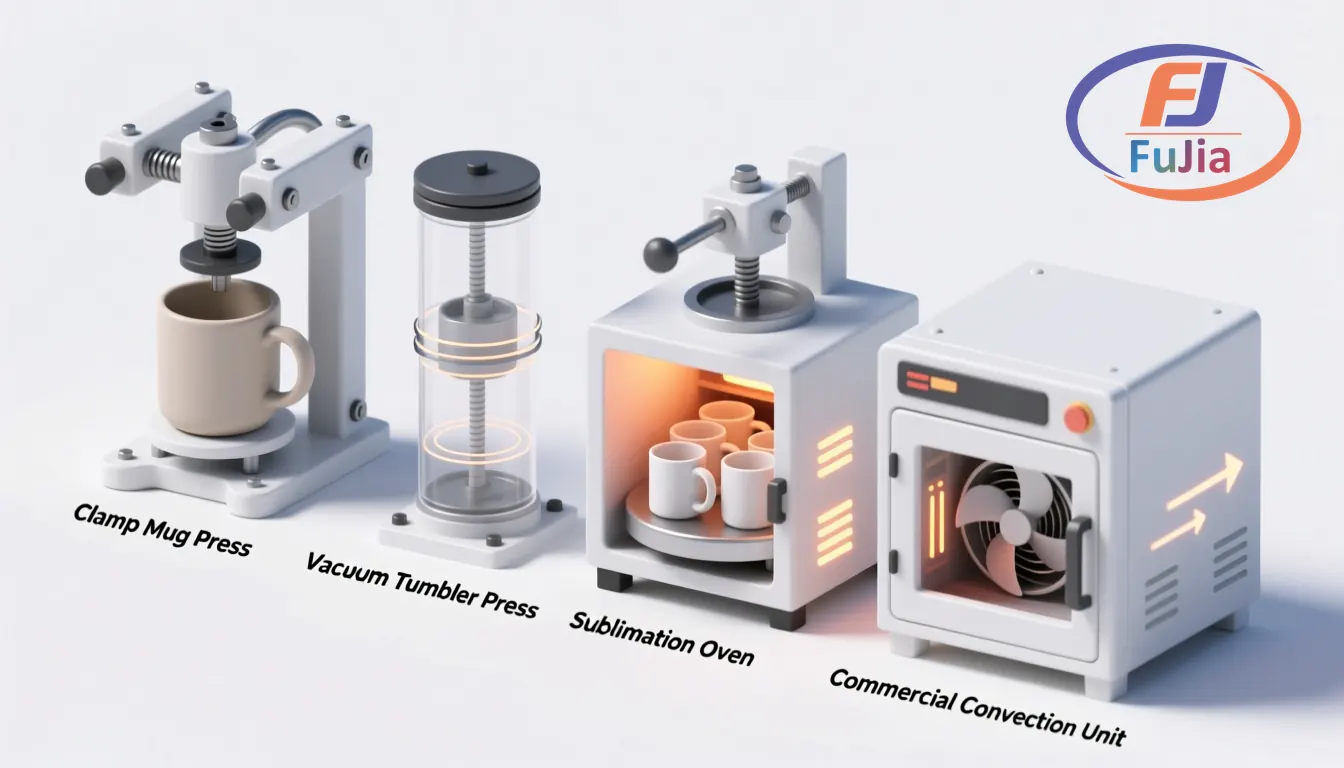
Which mug press is the best for sublimation?
\u003cp\u003eThe best sublimation mug press depends on your catalog: standard 11 oz ceramic mugs press perfectly on a $65.99-168 clamp unit, skinny tumblers and tapered vessels need a vacuum press at $93.99-168, full-wrap and odd shapes need an oven at $200-350, and production volume above 300 mugs daily justifies a commercial convection unit at $400-750. Heat evenness separates the tiers. The entry-tier fix is rotating the mug between side presses so each element covers the other’s weak zone, and it closes most of the evenness gap at craft volume. Match the press to the vessels you sell, not to the feature list.\u003c/p\u003e
Do dollar tree mugs work for sublimation?
\u003cp\u003eInconsistently, and that is the honest answer: Dollar Tree mugs are not sold as sublimation blanks, so their coating quality varies from batch to batch and store to stock, producing vivid transfers on some mugs and faded ghosting on others at identical press settings. They work for practice and test prints at craft volume. Any shop selling sublimated mugs should buy coated blanks from supply houses, where per-mug cost runs $1-2 and coating consistency makes every press cycle predictable, because the case of returns one bad batch costs exceeds a year of blank-price savings.\u003c/p\u003e
Can I sublimate a mug without a mug press?
\u003cp\u003ePartially: a standard kitchen oven at 180 °C with the mug wrapped tightly in sublimation paper and secured with heat tape can produce full-wrap transfers in 120-150 minute bake cycles at craft quality, and convection ovens improve evenness. The time math is the real cost, because an oven bakes in over two hours what a $65.99 press finishes in two minutes. A heat press with a mug-wrap attachment works for flat clam units at lower consistency. For anything beyond occasional gifts, a dedicated mug press at $65.99 pays for itself in consistency and time within the first batch, because oven workarounds trade hours for dollars.\u003c/p\u003e
How long to sublimate a mug in a mug press?
\u003cp\u003ePress a standard 11 oz ceramic mug at 180 °C (356 °F) for 60 seconds per side in a clamp press, two cycles covering the full wrap, or 120-150 seconds in one oven cycle for a full-wrap bake. Inner-color mugs want 60-70 seconds to cover the rim transition, and enamel mugs run 70-80 seconds for the rolled rim. Peel the paper hot, let the mug cool, and wash-test one piece per new blank batch before running production. The recipe card taped to the press outperforms the recipe in anyone’s head.\u003c/p\u003e
Verdict
\n\n\n\nA sublimation mug press is the friendliest production machine in personalization: $65.99-168 buys craft-to-business capability, 180 °C for 60 seconds per side is a recipe that survives any operator, and output scales from 200 mugs daily on a clamp to production lines on convection units as orders justify. Buy coated blanks, test each new lot once, and match the press type to the vessels your catalog actually sells. To see production mug sublimation running at 5,000-plus mugs monthly economics, contact Fujia Print for a workflow review.
\n\n\n\nSources
\n\n\n\n- \n\n\n
- Heat Press Nation mug presses: commercial mug press reference. \n\n\n
- Cricut Mug Press: consumer press baseline reference. \n\n\n
- Wikipedia: Dye-sublimation printing: transfer chemistry. \n\n\n
- AATCC: wash durability testing standards. \n\n\n
