

An industrial labeling machine applies or prints labels at production scale, covering everything from $86 handheld tools to $85,000 digital label presses. Fujia Print builds UV DTF and UV flatbed systems that print full-color labels directly onto products, one of three main approaches manufacturers choose from.
Key Takeaways
- Industrial labeling machines split into applicators (apply pre-printed labels) and direct-print systems (print onto products)
- Applicators run $1,500-$50,000 for 100-1,000+ labels/min; thermal printers cost $999-$3,999 for on-demand safety labels
- UV DTF crystal label systems cost $0.02-0.05 per label with zero setup fee, handling 1,000-5,000+ labels per day
- Break-even for in-house UV printing vs outsourced screen printing sits below 3,000 identical pieces
- Choose based on substrate shape, daily volume, and whether labels need variable data or full-color artwork
What Is an Industrial Labeling Machine?
An industrial labeling machine is equipment designed to apply or produce labels at manufacturing scale. The term covers two distinct equipment families that solve different problems.
Label applicators take pre-printed labels from rolls and apply them to products. HERMA, a German manufacturer founded in 1906, builds the 500 series applicator used across 14+ fully automatic models (132M, 362E, 752C). CTM Labeling Systems and Technopack Corp offer similar wrap-around and flat-surface machines. These systems apply labels at 100-1,000+ per minute and dominate food packaging, pharmaceuticals, and logistics.
Direct-print label systems eliminate pre-printed labels entirely. Thermal printers like LabelTac ($999-$3,999) melt resin ribbon onto label stock for OSHA-compliant pipe marking and arc flash warnings. UV DTF and UV flatbed printers from Fujia Print’s UV DTF lineup print CMYK + White + Varnish ink directly onto products or transfer film, then apply labels to any surface in 10-15 seconds.
The distinction matters. If you need identical barcodes on 10,000 boxes per hour, an applicator is the right machine. If you need full-color brand labels on 800 different product variants per day, direct digital printing eliminates the setup costs that make applicators impractical.
Types of Industrial Labeling Machines
Label Applicators (Pre-Printed Label Application)
Label applicators are the most common result when buyers search for “industrial labeling machine.” PMMI, the Association for Packaging and Processing Technologies, categorizes these into semi-automatic (hand-fed, 20-40/min), fully automatic (inline, 100-150/min), and high-speed automatic (inline, 500-1,000+/min).
| Applicator Type | Speed | Best For | Price Range |
|---|---|---|---|
| Semi-automatic (hand-fed) | 20-40/min | Small batches, mixed products | $1,500-$4,000 |
| Fully automatic (inline) | 100-150/min | Bottles, boxes, consistent products | $5,000-$15,000+ |
| High-speed automatic | 500-1,000+/min | Food, pharma, high-volume packaging | $15,000-$50,000+ |
Thermal Label Printers
Thermal label printers create labels on-demand using heat-transfer ribbon. LabelTac dominates this segment with three desktop models:
| Model | Width | Speed | Volume | Price |
|---|---|---|---|---|
| LabelTac 4 | 0.5-4 in | 4 in/sec | 500 labels/day | $999 |
| LabelTac Pro X | 0.5-4 in | 6 in/sec | 2,500 labels/day | $1,299 |
| LabelTac 9 (Large Format) | 4-9 in | 4 in/sec | 2,500 labels/day | $3,999 |
The LabelTac 4 weighs 4.85 lbs (2.2 kg) with 300 dpi resolution. The Pro X adds expanded ribbon capacity (984 ft/roll vs 298 ft) and 128MB RAM for 2.5x daily volume. These printers target safety compliance, pipe marking, GHS chemical labeling, rack labeling, and barcoding. All include lifetime warranty.
UV DTF and UV Flatbed (Direct Digital Printing)
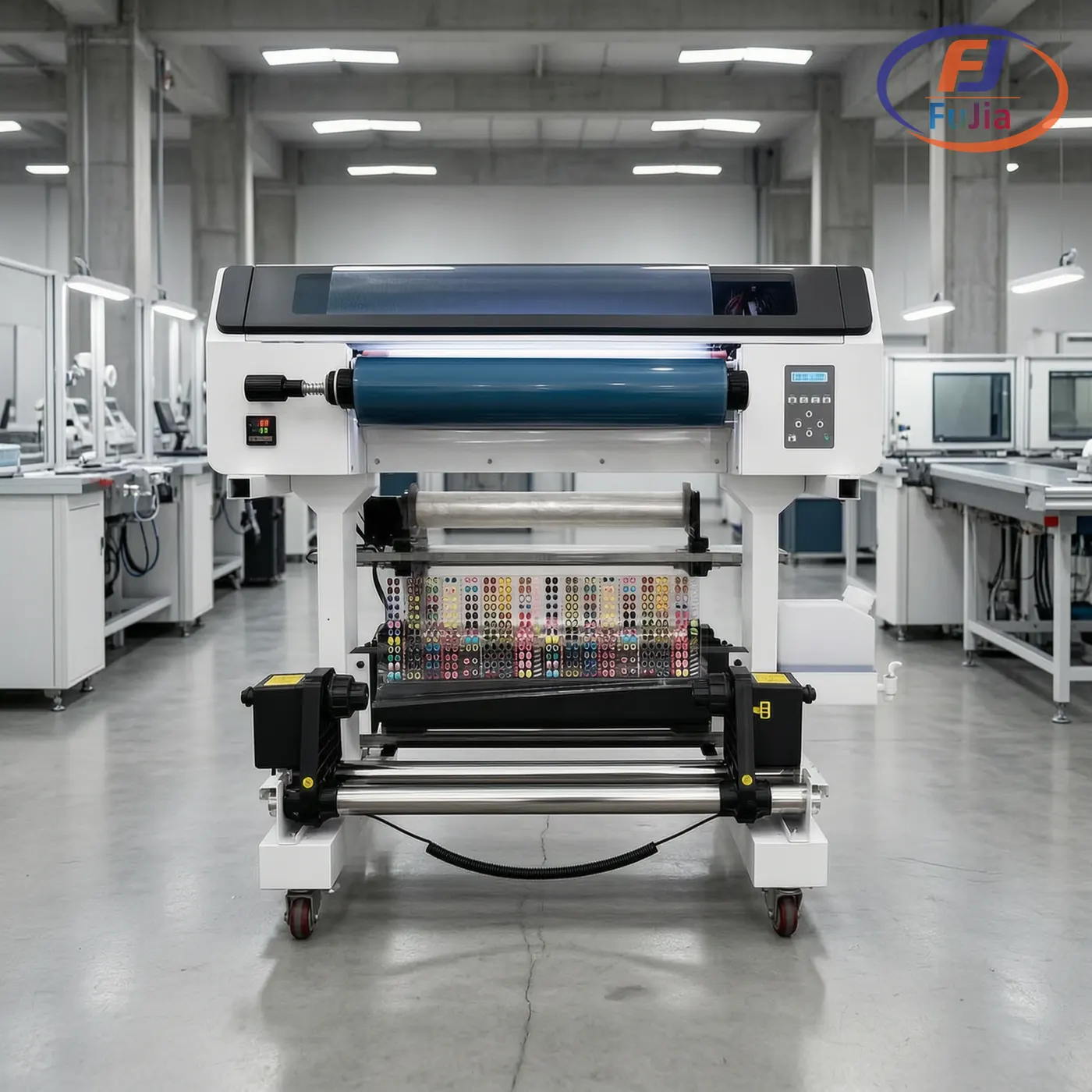
UV DTF crystal label systems represent the newest category. Fujia Print’s UV flatbed printers and UV DTF systems print full-color labels with a 6-color CMYK + White + Varnish ink set, cured instantly by water-cooled UV-LED lamps. No drying racks, no waiting.
The A1 UV DTF 3/4-Head model produces crystal labels at 65cm width using 3-4 print heads for high-volume output. The A1 6090 UV flatbed offers a 600x900mm print bed with 3-4 Ricoh GEN5 or Epson I3200 heads, printing at 4-8 m²/hr with up to 720×1800 dpi resolution. The 180mm print height accommodates products as large as a small appliance panel.
For product labeling applications, UV systems offer advantages no applicator can match: unlimited color, zero setup cost per design change, and the ability to print directly onto curved, textured, or irregular surfaces.
Cost Comparison: Which System Makes Sense?
| System Type | Equipment Cost | Per-Label Cost | Setup Cost | MOQ |
|---|---|---|---|---|
| Semi-auto applicator | $1,500-$4,000 | $0.01-0.03 (label stock) | Minimal | 500+ (roll) |
| LabelTac thermal | $999-$3,999 | $0.05-0.15 (ribbon+supply) | None | 1 |
| UV DTF crystal label | $3,000-$15,000 | $0.02-0.05 (ink+film) | $0 (digital) | 1 |
| UV flatbed direct | $5,000-$25,000 | $0.05-0.15 (ink) | $0 (digital) | 1 |
| Outsourced screen print | $0 | $0.10-0.50 | $150-400/screen | 500+ |
Traditional screen printing requires $150-400 per screen setup and 500+ piece minimums. UV DTF loads a new design in 30 seconds and prints MOQ 1. A small appliance brand using a Fujia UV A1 flatbed went from 200 to 800 pieces per day, a 4x increase, with 30-second design loading compared to $150-400 per screen.
For break-even analysis: below 3,000 identical pieces, in-house UV printing costs less than outsourced screen printing. Above 3,000 identical pieces, screen printing’s per-unit cost advantage overcomes the setup overhead.
How to Choose: Decision Framework
Step 1: Identify Your Substrate
Flat surfaces (boxes, pallets) work with any system. Curved surfaces (bottles, mugs) need either a specialized wrap-around applicator or UV DTF crystal labels that conform to any shape. Rigid 3D objects (phone cases, appliance panels) need UV flatbed direct printing with auto height detection up to 180mm.
Step 2: Calculate Daily Volume
Under 100 pieces/day: handheld labeler ($86-$200) or entry thermal printer ($999). 100-500 pieces/day: semi-automatic applicator or UV DTF desktop system. 500-2,500 pieces/day: automatic applicator or A1 UV DTF production system. 2,500+ pieces/day: high-speed inline applicator or multi-head UV DTF with automated transfer at 5,000+ labels/hour.
Step 3: Determine Variable Data Needs
If every label is identical (regulated food packaging per FDA labeling requirements), an applicator is most efficient. If labels vary by batch, product, or customer (promotional products, custom branding), digital printing eliminates setup costs between runs. UV DTF handles unlimited color and design changes with zero physical setup.
Applications by Industry
| Industry | Best System | Why |
|---|---|---|
| Food and beverage | Automatic applicator (500+/min) | Regulatory compliance, identical labels at high speed |
| Pharmaceuticals | High-speed applicator + serialization | Traceability, validation requirements |
| Safety and OSHA compliance | Thermal label printer | Pipe marking, arc flash, GHS labels up to 9 inches wide |
| Promotional products | UV DTF crystal label | Full color, MOQ 1, any surface shape |
| Small appliances | UV flatbed (600x900mm bed) | Direct print on metal/plastic panels, 800+ pieces/day |
| Craft beverages | UV DTF crystal label | Short runs, custom designs, curved bottle surface |
| 3C accessories | UV flatbed + rotation jig | Phone cases, tablet backs, 40+ SKU in 60 days |
A corporate gift distributor replaced 3 suppliers with a single UV DTF system, cutting minimum order quantity from 500 to 50 per design and delivery from 21 to 7 days. Order value doubled because the lower MOQ enabled custom designs for smaller clients.
UV DTF vs Traditional Labeling: When Direct Print Wins
UV DTF crystal labels outperform traditional labeling in three specific scenarios:
Multi-surface jobs. A promotional products company printing on mugs, bottles, phone cases, and metal plaques needs one UV DTF system, not four specialized applicators. UV DTF transfers to all of these in 10-15 seconds by hand, using crystal labels with 3H+ pencil hardness and dishwasher-safe durability rated for 100+ wash cycles.
Frequent design changes. Thermal printers require ribbon changes between colors. Applicators require label roll changes between designs. UV DTF loads a new digital file in 30 seconds. A 3C accessories maker using a Fujia UV A2 + UV DTF A3 combo achieved same-day shipping with 60% lower per-label cost.
Premium appearance. UV DTF crystal labels have a glossy, raised texture with optional spot varnish that screen printing and thermal labels cannot replicate. A sports equipment brand raised retail prices 15% by switching to UV DTF crystal labels for a premium finish.
The limitation is throughput. UV DTF hand transfer runs 30-40 bottles/hour. For 500+ bottles/minute on a food packaging line, automatic applicators remain the only viable option.
What is the difference between a labeling machine and a label printer?
A labeling machine (label applicator) applies pre-printed labels from rolls onto products at speeds of 100-1,000+ per minute. A label printer creates the labels themselves through thermal transfer (LabelTac, $999-$3,999), UV flatbed direct printing ($5,000-$25,000), or UV DTF crystal label transfer ($3,000-$15,000). Labeling machines dominate food and pharmaceutical packaging where every label is identical. Label printers serve businesses needing variable data or custom designs. Some systems like HERMA’s PA4/PA6 print-and-apply units combine both: printing variable data on-site, then applying the label in one motion. Fujia Print’s UV DTF crystal labels offer a third path: print full-color labels on transfer film, then apply by hand to any surface in 10-15 seconds at $0.02-0.05 per label.
How much does an industrial labeling machine cost?
Industrial labeling machines span $86 to $85,000. Handheld tools like the Brother PT-E110BP cost $86. Desktop thermal printers run $999 (LabelTac 4) to $3,999 (LabelTac 9). Semi-automatic applicators cost $1,500-$4,000 for hand-fed models. Fully automatic inline systems run $5,000-$50,000+ depending on speed and validation requirements. UV DTF crystal label systems from Fujia Print cost $3,000-$15,000 depending on print head count, with per-label ink cost of $0.02-0.05. Digital label presses like the Afinia DLP-2200 reach $85,000 for commercial-grade production. A Fujia UV A1 flatbed achieved 4x output increase (200 to 800 pieces/day) for a small appliance brand, with 30-second design loading replacing $150-400 per-screen setup costs.
Which labeling machine is best for small businesses?
For small businesses producing under 500 labeled items per day, three options stand out. The LabelTac 4 ($999) handles safety signs and OSHA pipe marking up to 4 inches wide at 300 dpi, making it ideal for facility management and compliance labeling. A UV DTF desktop system (A3, 1-2 heads, $3,000-$5,000) prints full-color crystal labels for promotional products and short-run branding at $0.02-0.05 per label, with zero setup cost between design changes. A semi-automatic bottle labeler ($1,500-$3,500) applies pre-printed labels to 20-40 containers per minute, serving craft beverage and cosmetic producers. For multi-surface product labeling needs, UV DTF offers the best overall value: Fujia Print’s break-even analysis shows in-house UV printing costs less than outsourced screen printing below 3,000 identical pieces.
Conclusion
Industrial labeling machines divide into applicators ($1,500-$50,000) for high-volume identical labels, thermal printers ($999-$3,999) for compliance signage, and UV direct-print systems ($3,000-$25,000) for full-color variable labeling. The right choice depends on substrate shape, daily volume, and design variability. For factory-direct pricing on UV printing equipment, contact Fujia Print.
