

Selling DTF printers is one business. Selling what keeps them running is another — and for most brands, it’s the better one. Consumables are recurring revenue. Every printer you sell needs ink, film, and powder every month. If you control the supply chain, you control the relationship.
This guide covers how to build a one-stop DTF consumables brand: what to source, how to price it, how to bundle it into starter kits, and how to find manufacturers who can private-label everything from ink bottles to powder bags.
This article is for: DTF printer brands adding consumables to their catalog, distributors building a private-label supply line, and print shop owners scaling into wholesale distribution.
Why One-Stop DTF Supply Wins Over Piecemeal Sourcing
Most DTF print shops buy consumables from three or four different suppliers: ink from one vendor, film from another, powder from whoever has stock. Every supplier means a separate order, separate shipping, separate payment terms, and separate quality issues to troubleshoot.
A one-stop supply brand solves that friction.
For your customers, the value is immediate:
| Pain Point | One-Stop Solution |
|---|---|
| Incompatible ink + film causing wash failures | Pre-tested, matched consumables with vendor-backed ICC profiles |
| 3 separate orders, 3 shipping fees | Single order, one invoice, consolidated freight |
| Powder clogs in humid climates | Supplier prescribes the right grain size for their region |
| “Which ink works with my printer?” | One catalog, guaranteed compatibility |
| Stockouts during peak season | Bundled reorder programs with predictable lead times |
For your business, the math is straightforward. A single i3200 DTF printer running at moderate volume consumes approximately $200–$400 in consumables per month (MTU Tech cost analysis). If you sell 50 printers and capture just the consumables revenue, that’s $10,000–$20,000 monthly recurring, before any new machine sales. At typical wholesale margins of 35–55% on consumables, you’re looking at $3,500–$11,000 in gross profit per month from consumables alone.
DTF Consumables Breakdown: What You’re Actually Selling
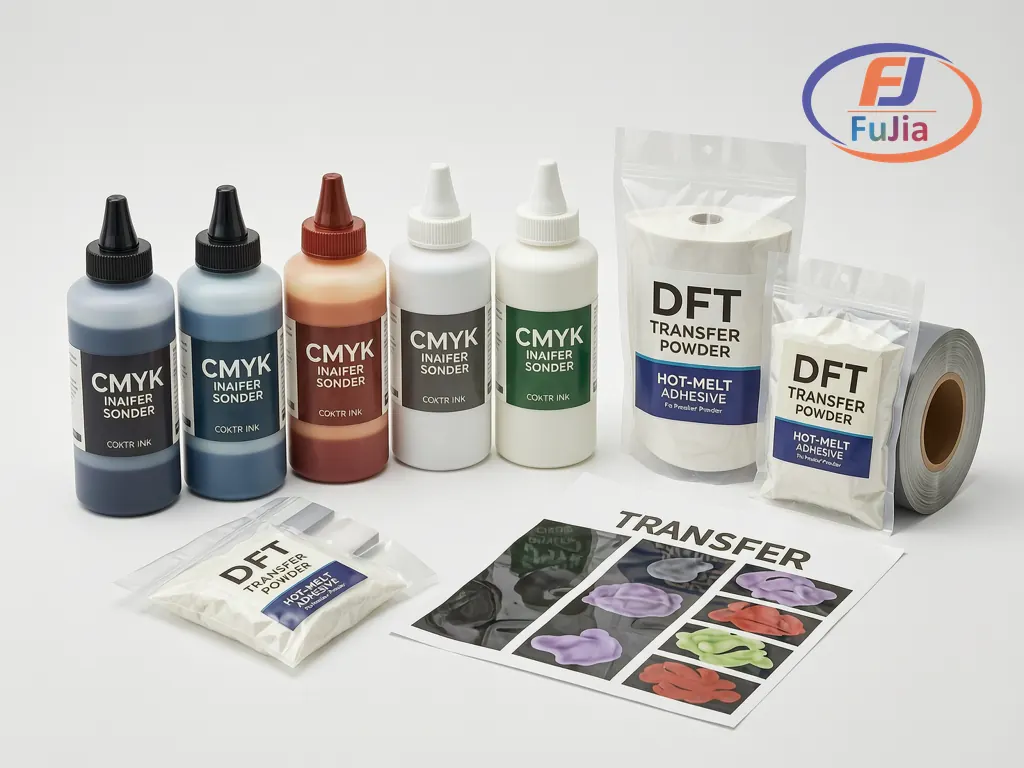
There are three core consumable categories. Everything else is accessories.
1. DTF Ink — The Highest-Margin Item
DTF ink is a water-based pigment ink formulated specifically for the DTF process. It comes in CMYK + White, with white ink consuming roughly 60–70% of total ink volume due to the underbase layer. For a comprehensive breakdown of ink chemistry and compatibility, see our DTF ink selection guide.
| Specification | Entry Grade | Professional Grade | Industrial Grade |
|---|---|---|---|
| Wholesale Price/Liter | $30–$50 | $50–$80 | $80–$120 |
| White Ink Opacity | Medium | High | Very High |
| Color Gamut | Standard CMYK | Wide gamut | Ultra-wide, spot color capable |
| Clogging Resistance | Basic filtration | Multi-stage filtered | Nano-filtered, anti-sedimentation |
| Typical Shelf Life | 6 months | 12 months | 18+ months |
| MOQ for Private Label | 100–200L | 50–100L | 20–50L |
White ink is the performance bottleneck. Low-grade white ink settles fast, clogs printheads, and produces muted prints. This is where cutting corners costs your customers money — and your brand its reputation.
For your own calculations: a 1-liter bottle of CMYK ink retails for $40–$80. A 1-liter bottle of white ink retails for $45–$90. At 50% wholesale margin, you’re clearing $20–$45 per bottle.
2. DTF PET Film — The Volume Driver
DTF transfer film is a coated PET (polyethylene terephthalate) sheet that receives the ink during printing. Jinlong Prints and other China-based consumables specialists (Jinlong) offer integrated film, ink, and powder supply under one roof, which is the model to replicate for your own brand.
Two main types dominate the market:
| Type | Characteristics | Wholesale Price/100m Roll | Best For |
|---|---|---|---|
| Cold Peel | Peels after cooling, matte finish, softer hand feel | $50–$120 | Fashion garments, dark fabrics |
| Hot Peel | Peels while warm, glossy finish, faster workflow | $60–$150 | High-volume production, sportswear |
Film quality is measured by coating uniformity, static control, and release consistency. Poor coating causes ink pooling and uneven powder adhesion. Inconsistent release leaves residue on garments.
A standard 60cm DTF printer running 8 hours produces roughly 100–200 meters of printed film per day. At $0.80–$3.00 per meter retail, the monthly film spend for one machine easily hits $1,600–$12,000. If your customer runs 5 machines, film alone is a five-figure monthly account.
3. DTF Hot-Melt Powder — Small Component, Big Impact
Hot-melt adhesive powder (typically TPU-based) is sprinkled onto the wet ink, shaken off, then melted during curing. Powder grain size is the critical variable:
| Grain Size | Particle Range | Best For |
|---|---|---|
| Fine (80–120μm) | Smallest particles | Detailed designs, thin fabrics, photo prints |
| Medium (120–200μm) | General purpose | Standard cotton/polyester, most common spec |
| Coarse (200–300μm) | Largest particles | Heavy fabrics, thick ink deposits, workwear |
Wholesale pricing ranges from $5–$15/kg for entry-grade powder to $15–$45/kg for premium TPU formulations. One kilogram of powder covers approximately 15–25 A3-size prints, depending on coverage. Retail pricing typically lands at $20–$60/kg.

The Starter Kit OEM Model: Bundle, Brand, and Scale
A DTF starter kit bundles the essential equipment and consumables into a single SKU. For your customer, it’s a “ready to print” box. For you, it’s a higher average order value and a consumables lock-in from day one.
What Goes Into a Starter Kit
| Component | Entry Kit (A4 Desktop) | Professional Kit (60cm) | Industrial Kit (60cm+) |
|---|---|---|---|
| Printer | XP600-based, 30cm | Single i3200, 60cm | Dual i3200, 60cm+ |
| Powder Shaker | Manual or entry auto | Integrated auto shaker | High-speed industrial shaker |
| Curing Unit | Entry IR oven or heat press | Dedicated IR curing oven | Tunnel IR curing system |
| Ink | 4×500ml CMYK + 2×500ml White | 4×1L CMYK + 4×1L White | 4×5L CMYK + 6×5L White |
| Film | 2 rolls (100m each) | 5 rolls (100m each) | 10 rolls (100m each) |
| Powder | 2kg | 5kg | 10kg |
| Accessories | Heat tape, squeegee, cleaning kit | Full maintenance kit, spare dampers | Spare printhead, spare capping station, full tool kit |
| Training | Video course + quick-start guide | Video + 1 remote session | Video + 3 remote sessions |
| Estimated Ex-Factory Cost | $1,800–$2,800 | $4,500–$6,500 | $8,000–$12,000 |
| Suggested Retail (Branded) | $3,500–$5,000 | $8,500–$12,000 | $16,000–$22,000 |
The key to starter kit OEM is that everything is private-labeled: the printer, the ink bottles, the film boxes, the powder bags, the training materials. When the customer opens the box, they see one brand — yours — across every component. For printer OEM in particular, refer to our DTF printer OEM complete guide.
Why Starter Kits Beat Selling Components Separately
- Higher initial order value. A customer buying components individually might spend $2,000 on ink and film. A starter kit customer spends $5,000+.
- Immediate consumables lock-in. The kit ships with 2–3 months of consumables. When they run out, they reorder from you — because your ink is ICC-profiled to your printer, and your film is tested with your powder.
- Lower support burden. You know exactly what equipment and consumables the customer is using. No “I bought some cheap ink on Amazon and now my prints look terrible” calls.
- Perceived value. A bundled kit at $5,000 feels like a better deal than separately priced items totaling $5,500, even if the margin is identical.
Pricing & Margin Structure
Here’s a realistic margin model for a one-stop DTF consumables brand sourcing from China manufacturers. Pricing data is benchmarked against Alibaba SmartBuy’s DTF supply chain analysis and verified manufacturer quotes.
| Product | Ex-Factory Unit Cost | Landed Cost (+20% freight/duty) | Wholesale Price (to distributors) | Retail Price | Gross Margin (Retail) |
|---|---|---|---|---|---|
| Ink (1L CMYK) | $40 | $48 | $55 | $70 | 37% |
| Ink (1L White) | $50 | $60 | $68 | $85 | 34% |
| Film (100m roll) | $85 | $102 | $140 | $195 | 52% |
| Powder (1kg) | $12 | $14 | $22 | $35 | 63% |
| Starter Kit (Entry) | $2,300 | $2,760 | — | $4,200 | 34% |
| Starter Kit (Pro) | $5,500 | $6,600 | — | $9,500 | 30% |
Consumable margins are healthier than printer margins because there’s less warranty risk and no complex installation support. Powder and film are the margin leaders at 50%+. Ink margins are thinner but ink is the highest-frequency reorder item.
A distributor program adds 15–25% on top of ex-factory cost for volume buyers. If you sell 100 liters of ink per month to 10 distributors, you’re doing $5,500/month in wholesale revenue at low support cost. For the full printhead comparison that determines which consumables to stock, read our DTF printer OEM guide.
How to Source a Reliable DTF Consumables Manufacturer
Sourcing consumables is different from sourcing printers. Printer factories need mechanical engineering. Consumable factories need chemical engineering — ink formulation, coating technology, powder polymerization.
The 5-Point Consumables Manufacturer Checklist
1. Specialization matters. A factory that makes “DTF printers and also some ink” is not an ink manufacturer. Look for factories that specialize in one consumable category with 5+ years of dedicated production.
2. Demand batch consistency data. Ink color varies between batches. Quality manufacturers test every batch with a spectrophotometer and provide a batch consistency report (Delta E < 2.0 is the minimum acceptable standard). Film coating thickness should be consistent within ±2μm across a roll.
3. Request technical documentation. A legitimate consumables manufacturer can provide:
– Ink: TDS (Technical Data Sheet), MSDS (Material Safety Data Sheet), viscosity curve, particle size distribution
– Film: Coating weight (g/m²), release force (g/25mm), static decay time
– Powder: Melting point range, melt flow index, particle size distribution curve, TPU content percentage
If they can’t provide these, they’re a trading company repackaging generic products.
4. Test with your specific printer and climate. Ink that prints perfectly in Shenzhen (25°C, 80% humidity) may behave completely differently in Phoenix (40°C, 10% humidity). Always test samples with your exact printer model in your target market’s climate conditions. Run at least 100 prints and wash-test 20 garments through 5 cycles before committing to a container order.
5. Private-label capability is about more than stickers. Private-labeling consumables requires:
– Custom bottle shapes and caps for ink (not just a sticker on a generic bottle)
– Custom box printing for film rolls
– Custom bag printing and sealing for powder
– Bilingual labeling (English + local language)
– Certification markings printed directly on packaging (CE, RoHS, REACH)
Ask for photos of private-label work they’ve done for other clients — not just a mockup, but actual packaged products.
Starter Kit Configuration: 3 Tiers for 3 Markets
Not all customers need the same kit. Segment by use case:
Tier 1 — “Try DTF” (Hobbyist / Micro-Business)
- A4 desktop XP600 printer, manual powder application, entry heat press
- 2L CMYK + 2L White ink, 2 film rolls, 2kg powder
- Video training, quick-start printed guide
- Ex-factory: $1,800–$2,800 | Retail: $3,500–$5,000
- Customer prints 5–20 transfers/day
Tier 2 — “Print Shop Starter” (Small Business)
- 60cm single i3200 printer, automatic shaker, dedicated IR oven
- 4L CMYK + 4L White ink, 5 film rolls, 5kg powder
- Video training + 1 remote setup session, maintenance schedule card
- Ex-factory: $4,500–$6,500 | Retail: $8,500–$12,000
- Customer prints 50–150 transfers/day
Tier 3 — “Production Ready” (Commercial)
- 60cm dual i3200 printer, high-speed shaker, tunnel IR curing
- 20L CMYK + 30L White ink, 10 film rolls, 10kg powder
- Video course + 3 remote training sessions, spare parts kit with spare printhead
- Ex-factory: $8,000–$12,000 | Retail: $16,000–$22,000
- Customer prints 200–500 transfers/day
Each tier ships in branded packaging with a “Reorder Card” listing consumable SKUs and your ordering portal. The card is the most important piece of paper in the box — it turns the one-time sale into a recurring account.
Common Pitfalls When Building a Consumables Brand
1. Selling generic consumables as “premium.” If your ink comes from the same factory as 50 other brands with only a sticker difference, customers will figure it out. Either genuinely spec better materials (higher-grade pigments, finer powder mesh) or compete on price transparency, not premium positioning.
2. Inadequate inventory planning. Consumables have shelf lives. DTF ink typically lasts 12–18 months unopened, 6 months opened. Film coatings can degrade in storage if not climate-controlled. Don’t order 5,000 liters of ink for your first batch — start with 200–500L per color, validate sell-through, then scale.
3. Ignoring certification costs. Selling ink and powder in the EU requires REACH compliance and often OEKO-TEX certification. In the US, CPSIA applies to textile chemicals. Certification can cost $2,000–$8,000 per product line and take 6–12 weeks. Budget for this before you place your first order.
4. No ICC profile for your ink + film combination. Every ink/film combination produces slightly different color output. Without a custom ICC profile, your customer’s prints won’t match what they see on screen. A single ICC profile costs $200–$500 from a color management specialist. Factor one profile per ink/film/printer combination into your launch budget.
5. Overcomplicating the starter kit. A starter kit with 47 SKUs is not a starter kit — it’s an inventory nightmare. The best starter kits have 10–15 line items and fit in 2 boxes. Everything the customer needs, nothing they don’t.
FAQ
Q: What’s the minimum order quantity for private-label DTF consumables?
A: Ink: 100–200L per color for custom bottles and labels. Film: 50–100 rolls for custom box printing. Powder: 100–500kg for custom bag printing. Some manufacturers offer lower MOQs with laser-printed labels instead of full custom packaging, which works well for market testing.
Q: How much does it cost to launch a DTF consumables brand?
A: A realistic first-batch budget is $8,000–$15,000. This covers 200–400L of ink, 50–100 film rolls, 100–200kg powder, custom packaging design, initial ICC profiles, and certification documentation. Add $3,000–$5,000 for a basic e-commerce site with inventory management.
Q: Can I sell consumables without selling printers?
A: Yes. Pure consumables distributors can build substantial businesses by offering better pricing, faster shipping, and more reliable stock than printer manufacturers who treat consumables as an afterthought. The disadvantage: without printer sales, you need to compete harder on price and customer acquisition.
Q: How do I handle consumables returns and quality complaints?
A: Have a written quality policy before you ship. Standard terms: return unopened product within 30 days, no returns on opened ink or powder. For quality complaints, require batch numbers and photos. Keep retain samples from every batch — a 100ml bottle of each ink batch stored in your office is your evidence when a customer claims “this ink is defective” but actually used the wrong curing temperature.
Q: What’s the shelf life concern with stocking consumables?
A: DTF ink: 12–18 months sealed, 6 months after opening. Store between 15–30°C, away from direct sunlight. Film: 12–24 months if stored in climate-controlled conditions (20–25°C, 40–60% humidity). Powder: 18–24 months sealed, susceptible to moisture absorption — use desiccant packs in packaging and educate customers to reseal bags immediately after use.
Next Steps
Building a one-stop DTF consumables brand is a logistics and quality-control game, not a technology game. The manufacturers exist. The demand exists. The gap is in execution.
- Pick your starting tier. Don’t launch with all three. Start with Tier 2 (Professional Kit) — it’s the volume sweet spot where margins and demand intersect.
- Source 3 ink manufacturers, 2 film manufacturers, 2 powder manufacturers. Test their samples with the same printer, same design file, same wash protocol. Keep the one that performs best end-to-end.
- Commission your ICC profiles. One profile per ink/film combination. Without this, you’re selling ingredients without a recipe.
- Design your packaging as a system. Every box, bottle, and bag should look like part of the same family. Consistency is what separates a brand from a reseller.
- Launch with a reorder program. Offer 10% off on the first consumables reorder for starter kit customers. The goal isn’t the first sale — it’s the tenth.
Related Reading
Factory-Direct Printing Equipment – Talk to the Source
Fujia Print manufactures DTF and UV printers in Guangzhou. Not a trading company, not a middleman. One supplier for your printer, consumables, and after-sales. Factory-direct pricing, in-house R&D, real support that answers the phone.
