

A commercial DTF printer prints durable full-color transfers on film at production speed, then presses them onto garments without minimum order limits. This article covers the specs, speed, and cost that separate a commercial unit from a desktop printer.
Key Takeaways
- A commercial DTF printer uses 2 or more Epson printheads across a 600 mm plus width to hold 8 to 27 m² per hour.
- Fujia builds commercial DTF printers with a Honson mainboard, Leadshine servo, and THK guide rail, named components competitors rarely disclose.
- A Turkish garment factory using Fujia’s A1 dual-head DTF gained 40 percent more throughput and cut delivery from 7 days to 2.5 days.
- Cost runs from about $3,000 for an A3 unit to $15,000 plus for a 24 inch production model, with payback often inside 12 months.
What Is a Commercial DTF Printer?
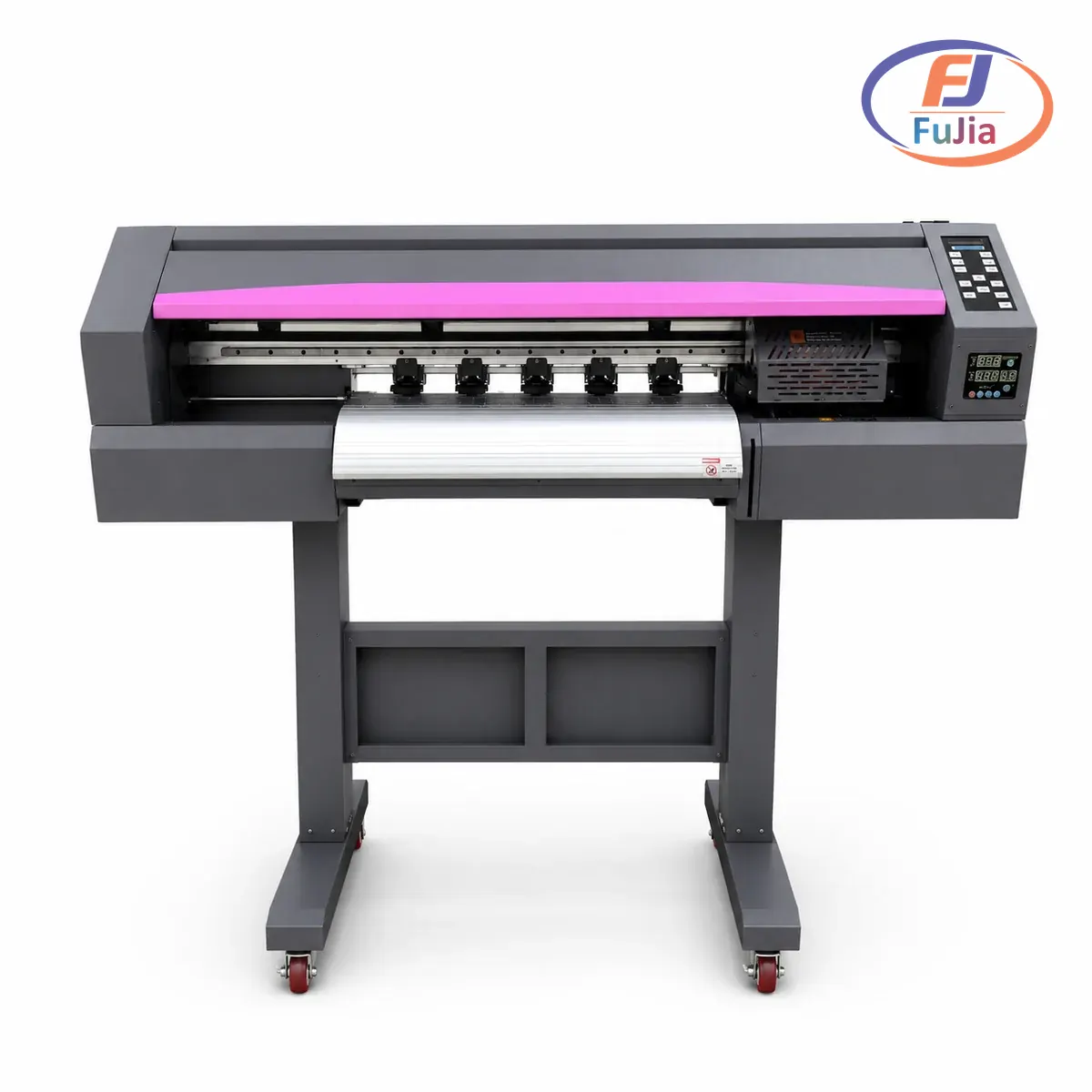
A commercial DTF printer is a direct-to-film machine built for daily production rather than occasional hobby use. It prints a mirrored CMYK plus white design onto PET film, shakes adhesive powder over the wet ink, cures it, and delivers a transfer that a heat press applies to cotton, polyester, blends, and dark fabrics at 160°C for 15 seconds with a cold peel.
The commercial label comes from the build, not just the badge. A commercial unit carries industrial motion parts, larger ink tanks, and a powder shaker that an operator can run for 8 to 12 hours without quality drift. Fujia’s commercial line starts at the A1 DTF 2-Head with two Epson I3200 printheads across a 650 mm width and scales to the A1 DTF 4-Head rated at 27 m² per hour at 4 pass. The inkjet printing method behind DTF is the same drop-on-demand technology used across modern wide-format production, which is why the output stays sharp at production volume.
What Makes a DTF Printer Commercial-Grade?
Three things separate a commercial DTF printer from a converted desktop machine. The first is the transmission stack. Fujia uses a Honson mainboard paired with a Leadshine servo motor and THK silent guide rail, the same tier of components found in far more expensive European builds. The second is white ink management. Titanium dioxide in white ink settles fast, so Fujia fits an auto power-off circulation system that keeps the white ink moving even during a power cut, which prevents the clogged head that wrecks a production day. The third is the curing path: dual-section front and rear heating with live temperature and humidity monitoring holds the film at the right state for a clean transfer.
Noise stays under 32 dB at idle and under 65 dB at full run, low enough for a shared shop floor. Daily maintenance takes 3 to 5 minutes: wipe the capping station and run a nozzle check. These are the details a screen printing shop weighs when it moves from screens to film, because the running cost and uptime decide whether the switch pays off. The full DTF printers range shows where each model sits in that trade-off.
Fujia Commercial DTF Models Compared
| Model | Printheads | Width | Speed | Best for |
|---|---|---|---|---|
| A1 DTF 2-Head | 2x Epson I3200 | 650 mm | 8 to 13 m²/hr | Small commercial shop, 1,500 to 3,000 pieces/month |
| A1 DTF 4-Head | 4 to 5x Epson I3200 | 650 mm | 27 m²/hr @4Pass | High-volume production, gang sheets |
| A2 DTF 2-Head | 2x Epson | ~420 mm | Medium volume | Studio with limited floor space |
| A3 DTF 2-Head | 2x Epson | ~300 mm | Desktop volume | Entry commercial, proofing |
Every model uses CMYK plus white plus light cyan and light magenta, and can run up to 8 colors with orange, red, green, and blue for brand-matched output. The RIP software supports Maintop, Photoprint, Flexi, and RIIN, so the printer drops into an existing workflow. Ink runs through a siphon and positive pressure supply with 1,000 to 1,500 ml per color, which keeps per-print cost low on long runs. Material standards bodies such as NIST publish the reference data used to rate how wash-fast a transfer is.
How Much Does a Commercial DTF Printer Cost?
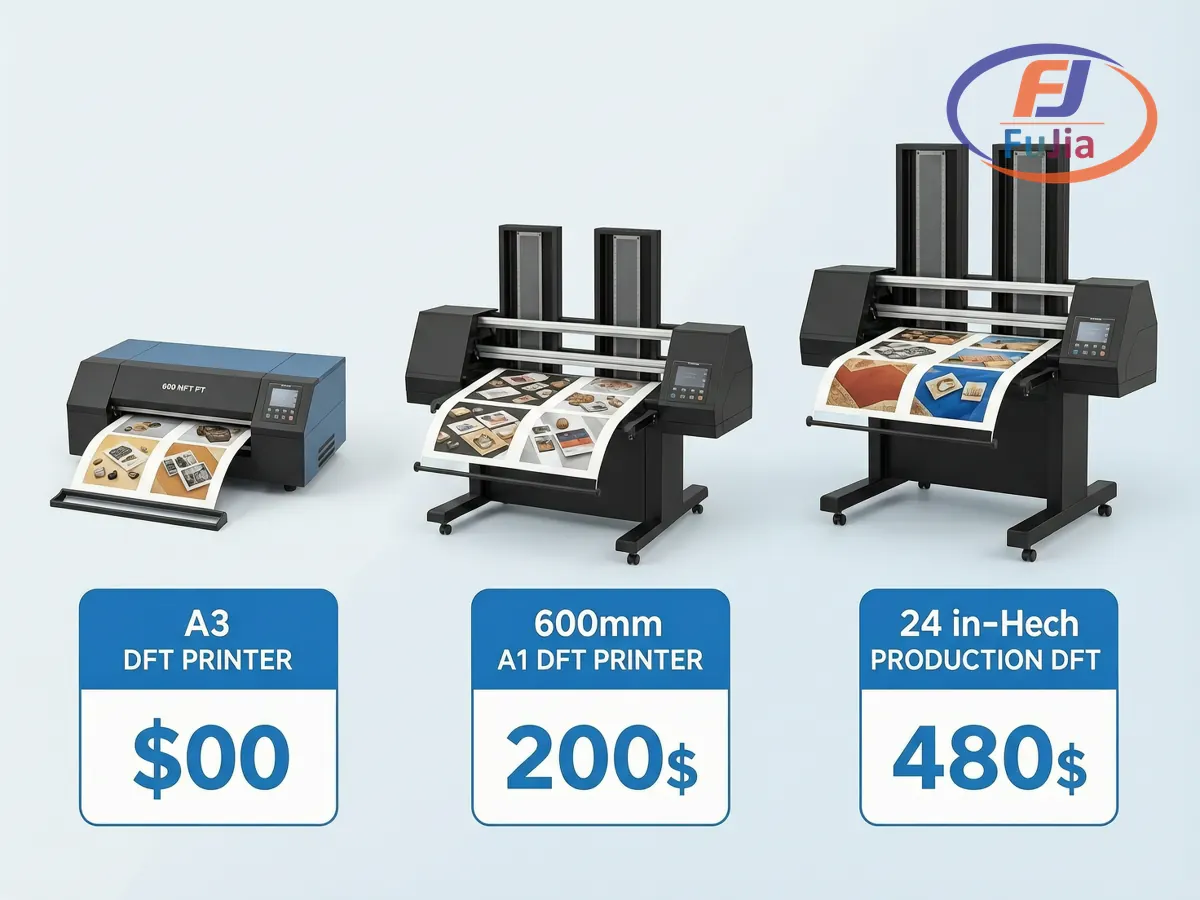
Price tracks width and head count. An A3 desktop commercial unit starts near $3,000, a 600 mm A1 dual-head model sits in the $6,000 to $10,000 range, and a 24 inch four-head production printer reaches $15,000 to $28,000 based on listings from major US DTF suppliers. The printer is only part of the cost: DTF film, powder, and ink add a per-transfer material cost that falls as volume rises because the large ink tanks dilute fixed cost.
Across the 500 plus print businesses Fujia serves, DTF printer payback typically lands within 3 to 8 months once a shop fills 1,500 to 3,000 pieces per month, because the per-piece cost drops well below outsourced screen printing below about 3,000 identical pieces. The Brazilian studio in Fujia’s case files cut per-order cost by 64 percent, from R$18 to R$6.5, with a 5.5 month payback. Break-even varies by region, since shops with higher labor cost see faster return.
Which is the best DTF printer for commercial use?
The best DTF printer for commercial use is one sized to your monthly volume, not the most heads you can afford. A shop running 1,500 to 3,000 garments per month is well served by a 600 mm A1 dual-head model with two Epson I3200 printheads, which holds 8 to 13 m² per hour and fits a standard workbench. A shop above 3,000 pieces per month should step up to a four-head A1 model rated near 27 m² per hour, because the extra heads shorten gang-sheet time and keep a 12 hour day moving. The deciding factors are the transmission stack and uptime support, since a clogged head costs more than the price gap between models. Fujia’s commercial DTF line uses a Honson mainboard, Leadshine servo, and THK guide rail, and backs it with a 12-month warranty, 48 hour parts dispatch, and a lifetime engineering group, which is what keeps a commercial machine earning instead of waiting on a repair.
How much does a good DTF printer cost?
A good DTF printer costs from about $3,000 for an A3 desktop commercial unit to $15,000 or more for a 24 inch production model, based on listings from major US DTF suppliers. The good part is less about price and more about the support behind the machine: a 12-month warranty, parts shipped within 48 hours, and remote onboarding that gets a first clean print in about 3 days. Material cost is separate and scales with volume, because CMYK plus white ink in 1,000 to 1,500 ml tanks lowers the per-transfer cost on long runs. Across the 500 plus print businesses Fujia serves, shops that fill 1,500 to 3,000 pieces per month typically see payback inside 3 to 8 months, so the printer price is a small part of the total return. Buy the width and head count that match your real monthly volume rather than the cheapest or the biggest unit on the page.
Which printer is best for DTF printing?
The printer best for DTF printing is a dedicated direct-to-film machine with Epson I3200 or XP600 printheads, not a modified inkjet, because the film path, powder shaker, and white ink circulation are built in. For commercial work the A1 dual-head DTF with two Epson I3200 heads across a 650 mm width is the standard choice, holding 8 to 13 m² per hour with the uptime that daily production needs. A four-head A1 model suits shops above 3,000 pieces per month. The printheads matter less than the motion system around them: Fujia pairs the heads with a Honson mainboard, Leadshine servo motor, and THK guide rail so a 12 hour run holds quality without drift. Add the 160°C, 15 second, cold peel transfer step and 50 plus wash durability, and the result is a transfer that survives commercial laundering, which is the real test of best for a print business.
Is DTF business profitable?
A DTF business is profitable for shops that reach steady monthly volume, because the per-piece cost drops far below outsourced screen printing below about 3,000 identical pieces. Fujia’s own case files show a Turkish garment factory gaining 40 percent more throughput and cutting delivery from 7 days to 2.5 days after moving to an A1 dual-head DTF, while a Brazilian studio cut per-order cost by 64 percent with a 5.5 month payback. Across the 500 plus print businesses Fujia serves, payback typically lands within 3 to 8 months once a shop fills 1,500 to 3,000 pieces per month, and apparel clients report 60 percent margin at 3,000 plus pieces per month. Profit depends on volume and uptime, so the support behind the machine, a 12-month warranty and 48 hour parts dispatch, matters as much as the sticker price when you calculate the return.
Conclusion
A commercial DTF printer earns its name through industrial motion parts, white ink circulation, and the uptime support that keeps a shop running 12 hours a day. For factory-direct pricing and the full A1 DTF lineup, see the Fujia Print DTF printers or explore apparel printing results from real customers.
