

The best DTF printer in 2026 depends on production volume: the Fujia A3 desktop (FJ-A30) wins for startups at under $3,000, the Fujia A1 dual-head leads the professional tier at 8-13 m²/hr, and the Fujia A1 4-Head tops industrial rankings at 27 m²/hr with quad Epson i3200 printheads. The 2026 market split clearly into three tiers as i3200 printhead costs dropped 20% year-over-year, pushing industrial-grade features into sub-$5,000 machines.
\n\n\n\n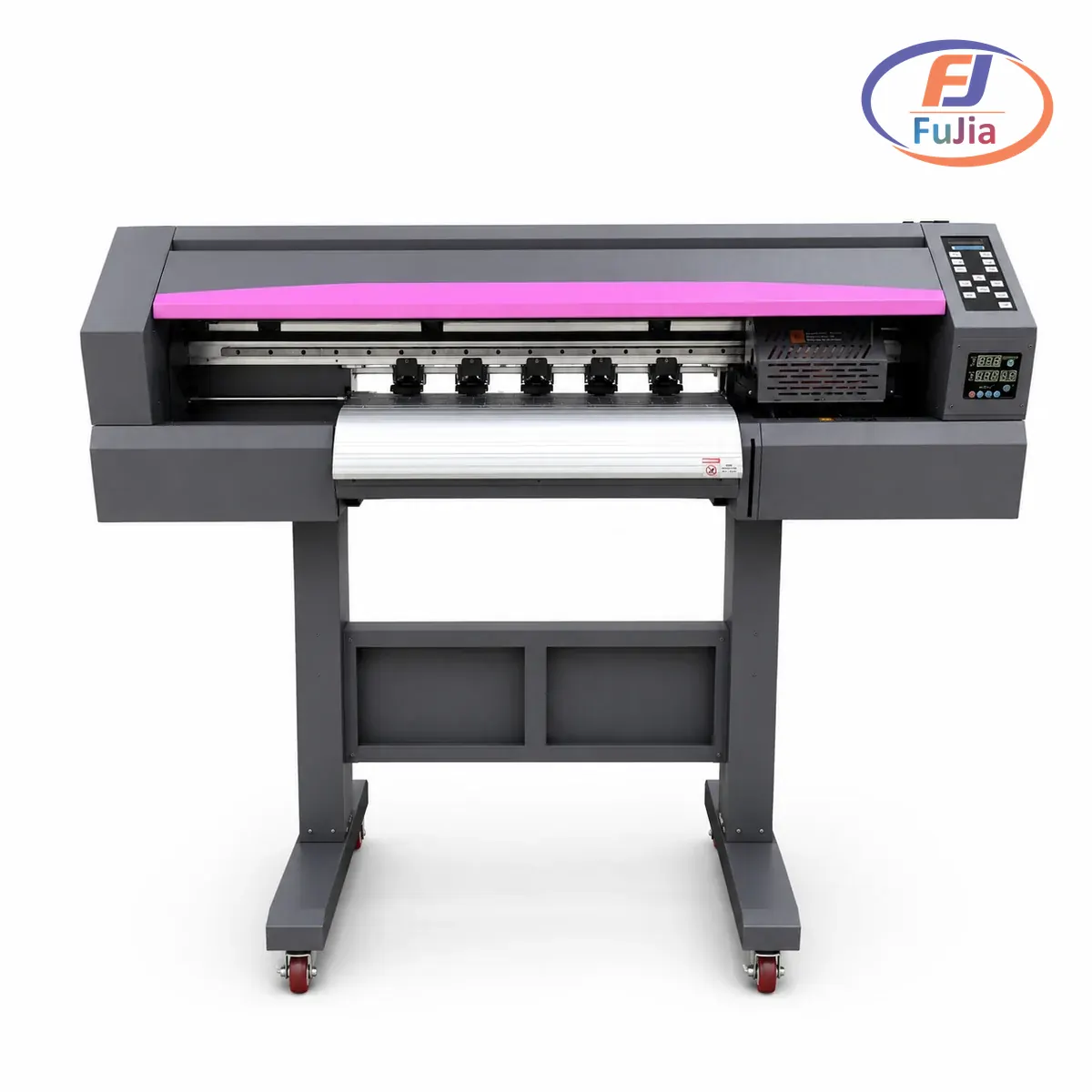
Key Takeaways
\n\n\n\n- \n\n\n
- The best DTF printer for 2026 is determined by daily output: under 100 transfers favors a single-head A3 desktop, 100-500 transfers needs a dual-head A2 or A1, and 500+ transfers requires a quad-head A1 industrial system. \n\n\n
- Epson i3200 printheads became the 2026 industry standard, replacing the older XP600 in all professional and industrial tier machines. \n\n\n
- 2026 DTF trends include powder-free printing technology reaching commercial viability, AI-assisted color profiling in RIP software, and factory-direct pricing from Chinese manufacturers that cut mid-tier costs by 30-40%. \n\n\n
- Real Google Shopping prices from August 2026 range from $300 for the Procolored F8 Panda to $22,995 for the Roland TY-300, with the sweet spot for professional use at $5,000-$8,000. \n\n\n
- Fujia Print’s A1 4-Head delivers 27 m²/hr at 720×2400 dpi, matching or beating the Epson SureColor G6070 ($21,373) at 15-30% lower factory-direct pricing. \n\n\n
How We Ranked DTF Printers for 2026
\n\n\n\n
Ranking the best DTF printer requires looking past marketing claims at three measurable factors: printhead configuration, daily rated output, and total cost of ownership including consumables. Every printer in this ranking uses the Epson i3200 printhead or its predecessor the XP600, the two heads that dominate the DTF market in 2026. We recommend scoring candidates on those three factors in writing before comparing badges, and the full configuration ladder behind this ranking is mapped on the DTF printers lineup page.
\n\n\n\nThe 2026 DTF landscape shifted in three ways compared to 2025. First, i3200 printheads dropped to roughly $350 per unit at wholesale, down from $400-$500 in early 2025, enabling 4-head configurations under $16,000. Second, powder-free DTF technology reached commercial viability in early 2026, with several manufacturers shipping systems that eliminate the powder-curing step entirely. Third, factory-direct shipping from Guangzhou manufacturers like Fujia Print compressed the price gap between Chinese and Western-branded machines, with Fujia’s 3,500 m² factory producing 2,000 machines annually for 50+ export countries.
\n\n\n\nThe table below maps the three tiers against the criteria that matter for 2026 buyers.
\n\n\n\n| Tier | \nBest 2026 Pick | \nPrintheads | \nSpeed | \nPrice Range | \nDaily Output | \n
|---|---|---|---|---|---|
| Desktop / Startup | \nFujia FJ-A30 | \n1 XP600 | \n2-3 m²/hr | \n$1,400-$3,000 | \n30-80 transfers | \n
| Professional | \nFujia A1 Dual-Head | \n2 i3200 | \n8-13 m²/hr | \n$5,000-$15,000 | \n200-500 transfers | \n
| Industrial | \nFujia A1 4-Head | \n4 i3200 | \n22-27 m²/hr | \n$15,000-$18,000 | \n500-1,000+ transfers | \n
Best Desktop DTF Printer 2026: Fujia FJ-A30
\n\n\n\nThe Fujia FJ-A30 is the best desktop DTF printer for 2026 because it delivers professional-grade DTF output at 2-3 m²/hr and 1440×1440 dpi maximum resolution in a 30cm A3 footprint that fits a standard workbench. The single Epson XP600 printhead handles CMYK plus white ink, producing transfers rated Grade 4-5 on the AATCC colorfastness scale after 50+ heavy machine washes.
\n\n\n\nA creative studio in São Paulo, Brazil documented the FJ-A30’s performance over 6 months. The studio reduced per-order cost by 64%, dropping from R$18 per outsourced A3 sheet to R$6.50 per in-house order. Order volume grew 45%, from 15 to 22 orders per week, with a projected payback period of 5.5 months against the 18-month projected timeline. The machine occupies 20 m² of workspace including the heat press area.
\n\n\n\nGoogle Shopping data from August 2026 shows the desktop tier priced as follows.
\n\n\n\n| Desktop Model | \n2026 Price | \nRating | \nKey Feature | \n
|---|---|---|---|
| Procolored F8 Panda | \n$300 | \nNew | \nLowest entry price | \n
| Highly Flavored DTF | \n$1,800 | \nNew | \nMid-range desktop | \n
| Fujia FJ-A30 | \n~$2,500 | \nFactory-direct | \n1440 dpi, XP600 | \n
| Procolored K13 Lite | \n$2,799 | \n4.8 stars | \n13″ A3 format | \n
The Procolored F8 Panda at $300 represents the extreme budget end. Buyers should note that sub-$500 DTF printers typically use modified Epson L1800 desktop printers rather than purpose-built DTF chassis, requiring frequent printhead replacement and lacking white ink circulation.The honest entry tier starts near $2,000, and the machines below it teach troubleshooting rather than printing.
\n\n\n\nBest Professional DTF Printer 2026: Fujia A1 Dual-Head
\n\n\n\nThe Fujia A1 Dual-Head earns the best professional DTF printer designation for 2026 by combining 8-13 m²/hr output with 650mm print width at a factory-direct price point 30-40% below branded equivalents. The dual Epson i3200 configuration dedicates one head to CMYK and one to white ink, delivering the dense, uniform white layer that professional garment decoration demands.
\n\n\n\nA custom sportswear brand documented on the Fujia apparel printing solutions page at fujiaprinter.com/apparel-printing runs a 60cm dual-head system at 3,000+ pieces per month with 60% margins. The brand expanded from light cotton tees to dark polyester jerseys within 60 days of installation, a material transition that DTG cannot match without separate pretreatment. The DTF heat press settings of 160 degrees Celsius for 15 seconds with cold peel apply universally across cotton, polyester, blends, and denim.
\n\n\n\nEngineering details separate the Fujia A1 from white-label alternatives. The transmission uses a Honson mainboard with Leadshine servo motor and THK silent guide rail, the same component stack found in CNC equipment. White ink circulates automatically through a siphon and positive-pressure system holding 1,000-1,500ml per color, preventing the titanium dioxide settling that destroys printheads in machines lacking active circulation. Noise levels measure under 32 dB at idle and under 65 dB during printing.
\n\n\n\nBest Industrial DTF Printer 2026: Fujia A1 4-Head
\n\n\n\nThe Fujia A1 4-Head (DTF-A1-4H) ranks as the best industrial DTF printer for 2026 by delivering 27 m²/hr at 4-pass with quad Epson i3200 printheads in a 650mm format. The 4-head configuration splits CMYK across two heads and white across two heads, doubling white ink density and enabling the wider color gamut that high-end apparel brands require.
\n\n\n\nA garment factory in Istanbul, Turkey upgraded from screen printing to the Fujia A1 dual-head system and documented measurable results over 12 months. Throughput rose 40%. Production costs fell 30%. Delivery times compressed from 7 days to 2.5 days. The factory’s Honson-Leadshine-THK transmission stack ran 12-hour continuous shifts without quality drift, a reliability level that generic-component machines cannot sustain. Small-batch orders under 50 pieces per design, previously unprofitable under screen printing minimums, grew to represent 60% of total revenue.
\n\n\n\nThe industrial tier in 2026 includes established competitors. The Epson SureColor G6070 at $21,373 and the Mimaki TxF series at $8,495-$12,495 represent the branded alternatives. Fujia’s factory-direct A1 4-Head targets $15,000-$18,000, matching the throughput of the Epson G6070 at 15-30% lower cost. The branded premium buys dealer networks and same-region service, and buyers without a local technician should weigh that honestly before chasing the factory price.
\n\n\n\n2026 DTF Industry Trends Shaping Purchasing Decisions
\n\n\n\nThree 2026 trends directly affect which DTF printer qualifies as “best” for a given buyer.
\n\n\n\nPowder-free DTF technology reached commercial viability in early 2026. Several manufacturers now ship systems that embed adhesive directly into the ink, eliminating the powder application and curing step entirely. For buyers, this means the integrated shaker-and-oven units common through 2025 are becoming optional. The Fujia A1 series supports both traditional powder workflow and the emerging powder-free process through firmware updates.
\n\n\n\nFactory-direct pricing compressed the mid-tier market further. Chinese manufacturers with ISO 9001 and CE certifications, including Fujia Print, expanded 2-year warranties with remote video diagnosis throughout 2026, matching the after-sales terms of Western brands. The result: professional-tier DTF printers from $5,000-$10,000 now compete directly with $8,000-$15,000 branded machines on features, not just price.
\n\n\n\nAI-assisted color profiling entered RIP software in 2026. Maintop and Photoprint both added AI-driven ICC profile generation that reduces color-matching time from hours to minutes. Buyers should verify that any DTF printer purchased in 2026 supports all three major RIP platforms: Maintop, Photoprint, and Flexi. Proprietary RIP ecosystems with no third-party support remain a red flag.
\n\n\n\n
What is the best DTF printer for home use?
\u003cp\u003eThe best DTF printer for home use in 2026 is the Fujia FJ-A30 or the Procolored K13 Lite, both priced under $3,000 and sized for a standard desk or workbench. The FJ-A30 offers 1440×1440 dpi resolution with a single Epson XP600 printhead, producing 2-3 m²/hr, which translates to roughly 30-50 custom transfers per day. Home users need a machine that fits 20 m² of workspace including heat press area, runs on standard 110V or 220V household power, and operates below 55 dB during printing. The FJ-A30 measures 32 dB at idle, quieter than most household air purifiers. Home users should budget $0.05-0.10 per transfer for ink, film, and powder combined, plus $200-$400 annually for printhead cleaning supplies and replacement dampers.\u003c/p\u003e
Which printer is best for DTF printing?
\u003cp\u003eThe best printer for DTF printing in 2026 uses Epson i3200 printheads rather than the older XP600. The i3200 delivers superior droplet control, a rated service life of 6 billion actuations per nozzle, and wider compatibility with DTF ink formulations. For daily volumes above 200 transfers, a dual i3200 or quad i3200 configuration is essential. The Fujia A1 Dual-Head, Fujia A1 4-Head, Epson SureColor G6070, and Mimaki TxF150-75 all use i3200 heads. Buyers should avoid machines that mix head types, such as pairing an XP600 with an i3200, because inconsistent droplet sizes cause visible banding on solid color fills. The RIP software matters equally: Maintop, Photoprint, and Flexi are the three platforms that every major DTF printer should support in 2026.\u003c/p\u003e
Is owning a DTF printer worth it?
\u003cp\u003eOwning a DTF printer is worth it for any business producing 200+ custom transfers per day or spending $3,000+ monthly on outsourced printing. The São Paulo creative studio case study documented a 64% reduction in per-order cost, from R$18 outsourced to R$6.50 in-house, with payback projected at 5.5 months. The Turkish garment factory recorded a 40% throughput increase and 30% cost reduction after transitioning from screen printing. DTF also eliminates the design constraints of screen printing: no per-color setup fees, no 200-piece minimum order quantities, full photographic CMYK plus white on any fabric from cotton to polyester to leather. For businesses below the 200-transfer daily threshold, starting with a single-head desktop model like the Fujia FJ-A30 at approximately $2,500 keeps risk low while building production capability. Demand first, machine second, and the tier ladder resolves itself.\u003c/p\u003e
Who makes the best DTF prints?
\u003cp\u003eThe best DTF prints come from printers using genuine Epson i3200 printheads with active white ink circulation and named-brand transmission components. Print quality depends on three factors: printhead droplet precision (i3200 delivers variable droplet sizes from 1.5 to 22 picoliters), white ink density (dual white heads produce 40% denser coverage than single-head configurations), and substrate transport stability (THK guide rails maintain positional accuracy within 0.01mm). The Fujia A1 series, Epson SureColor G6070, and Mimaki TxF series all meet these criteria. Wash durability for properly produced DTF transfers reaches Grade 4-5 on the \u003ca href=\u0022https://www.aatcc.org/testing/methods/\u0022\u003eAATCC colorfastness scale\u003c/a\u003e, meaning prints survive 50+ heavy machine wash cycles without cracking, fading, or peeling.\u003c/p\u003e
Conclusion
\n\n\n\nThe best DTF printer in 2026 matches daily production volume to the right tier: the Fujia FJ-A30 for startups under 100 transfers daily, the Fujia A1 Dual-Head for professional shops at 200-500 transfers, and the Fujia A1 4-Head for industrial operations exceeding 500 transfers. Factory-direct pricing from Fujia Print’s Guangzhou facility delivers 15-30% savings across all tiers without sacrificing the Honson-Leadshine-THK component quality that sustains 12-hour production runs. For 2026 DTF printer pricing and free sample inquiries, contact Fujia Print.
\n\n\n\nSources
\n\n\n\n- \n\n\n
- Epson Direct-to-Film Printers: Official Epson i3200 printhead specifications and SureColor G6070 industrial DTF printer documentation. \n\n\n
- Mimaki DTF Product Line: TxF series industrial DTF printer specs and operating environment requirements. \n\n\n
- AATCC Test Methods: Colorfastness grading standards (Grade 4-5 wash durability) referenced in DTF print quality evaluation. \n\n\n
