

UV printer ink is a liquid photopolymer that cures instantly under UV-LED light to form a solid, weather-resistant film on glass, metal, plastic, and wood. Commercial buyers in 2026 choose between hard, soft, and CMYK+W+varnish formulations priced from $30 to $210 per cartridge, with the true cost decision hinging on printhead compatibility and per-square-meter yield rather than sticker price. Fujia Print formulates a custom UV ink compatible with roll-to-roll, flatbed, and UV DTF printers from the same Guangzhou factory that builds the machines.
Key Takeaways
- UV printer ink cures in milliseconds via UV-LED photopolymerization, producing a 3H+ pencil-hardness film that withstands 500+ dishwasher cycles on varnished UV DTF labels
- Three formulations dominate the 2026 market: hard ink for rigid substrates ($30-90 per 500ml), soft ink for flexible vinyl and foil ($60-130 per 500ml), and CMYK+W+varnish 6-color sets ($130-210 per set)
- Per-print ink cost runs $0.02-0.05 per UV DTF label and $0.30-0.80 per m² on flatbed work, based on aggregate data from Fujia Print customers across 50+ countries
- Printhead compatibility is the single biggest cost driver: Ricoh GEN5 and Epson i3200 heads require different ink viscosities and surface tensions, and mixing formulations destroys printheads within hours
- Buyers sourcing ink should verify ISO 9001 and REACH certification, request a test print on their actual substrate, and calculate yield per m² before comparing cartridge prices
What Is UV Printer Ink?
UV printer ink is a 100% solid, photopolymer-based fluid made of monomers, oligomers, photoinitiators, and pigments. Unlike solvent or water-based inks that dry through evaporation, UV ink stays liquid until a UV-LED lamp emits photons at 385-405 nm wavelength, triggering the photoinitiators to cross-link the monomers into a solid polymer film within milliseconds. This instant curing is why UV printers print on virtually any substrate without pre-treatment.
The cured film achieves 3H+ pencil hardness when topped with a varnish layer, matching the scratch resistance reported on Fujia UV DTF crystal labels tested under the AATCC and ASTM D3363 protocols. Without varnish, the base CMYK+W film still reaches 2H hardness on glass and metal. The ink layer typically builds 15-30 microns thick per pass, with varnish adding another 10-20 microns for spot gloss or matte textures.
Fujia Print engineers its UV ink as a custom high-end formula compatible with the three printer architectures the factory produces: flatbed (6090 and 4050/4060 models), roll-to-roll, and UV DTF crystal label printers. The ink channels run CMYK + White + Varnish in a 6-color configuration, matching the Ricoh GEN5 and Epson i3200 printheads used across the lineup.
UV Printer Ink Types: Hard, Soft, and Formulation Variants
UV ink formulation determines what the ink can print on and how the finished print behaves under stress. The three formulations commercial buyers encounter in 2026 differ in flexibility, adhesion, and price.
| Formulation | Flexibility | Best Substrates | Price per 500ml | Cartridge Yield |
|---|---|---|---|---|
| Hard UV ink | Rigid, no bend | Glass, ceramic, metal, phone cases, acrylic awards | $30-90 | 80-120 m² |
| Soft UV ink | Flexible, stretches | Vinyl, leather, PVC cards, foil stamping, TPU | $60-130 | 60-90 m² |
| CMYK+W+Varnish set | Mixed | Multi-substrate shops running both rigid and flexible jobs | $130-210 per 6-color set | 70-100 m² average |
Hard ink uses rigid oligomers that cure into a brittle, high-gloss film ideal for flat surfaces that do not flex after printing. A phone case printed with hard ink survives daily handling but cracks if the case bends beyond 5 degrees. Soft ink incorporates flexible monomers that allow the film to stretch up to 180 percent elongation before cracking, making soft ink the only choice for vinyl wraps and heat-bent acrylics.
Varnish is the third functional channel, not a topcoat applied afterward. UV varnish prints as a separate layer through the sixth printhead, creating raised spot-gloss textures, embossed braille, or matte satin finishes. Varnish adds 30-50 percent to per-unit pricing on custom drinkware and promotional products because the visual upgrade justifies premium retail positioning.
Specialty formulations extend the range further. Edible UV ink exists for cake decorating and confectionery printing, formulated with FDA-compliant ingredients. Invisible UV ink appears clear under daylight but fluoresces blue or yellow under blacklight, used for anti-counterfeiting and event wristbands. Fujia Print focuses on the industrial hard, soft, and varnish trio because those three cover 95 percent of commercial UV printing demand.
Printhead Compatibility: The Real Cost Decision
Printhead compatibility dictates which ink a shop can use, and ignoring this spec destroys equipment. The two printhead families dominating industrial UV printing in 2026 demand different ink rheology.
| Printhead | Droplet Size | Ink Viscosity (at 25C) | Surface Tension | Compatible Ink Types |
|---|---|---|---|---|
| Ricoh GEN5 | 7-35 pl | 10-14 mPa.s | 28-32 mN/m | Hard, soft, varnish |
| Epson i3200-U1 | 1.5-8.8 pl | 5-8 mPa.s | 24-28 mN/m | Hard, soft, varnish (Epson-specific formula) |
| Epson XP600 | 1.5-6.8 pl | 5-7 mPa.s | 24-27 mN/m | Hard, soft (no varnish channel) |
Ricoh GEN5 printheads, used in the Fujia A1 6090 UV flatbed, require higher-viscosity ink that the piezoelectric crystals can jet reliably at 7-35 picoliter drop volumes. Epson i3200-U1 heads run lower-viscosity ink because the MEMS nozzles are smaller and operate at higher frequencies. Pouring Ricoh-formulated ink into an Epson i3200 printer causes immediate nozzle clogging within the first 200ml of printing, because the thicker fluid cannot clear the smaller Epson nozzles at standard firing temperatures.
Mixing brands within the same printhead family also carries risk. Each manufacturer tunes their photoinitiator package to match their own UV-LED wavelength and intensity. A Fujia UV printer runs a water-cooled UV-LED lamp tuned to 395 nm peak output, and Fujia ink’s photoinitiator package activates at that exact wavelength. Third-party ink formulated for a 385 nm lamp may undercure on a 395 nm lamp, leaving a tacky surface that fails the thumb-twist adhesion test. Fujia’s 2-year printer warranty requires OEM ink for this reason, and the factory testing center batch-tests every ink lot against the printhead and lamp configuration before shipment.
The practical guidance: verify the printhead model before buying ink, buy from a supplier who publishes viscosity and surface tension specs, and request a 100ml test sample before committing to a bulk order. Fujia Print supplies UV ink in 1-liter bottles and 500ml cartridges, with custom formulation available for OEM accounts running proprietary printhead configurations.
How Much Does UV Printer Ink Cost?
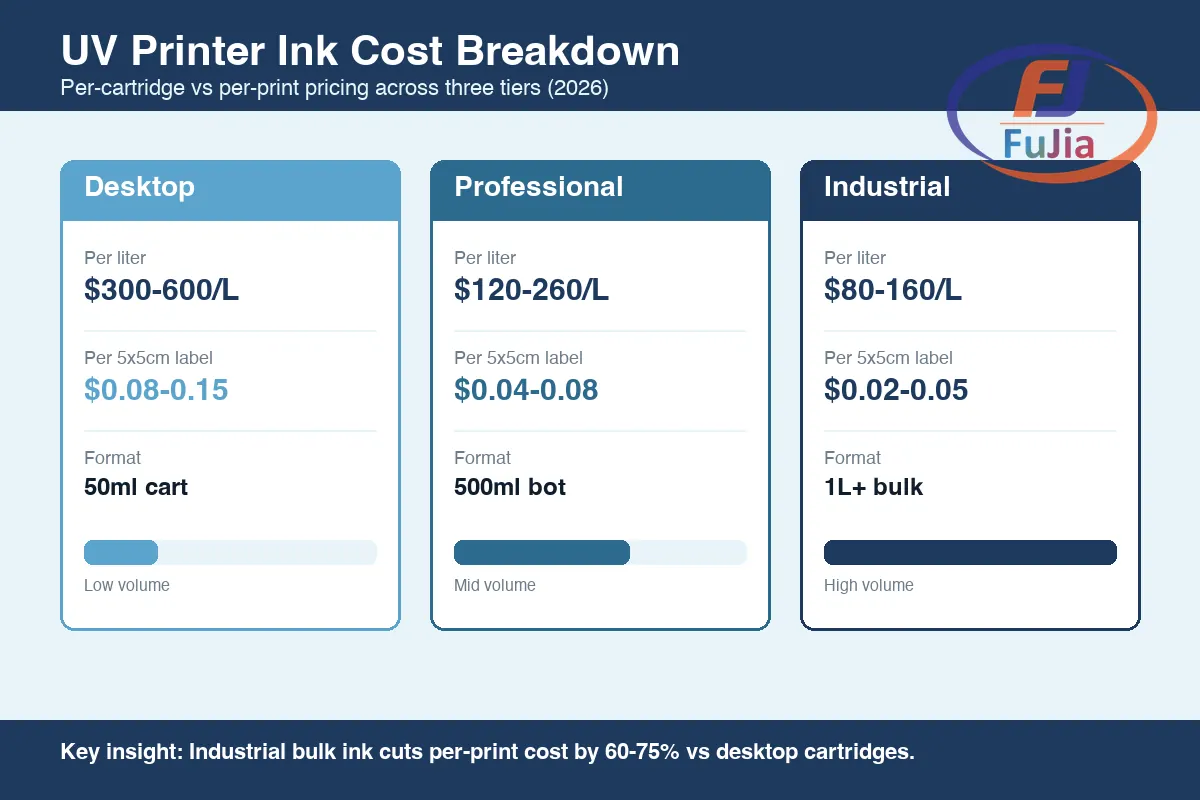
UV printer ink pricing spans a wide range because cartridge format, formulation, and brand markup multiply the raw material cost. The 2026 market breaks into three pricing tiers.
| Pricing Tier | Cartridge Size | Price Range | Per-liter Equivalent | Examples |
|---|---|---|---|---|
| Desktop cartridge | 50-100ml | $30-60 | $300-600/L | eufyMake E1, xTool O1, IEHK |
| Pro bottle / cartridge | 500ml | $60-130 | $120-260/L | Procolored, Xante X-Series, Imagic |
| Industrial bulk | 1L+ bottles | $80-210 per set | $80-160/L | Fujia UV ink, STS bulk, Inkcups industrial |
Desktop cartridges cost the most per milliliter because the proprietary chip and small fill volume inflate the unit price. The eufyMake UV ink cartridge at $29.99 for a 100ml CMYK color equals roughly $300 per liter, and the xTool O1 UV ink at $84.99 for a similar volume lands in the same range. Desktop cartridges make sense for hobbyist volumes under 50 prints per month.
Professional 500ml bottles and cartridges drop the per-liter cost to $120-260. Xante X-Series Vivid Color UV ink at $87.50 per 500ml equals $175 per liter, and Procolored UV ink at $59 per 500ml equals $118 per liter. This tier serves print shops running 200-2,000 prints monthly on A3 desktop UV printers.
Industrial bulk pricing applies to 1-liter bottles and multi-color sets purchased with a printer or as OEM supply. Fujia Print’s 6-color CMYK+W+Varnish set falls in the $130-210 range for a complete refill, delivering a per-liter cost of $80-160 depending on volume and OEM terms. Bulk buyers running A1 flatbeds at 4-8 m² per hour consume 2-5 liters monthly, making the per-liter gap between desktop and industrial ink worth $1,000-2,500 per month on consumables alone.
The real cost metric is per-print, not per-cartridge. A UV DTF label measuring 5×5 cm uses roughly 0.3-0.5ml of ink including white and varnish layers, costing $0.02-0.05 per label at industrial bulk pricing. A full-bed A1 print at 60×90 cm consumes 15-25ml of ink per cycle, costing $1.20-4.00 per bed depending on ink tier. Shops calculating break-even against outsourced screen printing find that in-house UV printing costs less than outsourcing below 3,000 identical pieces, based on aggregate data from Fujia Print customers across 50+ countries.
How Long Does UV Printer Ink Last?
UV printer ink shelf life runs 12 months sealed and 6 months opened when stored at 15-25C in opaque bottles away from direct UV light. The photoinitiators in UV ink slowly polymerize even in darkness, with the reaction accelerating above 30C and below 50 percent humidity. Ink past its shelf life does not suddenly fail, but cure speed drops 15-30 percent and adhesion on low-surface-energy substrates like polyethylene degrades noticeably.
In-printer lifetime is shorter because the ink in the dampers and lines exposes to ambient UV from fluorescent shop lighting and sunlight through windows. Fujia recommends flushing the ink system if a printer sits idle beyond 14 days, running a cleaning cycle with UV cleaning fluid (SKU UVI-CLF) to prevent partial curing inside the printhead nozzles. Daily maintenance of 3-5 minutes, wiping the capping station and running a nozzle check, extends in-printer ink life to the full 6-month window.
The cured print itself lasts far longer than the wet ink. Properly cured UV prints on outdoor signage survive 2+ years unlaminated under direct sun and rain, matching the outdoor durability rating on eco-solvent prints. Varnished UV DTF labels on drinkware survive 500+ dishwasher cycles and 100+ cycles at the 3H+ pencil hardness threshold. The cured polymer is chemically inert and resistant to acetone, mild acids, and petroleum solvents, which is why UV-printed industrial rating plates and serial number labels outlast the equipment they are attached to.
UV Printer Ink vs Solvent and DTF Ink
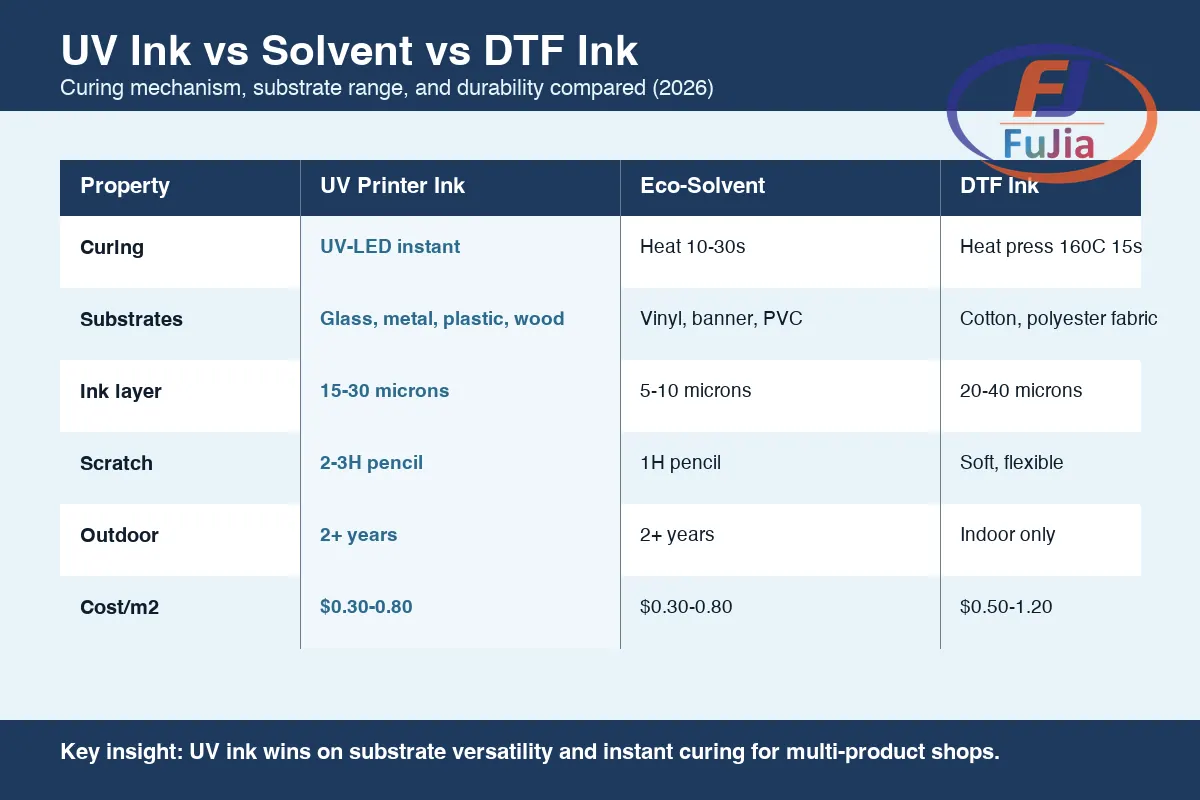
UV ink differs fundamentally from solvent, eco-solvent, and DTF ink in chemistry, curing mechanism, and application. Each ink type serves a distinct printing workflow.
| Property | UV Printer Ink | Eco-Solvent Ink | DTF Ink |
|---|---|---|---|
| Curing | UV-LED photopolymerization, instant | Heat evaporation, 10-30 seconds | Heat press at 160C for 15 seconds |
| Substrates | Rigid and flexible, no pre-treatment | Vinyl, banner, PVC media only | Cotton and polyester fabric via PET film |
| Ink layer | 15-30 microns, sits on top | 5-10 microns, absorbs into media | 20-40 microns with adhesive powder |
| Scratch resistance | 2-3H (3H+ with varnish) | 1H, requires lamination for abrasion | Soft hand, stretches with fabric |
| Outdoor durability | 2+ years unlaminated | 2+ years unlaminated | N/A (indoor garments only) |
| Cost per m² | $0.30-0.80 | $0.30-0.80 | $0.50-1.20 including film and powder |
UV ink wins on substrate versatility and instant drying, making UV the default choice for multi-product shops printing on glass, metal, plastic, and wood in the same shift. The chemistry behind this instant cure is covered in detail in our UV curable ink explainer. Eco-solvent ink wins on roll-to-roll speed for banners and vehicle wraps, where the 1.6m print width of the Fujia Eco-Solvent Printer produces 3 meters of banner in 5 minutes. DTF ink wins on apparel, where fabric stretch and repeated washing demand the elastomeric polymer bond that only heat-activated adhesive powder provides.
Shops running all three ink types source from Fujia Print’s UV printer consumables line because a single supplier eliminates the finger-pointing when a print fails. The founder built Fujia after running a print shop where the printer blamed the ink, the ink supplier blamed the film, and the film supplier blamed the printer. One supplier, one standard, one point of accountability.
Buying UV Printer Ink: Checklist
Sourcing UV printer ink requires verifying five specifications before committing to a supplier. The checklist below prevents the most expensive mistakes.
- Match the printhead model. Confirm whether the printer runs Ricoh GEN5, Epson i3200-U1, or Epson XP600 heads. The ink bottle label or spec sheet must list the compatible printhead family. Generic “universal UV ink” does not exist.
- Verify the curing wavelength. UV-LED lamps run at 385, 395, or 405 nm peak. The ink photoinitiator must match the lamp wavelength. Ask the supplier for the cure speed test result at the specific wavelength.
- Request certification documents. ISO 9001 manufacturing certification and REACH compliance documents confirm the ink meets European chemical safety standards. Fujia Print publishes both, plus ROHS and CE certification for the complete printer system.
- Order a 100ml test sample. Print the test on the actual production substrate, not the supplier’s reference material. Run a thumb-twist adhesion test, a cross-hatch tape test, and a 24-hour cure verification before approving bulk shipment.
- Calculate yield per m², not per liter. A $100-per-liter ink yielding 120 m² per liter costs $0.83 per m². A $160-per-liter ink yielding 100 m² per liter costs $1.60 per m². The cheaper cartridge is rarely the cheaper-per-print option.
Fujia Print ships free sample ink with every printer order, and the testing center prints customer designs on customer-supplied materials before the bulk ink order leaves the factory. This pre-shipment testing eliminates the compatibility guesswork that destroys printheads in the first week of production.
Does a UV printer use ink?
Yes, UV printers use liquid photopolymer ink that cures instantly under UV-LED light. UV ink is not a toner or dye sublimation process. The ink is a fluid mixture of monomers, oligomers, photoinitiators, and pigments delivered through piezoelectric inkjet printheads at room temperature. Ricoh GEN5 and Epson i3200-U1 printheads jet the ink droplets onto the substrate, and a UV-LED lamp positioned immediately after the printhead emits 395 nm photons that trigger cross-linking within milliseconds. The cured ink forms a solid polymer film 15-30 microns thick, depending on the number of passes and whether a varnish layer is applied. UV printers use between 4 and 8 ink channels: CMYK for color, White for opacity on dark or transparent substrates, Varnish for texture and protection, and optional Light Cyan and Light Magenta for smoother gradients. A 6-color CMYK+W+Varnish configuration covers 95 percent of commercial UV printing applications. Fujia Print’s UV printers run this 6-channel setup using custom-formulated ink matched to the Ricoh and Epson printheads in the factory’s 3,500 m² Guangzhou production facility.
What are the disadvantages of UV ink?
UV printer ink has four documented disadvantages that buyers should weigh against the speed and substrate versatility benefits. First, the cured ink film is rigid on hard formulations, meaning hard UV ink cracks when applied to flexible substrates that bend beyond 5 degrees. Phone cases, vinyl wraps, and leather goods require soft UV ink formulation, which costs 30-50 percent more per liter than hard ink. Second, uncured UV ink is a skin irritant and potential sensitizer. Operators must wear nitrile gloves and eye protection when refilling ink tanks or cleaning printheads, and printers must be positioned in ventilated areas because the monomer vapors cause headaches with prolonged exposure. Third, UV ink costs 2-4 times more per liter than water-based inkjet ink, with desktop cartridges reaching $300-600 per liter equivalent. The per-print cost remains competitive at $0.02-0.05 per label because the ink layer is thin, but the upfront cartridge investment is higher. Fourth, UV ink is incompatible with some food-contact applications without specific FDA-compliant edible formulations, and the photoinitiators can migrate into fatty foods if the ink is not fully cured. Proper curing verification with a UV radiometer eliminates this risk. None of these disadvantages disqualify UV ink for commercial printing, but each one requires a specific mitigation step that water-based and solvent inks do not demand.
How much does UV printer ink cost?
UV printer ink costs between $30 and $210 per unit in 2026, with the price depending on cartridge size, formulation, and supplier tier. Desktop cartridges for hobbyist printers like the eufyMake E1 and xTool O1 range from $29.99 to $84.99 per 100ml cartridge, equivalent to $300-600 per liter. Professional 500ml bottles and cartridges from Procolored, Xante, and Imagic range from $59 to $130, equivalent to $120-260 per liter. Industrial bulk 1-liter bottles and 6-color CMYK+W+Varnish sets from Fujia Print, STS Inks, and Inkcups range from $80 to $210 per set, equivalent to $80-160 per liter. The per-liter cost drops as volume increases because the raw monomer and pigment materials are inexpensive, and the markup comes from formulation, filtration, chip programming, and packaging. The practical metric is per-print cost, not per-liter cost. A UV DTF label measuring 5×5 cm consumes 0.3-0.5ml of ink including white and varnish layers, costing $0.02-0.05 per label at industrial bulk pricing. A full A1 flatbed bed at 60×90 cm consumes 15-25ml per cycle, costing $1.20-4.00 per bed. Shops calculating break-even against outsourced screen printing find that in-house UV printing at these ink costs pays back the printer investment within 3-8 months, based on aggregate data from Fujia Print customers across 50+ countries.
How long does UV printing ink last?
UV printing ink lasts 12 months sealed and 6 months opened when stored correctly, and the cured print lasts 2+ years outdoors and 500+ dishwasher cycles on varnished drinkware. Sealed ink bottles stored at 15-25C in opaque containers away from direct UV light maintain full curing performance for 12 months from the manufacture date. Opened bottles used in a printer with a sealed capping station last 6 months before the photoinitiators begin to degrade. Ink left in the dampers and printhead lines cures partially within 14 days of printer idle time, requiring a flush with UV cleaning fluid before the next production run. Fujia Print’s automatic sealed moisturizing and pumping system extends in-printer ink life to the full 6-month window by preventing air exposure in the printhead chamber. The cured print itself is chemically inert and far more durable than the wet ink. Outdoor UV prints on signage survive 2+ years unlaminated under direct sun, matching eco-solvent outdoor ratings. Varnished UV DTF labels survive 500+ dishwasher cycles and resist acetone, mild acids, and petroleum solvents. Wash durability on UV DTF drinkware reaches 100+ cycles at the 3H+ pencil hardness threshold. The cured polymer outlasts the product it decorates in most commercial applications.
Conclusion
UV printer ink is the consumable that determines whether a UV printer produces sellable prints or scrap. Hard, soft, and CMYK+W+Varnish formulations each serve specific substrates, printhead compatibility is non-negotiable, and the real cost metric is per-print yield rather than per-cartridge price. For factory-direct UV ink pricing matched to Ricoh and Epson printheads, explore Fujia Print’s UV printer lineup and consumables.
Sources
- ASTM D3363-20 Standard Test Method for Film Hardness by Pencil Test: backs the 3H+ pencil hardness claim for cured UV ink film with varnish, published by ASTM International Committee D01.
- AATCC TM135 Test Method for Dimensional Changes of Fabrics after Home Laundering: backs the wash durability and mechanical cycle testing protocol referenced for UV DTF label performance.
- U.S. FDA Food Ingredients and Packaging Inventory: backs the food-contact compliance and photoinitiator migration safety claims for edible UV ink formulations.
