

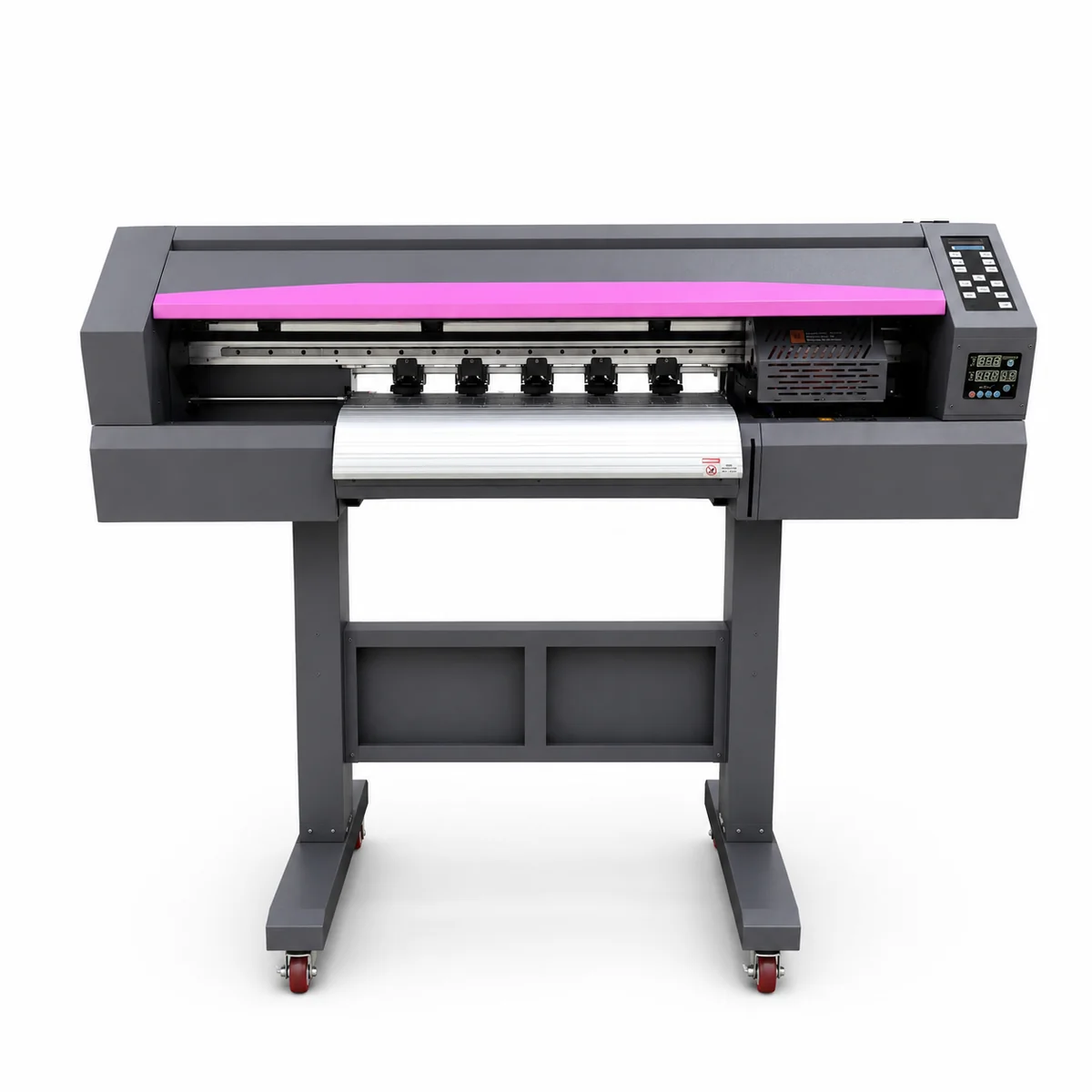
A heat press machine applies controlled heat and pressure to transfer printed designs from carrier media onto fabric, ceramic, metal, and composite substrates. The global heat press machine market reached USD 1.82 billion in 2025 and is projected to grow to USD 3.00 billion by 2032 at a CAGR of 7.4%, fueled by the expansion of custom apparel, print-on-demand services, and promotional product decoration. Fujia Print integrates heat press technology into complete DTF and sublimation workflows, with transfer parameters of 160 degrees C for DTF and 200 degrees C for sublimation calibrated across all equipment lines.
Key Takeaways
- A heat press machine combines a heated upper platen, a lower pressure surface, and a timing mechanism to permanently bond transfer designs to substrates at 150-220 degrees C.
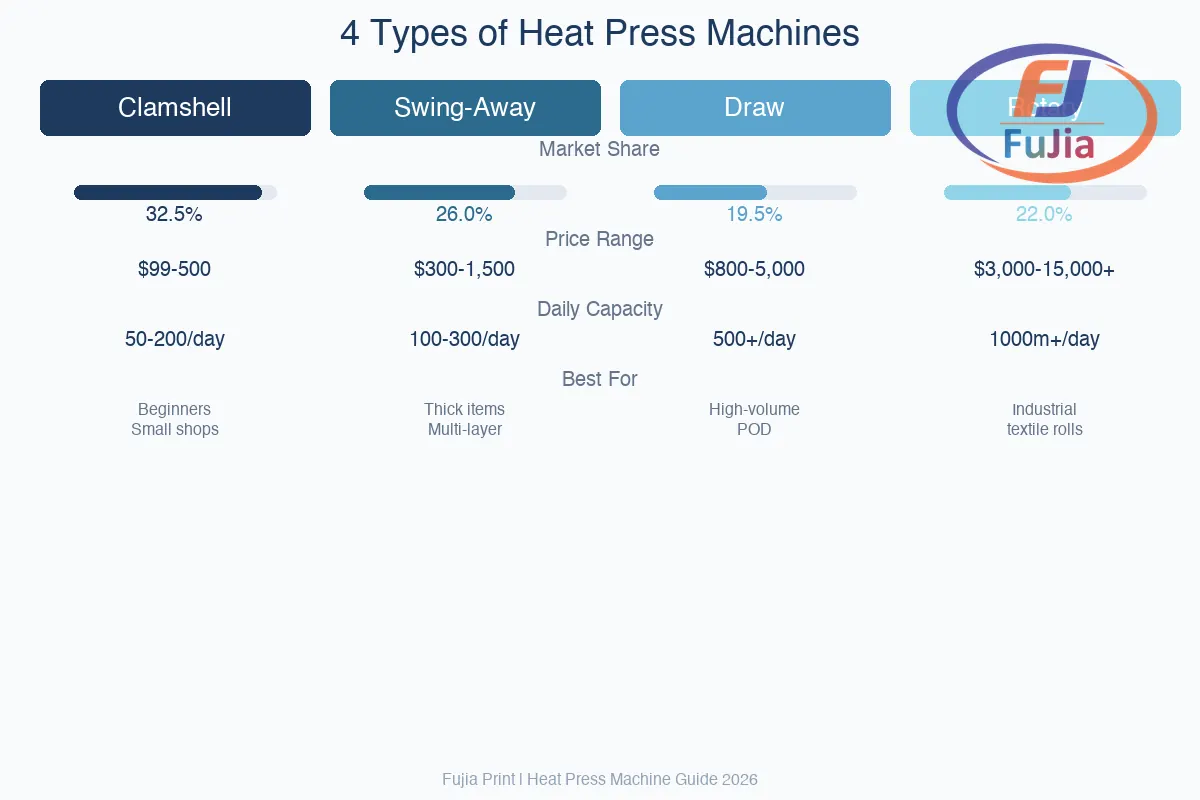
- Four machine architectures dominate the market: clamshell (32.5% share), swing-away (26%), draw press (19.5%), and rotary/continuous (22%), each optimized for different production volumes.
- Entry-level machines start at USD 39 (Cricut EasyPress Mini) and reach USD 1,350+ for professional clamshell systems from brands like Stahls’ and Hotronix.
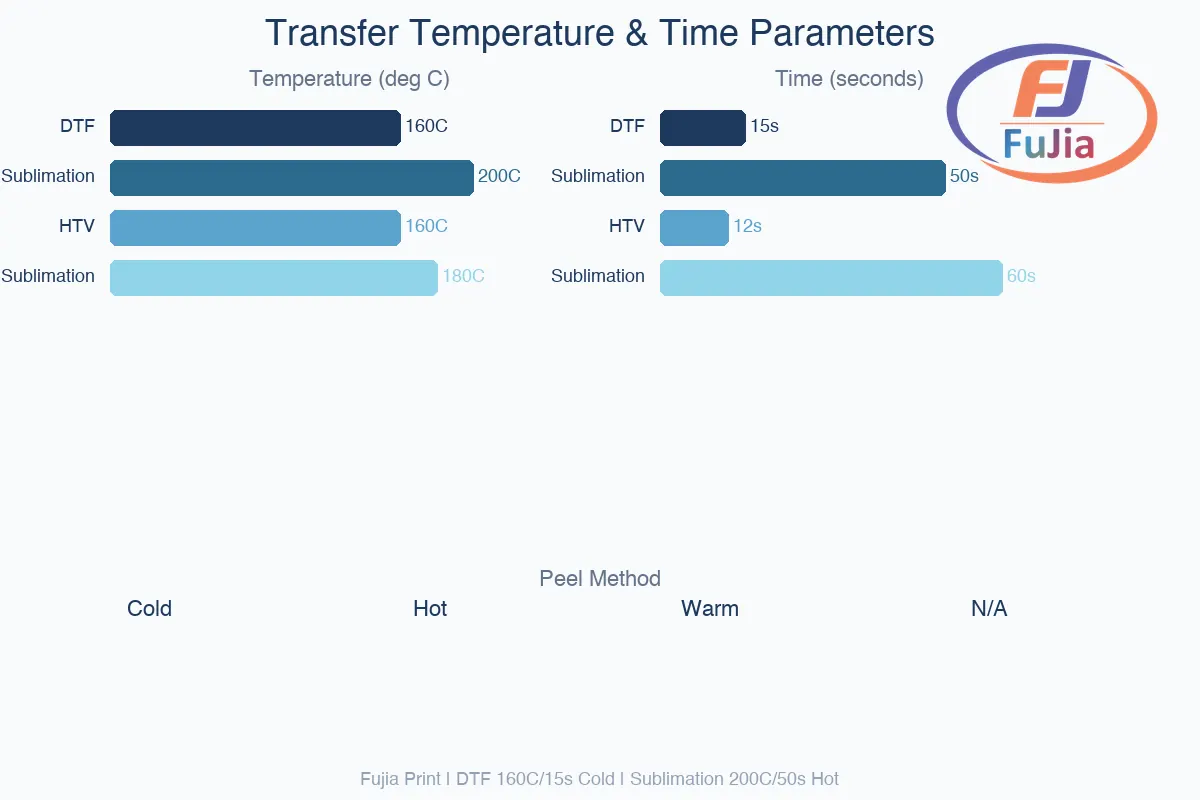
- DTF transfers require 160 degrees C at 15 seconds with cold peel, while sublimation demands 200 degrees C at 45-60 seconds with hot peel.
- Machine selection depends on platen size, pressure distribution uniformity, temperature accuracy (+/- 2 degrees C), and daily production volume.
What Is a Heat Press Machine?
A heat press machine is an electromechanical device that uses a heated metal platen (typically aluminum) to apply simultaneous heat and pressure to a substrate, activating the adhesive chemistry in transfer media. The upper platen heats to a target temperature controlled by a thermostat or digital PID controller. The lower platen provides a flat, heat-resistant surface that receives the garment or substrate. When the press closes, the heated upper platen contacts the transfer material, melting the adhesive or dye carrier and bonding it to the substrate surface.
Heat press machines serve three primary transfer technologies. Direct-to-film (DTF) transfers use a heat press at 160 degrees C for 15 seconds to melt TPU adhesive powder and bond ink to fabric. Dye sublimation requires 200 degrees C for 45-60 seconds to convert solid dye particles into gas that penetrates polyester fibers. Heat transfer vinyl (HTV) application uses 150-170 degrees C for 10-15 seconds to activate the polyurethane adhesive layer on vinyl sheets.
The ASTM D5034 standard defines test methods for breaking strength and elongation of textile fabrics, which provides the framework for evaluating whether heat press transfers compromise fabric structural integrity. Properly calibrated heat press parameters maintain fabric tensile strength within the acceptable range defined by ASTM D5034, while excessive temperature or pressure can reduce fabric breaking force by 10-20%.
Four Types of Heat Press Machines
Heat press machines are categorized by their mechanical architecture, which determines workflow, space requirements, and production speed. Each type serves distinct use cases from hobbyist crafting to industrial-scale garment decoration.
Heat Press Type Comparison
| Type | Market Share | Mechanism | Platen Sizes | Best For | Price Range |
|---|---|---|---|---|---|
| Clamshell | 32.5% | Hinged, opens like a clamshell | 9×12 to 16×20 in | Beginners, small shops, tight spaces | USD 99-500 |
| Swing-away | 26% | Upper platen swings 90 degrees to the side | 15×15 to 20×25 in | Multi-layer transfers, thick substrates | USD 300-1,500 |
| Draw | 19.5% | Lower platen pulls out like a drawer | 16×20 to 40×60 in | High-volume production, large designs | USD 800-5,000 |
| Rotary | 22% | Continuous roll-feed through heated drum | Roll-to-roll, 1.6m+ width | Industrial textile, soft signage | USD 3,000-15,000+ |
Clamshell Heat Press
Clamshell presses are the most common heat press type, accounting for 32.5% of the global market. The upper platen hinges upward in a single motion, opening like a clamshell. This design is compact, affordable, and simple to operate. The limitation is that the upper platen swings directly over the lower platen, which means the operator works in the heat zone when loading garments. Clamshell presses suit small to medium production volumes of 50-200 transfers per day.
The VEVOR 5-in-1 Heat Press at USD 149.90 (4.7-star rating on Home Depot) is a representative clamshell model with interchangeable platens for mugs, caps, and plates. At the professional end, Stahls’ Hotronix clamshell presses start at USD 1,350 and feature digital pressure readouts and auto-open timing.
Swing-Away Heat Press
Swing-away presses mount the upper platen on a pivot arm that rotates 90 degrees to the side. The operator loads garments on the lower platen without the heated surface overhead, which improves safety and accessibility for thick items like mouse pads, ceramic tiles, and layered fabrics. Swing-away presses typically cost 30-50% more than equivalent clamshell models due to the additional pivot mechanism. Production shops handling mixed substrates (garments plus hard goods) favor swing-away designs.
Draw Press
Draw presses feature a lower platen that slides out toward the operator like a drawer. The operator loads the garment on the extended lower platen, then pushes it back under the stationary heated upper platen. This design completely separates the loading zone from the heat zone, enabling faster cycle times for high-volume production. Draw presses dominate in print-on-demand fulfillment centers processing 500+ transfers daily.
Rotary and Continuous Feed
Rotary heat presses use a heated drum system where fabric and transfer paper feed continuously through the machine. These machines handle roll-to-roll production at widths up to 1.6 meters and beyond. Rotary presses are essential for dye sublimation on polyester fabric rolls for soft signage, sportswear, and home textiles. The Fujia Print sublimation line pairs A1 roll-to-roll sublimation printers with compatible rotary heat press systems for full-bleed edge-to-edge textile printing.
Temperature, Pressure, and Time Parameters
Heat press performance is defined by three variables: temperature accuracy, pressure distribution, and timing precision. Each transfer technology requires specific parameter combinations to achieve proper adhesion without substrate damage.
Transfer Parameter Matrix
| Transfer Type | Temperature | Time | Pressure | Peel | Substrate |
|---|---|---|---|---|---|
| DTF | 160 degrees C | 15 sec | 1.5-2.5 kg/cm2 | Cold | Cotton, poly, blends, nylon, leather |
| Sublimation (fabric) | 200 degrees C | 45-60 sec | 2.0-3.0 kg/cm2 | Hot | Polyester 60%+ (white/light) |
| Sublimation (mug) | 180 degrees C | 60 sec | Firm | N/A | Polymer-coated ceramic |
| HTV (heat transfer vinyl) | 150-170 degrees C | 10-15 sec | 2.0-2.5 kg/cm2 | Warm/cold | Cotton, poly, blends |
| UV DTF (hand transfer) | N/A | 10-15 sec | Manual | N/A | Any hard surface |
Temperature accuracy is the single most critical specification. Professional heat press machines maintain +/- 2 degrees C uniformity across the entire platen surface. Budget models may vary by +/- 10-15 degrees C between center and edges, which causes inconsistent transfer quality. This variance explains why entry-level presses at USD 99-150 often produce uneven transfers on large designs despite reaching the target center temperature.
Pressure distribution works through a combination of platen flatness, padding thickness, and adjustment mechanism. Clamshell presses use a single central pressure point that can create uneven distribution on larger platens. Swing-away and draw presses typically use dual or four-point pressure systems that distribute force more evenly. The DTF printers Fujia manufactures pair with heat presses calibrated for 1.5-2.5 kg/cm2, the optimal range for TPU adhesive activation across cotton and polyester substrates.
Heat Press Machine Pricing
Heat press machine prices span from USD 39 for craft irons to USD 15,000+ for industrial rotary systems. Price correlates with platen size, temperature accuracy, build quality, and automation features.
Price Tier Comparison
| Tier | Price Range | Typical Models | Platen Size | Temperature Accuracy | Daily Capacity |
|---|---|---|---|---|---|
| Craft / hobby | USD 39-99 | Cricut EasyPress Mini ($39), Cricut EasyPress SE ($99.99) | 4×6 to 9×9 in | +/- 5-10 degrees C | 10-20 transfers |
| Entry clamshell | USD 99-200 | VEVOR T-Shirt Press ($99.99), Adnoom 5-in-1 ($125.99), VEVOR 5-in-1 ($149.90) | 12×10 to 15×15 in | +/- 5 degrees C | 50-100 transfers |
| Pro clamshell | USD 200-500 | Htvront Auto Press ($199.99), LOKLiK Auto ($236), VEVOR 2-in-1 ($191.25) | 15×15 to 16×20 in | +/- 3 degrees C | 100-200 transfers |
| Commercial | USD 1,350-5,000 | Stahls’ Hotronix, Geo Knight, HIX | 16×20 to 40×60 in | +/- 2 degrees C | 500-1000 transfers |
| Industrial rotary | USD 3,000-15,000+ | Sefa, Monti Antonio, roll-fed drum systems | 1.6m+ roll width | +/- 1 degree C | 1000m+/day |
Based on data from our customers across 50+ countries, the break-even point for upgrading from a craft press (USD 100-200) to a professional clamshell (USD 1,350+) typically occurs at 100+ transfers per day. Below that volume, temperature accuracy differences of +/- 5 degrees C rarely produce visible quality differences on standard cotton tees. Above 100 daily transfers, the consistency and durability of professional equipment reduces reject rates from 8-12% to under 3%, paying for the price difference within 3-6 months.
Choosing the Right Heat Press Machine
Selecting a heat press machine requires matching four factors to the buyer’s production reality: transfer technology, substrate mix, daily volume, and workspace constraints.
Decision Framework
| If you need… | Choose | Why |
|---|---|---|
| DTF transfers on cotton tees, under 50/day | Entry clamshell 15×15 in | DTF at 160 degrees C for 15 sec runs on any clamshell with +/- 5 degrees C accuracy |
| Sublimation on polyester sportswear, 50-200/day | Pro clamshell or swing-away 16×20 in | Sublimation needs 200 degrees C uniformity; pro models maintain +/- 2-3 degrees C |
| Mixed DTF + sublimation + HTV, 100-500/day | Swing-away with interchangeable platens | Swing mechanism handles thick substrates and multi-layer transfers safely |
| High-volume POD fulfillment, 500+/day | Draw press 16×20 or larger | Drawer loading separates heat zone from operator, enabling 60-90 second cycle times |
| Roll-to-roll textile sublimation | Rotary drum press, 1.6m+ width | Continuous feed handles fabric rolls at 1-3 m/min throughput |
A Brazilian creative studio using the Fujia A3 desktop DTF printer achieved a 5.5-month payback period by pairing the printer with an entry-level clamshell press for small-batch custom apparel. The studio reduced per-order cost from R$18 to R$6.50 and increased order fulfillment from 15 to 22 orders per week, demonstrating that matching press capability to actual production volume matters more than buying the most expensive equipment.
Is it worth buying a heat press machine?
Buying a heat press machine is worth the investment for anyone producing more than 15-20 custom garments per month. Entry-level clamshell presses at USD 99-200 pay for themselves within 1-3 months compared to outsourcing transfers at USD 3-5 per shirt. A heat press enables in-house production of DTF, sublimation, and HTV transfers with full control over quality, turnaround time, and design iteration. For commercial operations, the heat press market reaching USD 1.82 billion in 2025 reflects strong demand for in-house decoration capability. The key factors to evaluate are daily transfer volume, substrate types (garments vs. hard goods), and temperature accuracy requirements (+/- 2 degrees C for sublimation vs. +/- 5 degrees C acceptable for DTF on cotton).
Which is better, Cricut or heat press?
Cricut EasyPress models and traditional heat press machines serve different production scales. The Cricut EasyPress Mini at USD 39 is a craft iron designed for occasional hobby projects with small designs (under 9×9 inches). A traditional clamshell heat press at USD 99-500 provides consistent pressure across the entire platen, which is essential for full-size garment transfers (15×15 inches and larger). Cricut EasyPress lacks the mechanical pressure mechanism that professional heat presses use, meaning the operator must apply manual pressure. For production beyond 20 transfers per day or for sublimation (which requires 200 degrees C with uniform pressure), a dedicated heat press machine outperforms Cricut products significantly. Cricut works well for hobbyists, while heat press machines serve small businesses and production shops.
What is the best heat press machine for beginners?
The best heat press machine for beginners is a 15×15 inch clamshell press priced between USD 99 and USD 200, such as the VEVOR T-Shirt Press at USD 99.99 or the Adnoom 5-in-1 Combo at USD 125.99. These models provide the essential features for learning heat transfer: digital temperature control up to 200 degrees C, an adjustable timer with audible alarm, and enough platen area for standard adult t-shirts. The 15×15 inch platen size accommodates full-front designs on adult S-XXL garments. Beginners should avoid machines smaller than 12×10 inches (too restrictive for standard apparel) and larger than 16×20 inches (unnecessary complexity and cost for learning). A 5-in-1 combo press with interchangeable mug and cap attachments offers the best value for beginners exploring multiple product types.
What is the difference between a steam press and a heat press?
A steam press uses steam to remove wrinkles from fabric and is a garment care appliance, not a transfer tool. A heat press machine uses dry heat at 150-220 degrees C combined with mechanical pressure to transfer designs onto substrates. Steam presses operate at lower temperatures (100-150 degrees C) and introduce moisture, which interferes with transfer adhesion chemistry. DTF adhesive powder melts at 110-125 degrees C but requires dry heat to flow properly into fabric fibers. Sublimation dye converts from solid to gas at 200 degrees C and would be ruined by steam moisture. Heat press machines feature Teflon-coated platens, precise digital temperature controllers, and adjustable pressure mechanisms, none of which steam presses provide. The two devices serve completely different purposes: steam presses iron clothes, heat press machines decorate them.
Conclusion
Heat press machines remain the indispensable bonding tool for every digital transfer technology, from DTF and sublimation to HTV and UV DTF. Selecting the right machine type and matching its temperature, pressure, and time parameters to the transfer technology determines production quality and profitability. For complete DTF and sublimation workflows including printers, inks, and calibrated heat press parameters, explore the Fujia Print product lines.
Sources
- Grand View Research / PMarketResearch: Heat Press Market 2025-2032: Global heat press machine market valued at USD 1.82 billion in 2025, projected to reach USD 3.00 billion by 2032 at 7.4% CAGR, driven by custom apparel and print-on-demand expansion.
- Growth Market Reports: Heat-Press Machine Market 2025-2034: Market segmentation by type (clamshell 32.5%, swing-away 26%, draw, sublimation), application, and region. Asia Pacific leads at 41% market share.
- ASTM D5034-21(2025): Breaking Strength and Elongation of Textile Fabrics: Standard test method for evaluating fabric tensile integrity, providing the framework for assessing whether heat press parameters compromise substrate structural properties.
