

White ink for DTF printers is a water-based pigment ink containing rutile titanium dioxide (TiO2) that provides the opaque underbase layer required for printing vibrant colors on dark garments. TiO2 has a density of approximately 4.2 g/cm3, over three times heavier than the carrier fluid at 1.0 to 1.2 g/cm3, which causes sedimentation and makes white ink the most maintenance-intensive channel in any DTF system. Understanding why white ink behaves differently from CMYK channels, and how to manage its settling properties, determines whether a DTF printer runs reliably for years or clogs within months.
Key Takeaways
- DTF white ink uses rutile titanium dioxide (TiO2) pigment at 15 to 30 percent by weight, with a density differential of roughly 3.5 times between pigment and carrier fluid, causing inevitable sedimentation.
- White ink viscosity ranges from 10 to 30 mPa seconds at 22 degrees Celsius, compared to 3.5 to 6.0 mPa seconds for CMYK inks, making it thicker and more prone to nozzle blockage.
- All white DTF ink sediments. The engineering difference is between soft sediment (remixable with gentle agitation) and hard sediment (permanently blocks ink lines and requires component replacement).
- Continuous white ink circulation systems reduce manual maintenance frequency by up to 80 percent over six months by keeping TiO2 particles suspended in the ink channels.
- Fujia Print DTF printers feature an automatic power-off white ink circulation system that prevents TiO2 precipitation during operation and even continues running during power outages.
What Makes White Ink Different in DTF Printing
DTF printing uses five ink channels: cyan, magenta, yellow, black, and white. The four CMYK channels behave like standard piezoelectric inkjet inks, with low-viscosity pigment or dye solutions that flow predictably through printhead nozzles. White ink is fundamentally different in both chemistry and behavior.
The white pigment in DTF ink is rutile titanium dioxide (TiO2), the most thermodynamically stable crystal form of the compound. Rutile TiO2 has a refractive index of n=2.75, which gives it the high opacity needed to create a solid white underbase on dark fabrics. Without this underbase, CMYK inks alone cannot produce visible colors on black or dark-colored garments because the translucent color pigments disappear into the dark substrate.
TiO2 particle size in quality DTF white ink is controlled between 0.2 and 0.5 micrometers (200 to 500 nanometers). This sub-micron range balances opacity requirements with printhead nozzle compatibility, since DTF printhead nozzles typically have apertures of 20 to 50 micrometers. The pigment loading reaches 15 to 30 percent by weight in standard formulations, with high-quality white ink requiring a solids content of at least 25 percent to achieve full coverage on dark substrates. For a broader overview of DTF printers and their ink system architecture, the white ink channel is the most technically demanding component in the entire machine.
The density differential between TiO2 pigment and the water-based carrier fluid is the root cause of all white ink maintenance challenges. At 4.2 g/cm3, TiO2 is approximately 3.5 times denser than the carrier fluid at 1.0 to 1.2 g/cm3. Gravity pulls the pigment particles downward whenever the ink sits still. Sedimentation can begin within 3 hours of idle time depending on ambient temperature, meaning even a normal lunch break can start the settling process.
(TOC triggers here)
Why White Ink Clogs: The Sedimentation Problem
White ink clogging in DTF printers is not a defect. It is a predictable physical property of titanium dioxide pigment in a liquid carrier. Understanding the distinction between soft sediment and hard sediment determines whether clogs are easily reversible or permanently damaging.
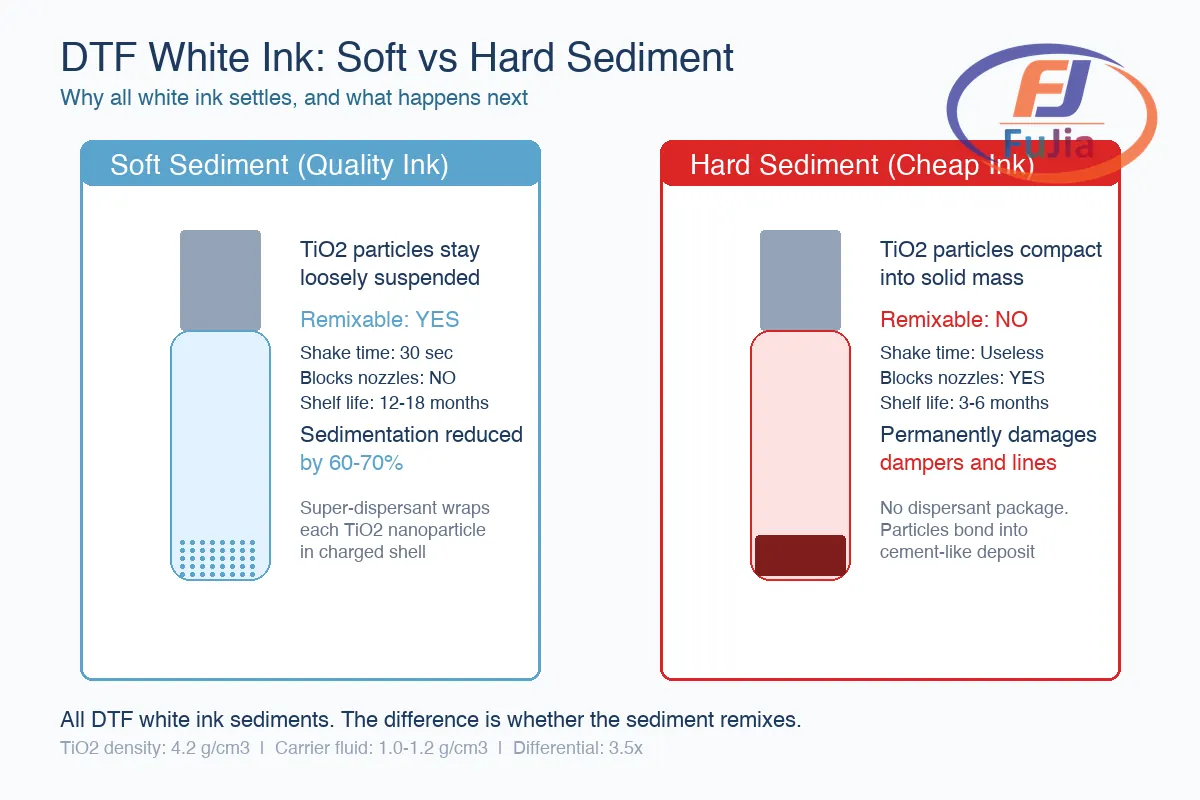
Soft sediment is a loose, non-solidifying precipitate that can be shaken or stirred back into uniform suspension. When you gently invert a white ink bottle, the network of dispersant molecules breaks instantly and the particles redistribute. Soft sediment does not block ink lines or printhead channels if the ink is agitated before use. Quality white ink formulations use super-dispersant packages that wrap each TiO2 nanoparticle in a charged molecular shell, creating electrostatic repulsion between particles and reducing sedimentation rate by 60 to 70 percent compared to standard formulations.
Hard sediment is a caked, solidified precipitate that cannot be remixed. It permanently blocks ink lines, dampers, and printhead channels, requiring physical cleaning or component replacement. Hard sediment forms when soft sediment is left undisturbed for extended periods (weeks or months), allowing the loose particles to compress and bond into a solid mass. This is what happens when a DTF printer sits unused for a long weekend without proper shutdown procedures.
White Ink vs CMYK Ink: Technical Comparison
| Property | CMYK DTF Ink | White DTF Ink |
|---|---|---|
| Pigment type | Organic pigment | Rutile TiO2 (inorganic) |
| Pigment density | ~1.5 g/cm3 | ~4.2 g/cm3 |
| Carrier density | 1.0-1.2 g/cm3 | 1.0-1.2 g/cm3 |
| Density differential | ~1.3x | ~3.5x |
| Viscosity (22C) | 3.5-6.0 mPa*s | 10-30 mPa*s |
| Particle size | <200 nm | 0.2-0.5 um (200-500 nm) |
| Pigment loading | 5-15% by weight | 15-30% by weight |
| Sedimentation time | Minimal (hours/days) | 3+ hours |
| Circulation required | No | Yes (mandatory) |
White Ink Circulation Systems: How They Work
A white ink circulation system is the single most effective engineering solution to the sedimentation problem. The system keeps TiO2 particles suspended by continuously moving ink through the printhead channels at timed intervals, preventing the settling that leads to clogs.
Most modern commercial DTF printers include a built-in circulation system, though entry-level models may require manual activation or lack the feature entirely. The circulation pump runs ink through a closed loop: from the ink reservoir, through the damper and printhead channel, and back to the reservoir. This continuous flow prevents TiO2 particles from settling in any component.
Timed circulation intervals vary by system design. Roller pump systems typically run 10 seconds of circulation every 2 hours. Gravity-fed loop systems run 30 seconds every 4 hours. The key principle is that ink must move before sedimentation begins, which means circulation must happen at least every 3 to 4 hours during any idle period.
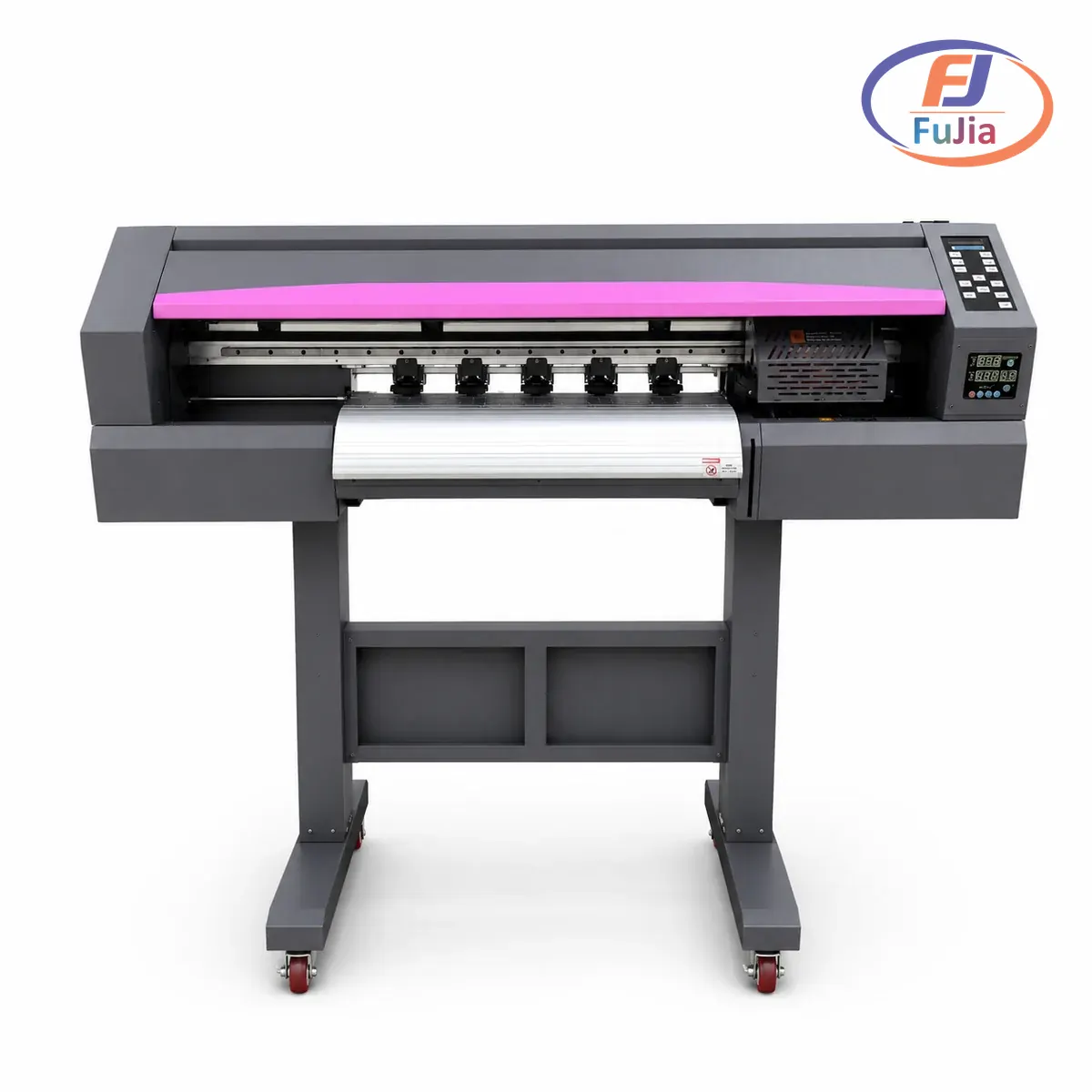
Fujia Print DTF printers implement an automatic power-off white ink circulation system that prevents TiO2 precipitation during operation. The system includes an auto power-off circulation mechanism that continues protecting the ink lines even during power outages, a feature not commonly found on entry-level machines. This design uses a siphon plus positive pressure supply system with 1000 to 1500 ml per color capacity, ensuring that white ink remains in motion through extended production runs.
For printers without built-in circulation, operators can install an external white ink stirring tank connected inline between the ink reservoir and the cartridge feed line. A 12V micro pump with low-flow output, food-grade silicone tubing (4 mm internal diameter), and a 24-hour programmable timer can simulate continuous motion. This retrofit is especially common with converted Epson desktop models used in entry-level DTF setups.
Daily White Ink Maintenance Protocol
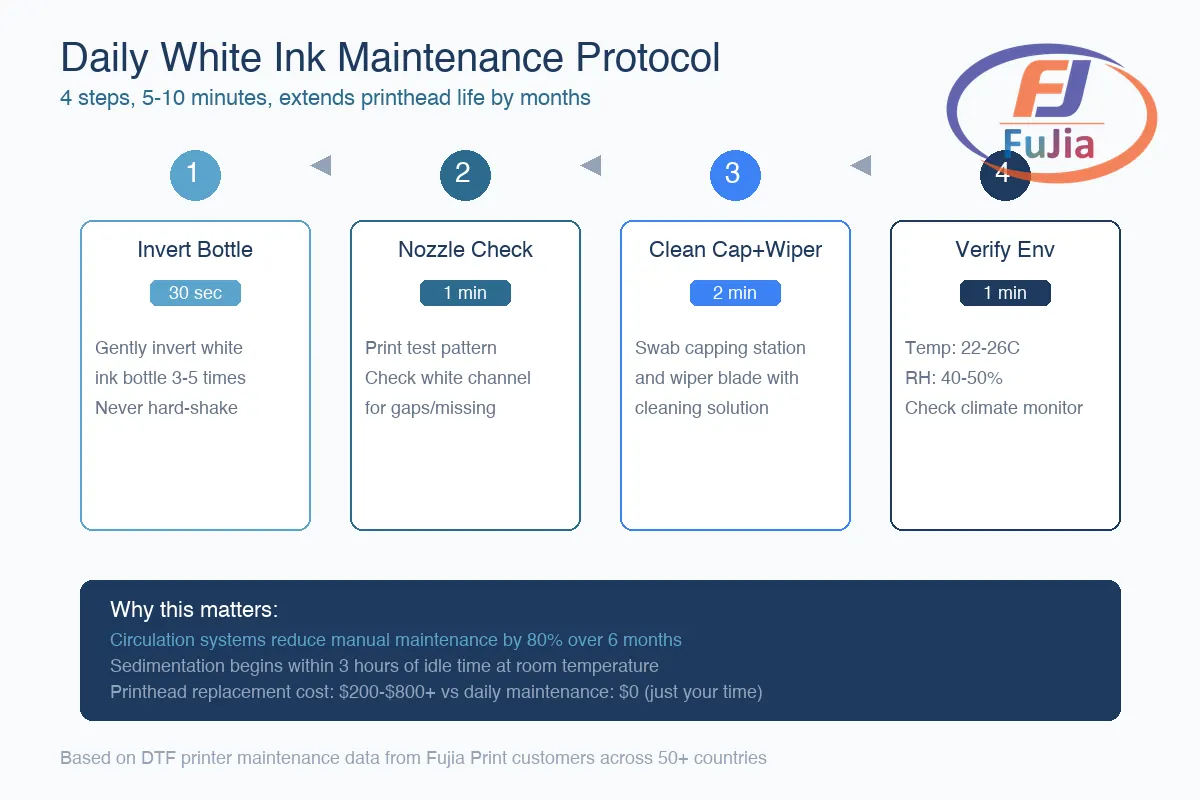
Even with a circulation system, daily maintenance routines extend printhead life and prevent the gradual degradation that leads to white ink failure. A complete daily protocol takes 5 to 10 minutes and follows four steps.
Gently invert white ink bottles. Remove the bottle and slowly invert it several times to re-suspend pigment without introducing air bubbles. Never hard-shake the bottle, as violent agitation creates micro-bubbles that cause ink spitting and banding. The goal is gentle mixing, not foaming.
Run a nozzle check. Print a small nozzle check pattern at the start of each session. If the white ink channel shows gaps or missing lines, run a light head cleaning cycle. Avoid running more than 2 to 3 cleaning cycles consecutively, as this wastes ink and can worsen the problem by introducing air into the channels.
Clean the capping station and wiper blade. The capping station creates the seal that prevents nozzles from drying out overnight. Dried ink residue on the rubber seal seeds repeat clogs. Use a foam-tipped swab moistened with cleaning solution to wipe the cap seal and wiper blade until free of residue.
Verify environmental conditions. Keep the print room between 22 and 26 degrees Celsius (72 to 79 degrees Fahrenheit) with relative humidity between 40 and 50 percent. High humidity above 60 percent causes moisture absorption in ink channels, promoting micro-clots. Low temperatures below 18 degrees Celsius increase ink viscosity, making circulation and purging less effective.
Choosing Quality White Ink for Your DTF Printer
Not all DTF white inks perform equally. The formulation quality directly determines how quickly sediment forms, how easily it remixes, and how long the ink remains usable after opening.
Soft sediment formulation is the most important quality factor. Look for ink specifications that mention super-dispersant packages, anti-settling agents, or soft sediment engineering. These formulations wrap each TiO2 nanoparticle in a charged molecular shell that creates electrostatic repulsion between particles, preventing aggregation into dense clusters. A secondary steric hindrance mechanism, where dispersant polymer chains physically block particle-to-particle contact, provides a second layer of protection.
Particle size consistency affects both opacity and printhead safety. Quality white ink controls TiO2 particle size between 200 and 500 nanometers, with tight distribution. Larger particles or wider size distribution increase clogging risk, since oversized particles cannot pass through 20 to 50 micrometer nozzle apertures. Ask suppliers for particle size analysis data if available.
pH stability matters for long-term storage. DTF white ink should maintain a pH between 7.0 and 9.0. Inconsistent pH causes pigment dispersion to break down over time, accelerating sedimentation. Ink stored in cool, dark conditions (15 to 30 degrees Celsius) maintains stability for 12 to 18 months sealed, or 6 months after opening.
Fujia Print’s DTF ink system uses imported premium resin and pigment raw materials with high concentration, uniform particle size, and smooth viscosity. The formulation includes anti-settling agents that work in concert with the printer’s built-in circulation system, reducing the frequency of manual bottle inversion from daily to every 2 to 3 days during active production periods. For more details on the full DTF ink color range including the 13-color system, see our DTF ink types guide.
Why does white ink clog more than color ink in a DTF printer?
White ink clogs more frequently than CMYK inks because its pigment, rutile titanium dioxide (TiO2), has a density of approximately 4.2 g/cm3, which is 3.5 times denser than the water-based carrier fluid at 1.0 to 1.2 g/cm3. This density differential causes TiO2 particles to settle to the bottom of ink lines, dampers, and printhead channels within 3 hours of idle time. CMYK pigments, by contrast, have densities much closer to the carrier fluid and remain suspended for days or weeks without agitation. When settled TiO2 particles dry inside printhead nozzles, they create blockages that require flushing or, in severe cases, printhead replacement. The solution is continuous white ink circulation, which keeps particles suspended by moving ink through the system at timed intervals. Printers with built-in circulation systems reduce manual maintenance frequency by up to 80 percent over six months compared to printers that rely on manual shaking alone.
How often should I shake or circulate white ink in my DTF printer?
You should circulate white ink daily at minimum, with gentle bottle inversion performed before each printing session. For printers with built-in circulation systems, the pump should run automatically at intervals of 10 seconds every 2 hours (roller pump) or 30 seconds every 4 hours (gravity loop). For printers without automatic circulation, manually invert the white ink bottle for 30 to 60 seconds at the start of each day and after any break longer than 2 hours. On long production days exceeding 8 hours, a mid-day circulation cycle provides additional protection. Never hard-shake white ink bottles, as violent agitation introduces micro-bubbles that cause ink spitting, banding, and inconsistent opacity. Gentle inversion re-suspends pigment without trapping air. The optimal room environment for white ink stability is 22 to 26 degrees Celsius with 40 to 50 percent relative humidity.
What is soft sediment white ink and do I need it?
Soft sediment white ink is a formulation that uses super-dispersant packages to ensure any settled titanium dioxide pigment remains loose and remixable rather than solidifying into permanent blockages. All DTF white inks sediment because TiO2 is physically heavier than the carrier fluid, making settling a certainty rather than a quality defect. The difference between soft and hard sediment is what happens after settling occurs. Soft sediment can be shaken or stirred back into uniform suspension with gentle inversion, and the remixable state persists for weeks of storage. Hard sediment, found in lower-quality inks or inks past their shelf life, forms a caked mass that cannot be remixed and permanently blocks ink lines and dampers. Soft sediment formulations reduce sedimentation rate by 60 to 70 percent compared to standard white ink. If you print daily, standard white ink with regular circulation may suffice. If you print infrequently (a few times per week) or store ink for extended periods, soft sediment white ink is worth the additional cost.
Can I print DTF transfers without white ink?
You cannot print DTF transfers on dark or colored garments without white ink. White ink serves two functions that no other channel can replicate. First, it creates an opaque underbase layer that covers the fabric color, preventing dark substrate tones from bleeding through and muting the CMYK design. Second, the white ink layer provides the adhesive surface that bonds with the hot-melt DTF powder during the curing process. Without white ink, the adhesive powder has nothing to bond with, and the transfer will not adhere to the fabric. You can technically print on white or very light-colored garments using CMYK-only DTF, but the color vibrancy drops significantly compared to prints with a white underbase, and the powder adhesion becomes unreliable. For consistent results across all fabric colors, white ink is a mandatory component of the DTF process. Shops that want to avoid white ink maintenance should consider sublimation printing for polyester-only, light-color applications instead.
Conclusion
White ink is the most functionally important and maintenance-intensive channel in any DTF printer system, and understanding its titanium dioxide chemistry, sedimentation behavior, and circulation requirements determines whether your printhead lasts months or years. For DTF printers with built-in automatic white ink circulation, factory-direct pricing, and engineered anti-settling ink formulations, explore the Fujia Print product lineup.
Sources
- DTF Technology: Industrial White Ink Material Data Sheet: Rutile TiO2 density 4.2 g/cm3, particle size <200nm, viscosity 10-30 mPa*s, pigment loading 15-30% by weight, soft sediment engineering specifications.
- ScienceDirect: Titanium Dioxide (TiO2) Properties: Rutile TiO2 refractive index n=2.75, thermal stability properties, and pigment density reference data.
- Grand View Research: Direct to Film Printing Market: DTF market growth driving demand for improved white ink formulations, roll-to-roll segment USD 652M (2024) to USD 987M (2030).
