

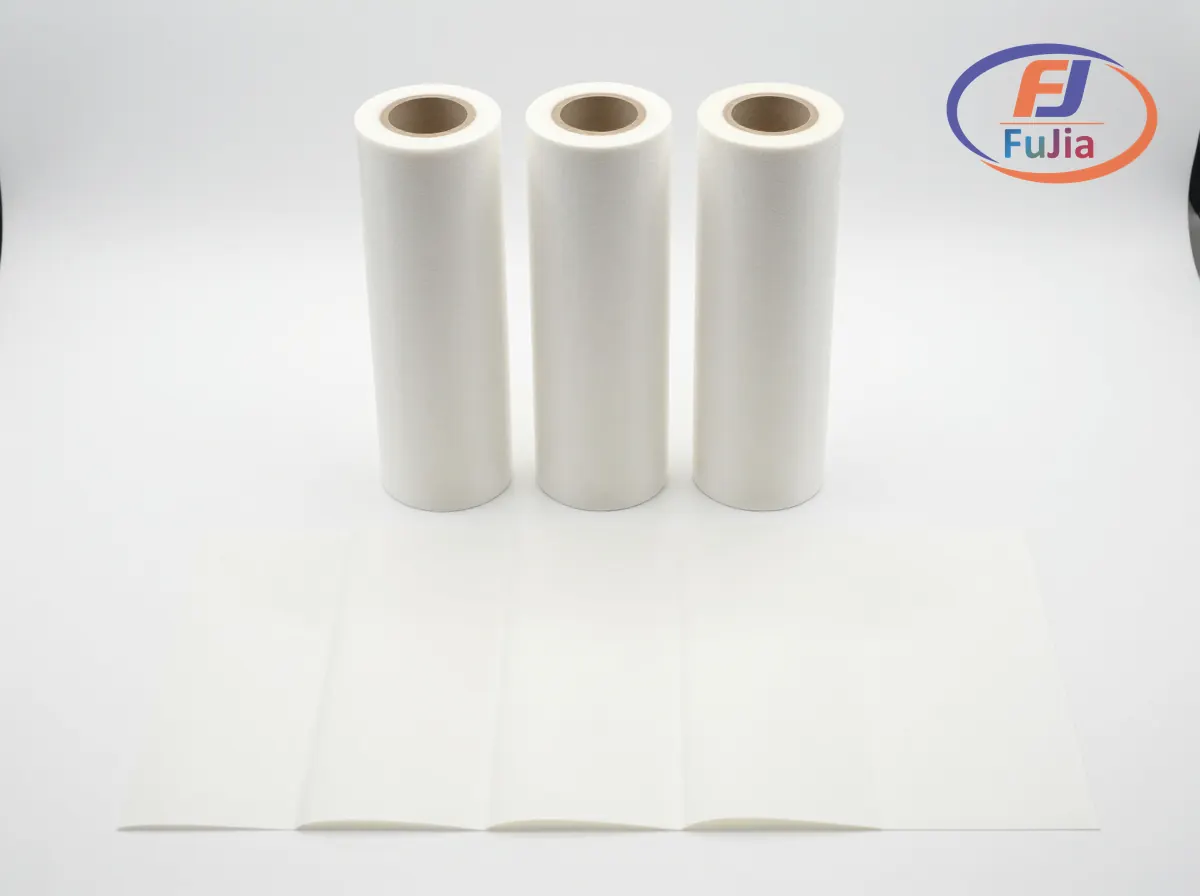
DTF printer paper, technically called DTF transfer film or PET film, is a coated polyethylene terephthalate substrate that receives CMYK and white ink from a DTF printer, carries adhesive powder, and transfers the printed design onto fabric through a heat press at 150-160 degrees Celsius for 10-15 seconds. DTF film comes in thicknesses of 38 to 100 micrometers, is available in A4 sheets to 120cm rolls, and wholesales at $0.12 to $1.50 per sheet depending on size, coating type, and order volume.
Key Takeaways
- DTF printer paper is PET film with a specialized coating, not regular paper, and it cannot be used in standard inkjet printers without DTF modification
- Standard thickness is 75 micrometers (plus or minus 5), with 3-layer coating: print-receptive layer, adhesive release layer, and PET base
- Cold peel film produces more durable transfers; hot peel film produces softer hand feel
- DTF film costs $0.12-$0.50 per A4 sheet in bulk and $45-$180 per 60cm x 100m roll depending on brand and coating quality
- Fujia Print DTF film uses Hengli virgin PET base with a proprietary coating developed through 5 years of R&D iteration, available in A1, A2, and A3 formats
What Is DTF Printer Paper?
DTF printer paper is not paper at all. The term refers to PET (polyethylene terephthalate) film coated with a specialized ink-receptive layer that allows DTF printers to deposit CMYK ink plus a white underbase onto its surface. PET film has a melting point of 250-260 degrees Celsius and shrinkage below 1.5% at 150 degrees Celsius, providing the dimensional stability needed to withstand heat press temperatures without warping or melting, according to technical data on PET film from Goodfellow. For a complete overview, see the Fujia DTF printer lineup guide.
The coating structure typically consists of three layers: a PET base film (75 micrometers thick), an adhesive release layer that allows the film to separate from the transferred design, and a print-receptive top layer that absorbs DTF ink uniformly. Without this coating, PET film would repel water-based DTF ink, causing it to pool and run rather than forming a sharp image. The coating also determines whether the film is cold peel or hot peel, affecting the final transfer quality and feel.
Types of DTF Transfer Film
| Type | Peel Method | Hand Feel | Durability | Best For |
|---|---|---|---|---|
| Cold peel | Remove after full cooling | Slightly thicker | Higher (50-100 washes) | Production runs, dark fabrics |
| Hot peel | Remove immediately after press | Softer, lighter | Good (40-50 washes) | Lightweight garments, fine detail |
| Hybrid (warm peel) | Peel warm or cold | Medium | Good | Mixed fabric applications |
| Double-sided | Print either side | Varies | Standard | Beginner-friendly, versatile |
| Pre-powdered | Adhesive pre-applied | Medium | Good | Beginners avoiding powder mess |
Cold Peel Film
Cold peel DTF film requires waiting for the transfer to cool completely (typically 10-30 seconds after pressing) before peeling away the PET carrier. The cooling process allows the thermoplastic polyurethane adhesive to fully bond with both the ink layer and the fabric fibers, producing transfers rated for 50-100 wash cycles. Cold peel transfers have a slightly thicker, more rubbery hand feel but deliver the highest durability for commercial apparel production. The Fujia Print DTF film uses a cold peel formulation with a proprietary coating developed over 5 years of R&D, built on a Hengli virgin PET base for consistent ink absorption across production batches.
Hot Peel Film
Hot peel film is removed immediately after the heat press cycle ends, while the transfer is still at peak temperature. This produces a thinner ink deposit with a softer feel that many users prefer for lightweight summer garments and fashion applications. The trade-off is slightly lower wash durability (40-50 cycles typical) because the adhesive does not have time to fully crystallize into the fabric structure. Hot peel is popular for print-on-demand operations where speed matters and garments see lighter use cycles.
DTF Film Sizes and Formats
DTF printer paper is available in two formats: precut sheets for desktop printers and continuous rolls for production machines.
| Format | Sizes | Price Range | Printer Type |
|---|---|---|---|
| A4 sheets | 8.3 x 11.7 in (210 x 297mm) | $0.25-$1.50/sheet | A3 desktop DTF (FJ-A30) |
| A3 sheets | 11.7 x 16.5 in (297 x 420mm) | $0.50-$2.00/sheet | A3 desktop DTF |
| 30cm rolls | 30cm x 100m | $30-$80/roll | A3 DTF roll-fed |
| 60cm rolls | 60cm x 100m | $45-$150/roll | A1 DTF (Fujia A1 2-Head, 4-Head) |
| 120cm rolls | 120cm x 100m | $90-$300/roll | Industrial wide-format DTF |
Sheet counts per carton: A4 sheets come 200 per carton, A3 sheets 200 per carton, and rolls are packed 4 per carton (30cm), 2 per carton (60cm), or 1 per carton (120cm). The Fujia Print film line covers A1 (60cm), A2 (42cm), and A3 (30cm) roll formats to match the company’s printer width specifications.
DTF Film Specifications
Standard DTF transfer film specifications across manufacturers:
| Parameter | Specification | Notes |
|---|---|---|
| Base material | PET (polyethylene terephthalate) | Melting point 250-260C |
| Thickness | 75 micrometers (plus or minus 5) | Also available in 38, 50, 100um |
| Width tolerance | plus or minus 2mm | Per industry standard |
| Coating layers | 3 (print-receptive, release, base) | Determines ink absorption |
| Transfer temperature | 150-160 degrees Celsius | 302-320 degrees Fahrenheit |
| Press time | 10-15 seconds | With medium pressure (5-7 kg) |
| Powder curing temp | 100-120 degrees Celsius | 2-3 minutes in curing oven |
| Shelf life | 12 months | Stored at 15-30C, 35-65% RH |
| Transfer rate | 95-98% | Ink transferred to fabric |
| Ink compatibility | CMYK + White pigment ink | Water-based DTF formulation |
Storage conditions matter: DTF film must be kept sealed in its original packaging at 15-30 degrees Celsius and 35-65% relative humidity. Exposure to humidity above 65% causes the coating to absorb moisture, leading to ink bleeding and poor powder adhesion. Once a roll is opened, unused portions should be resealed immediately.
How to Use DTF Printer Paper
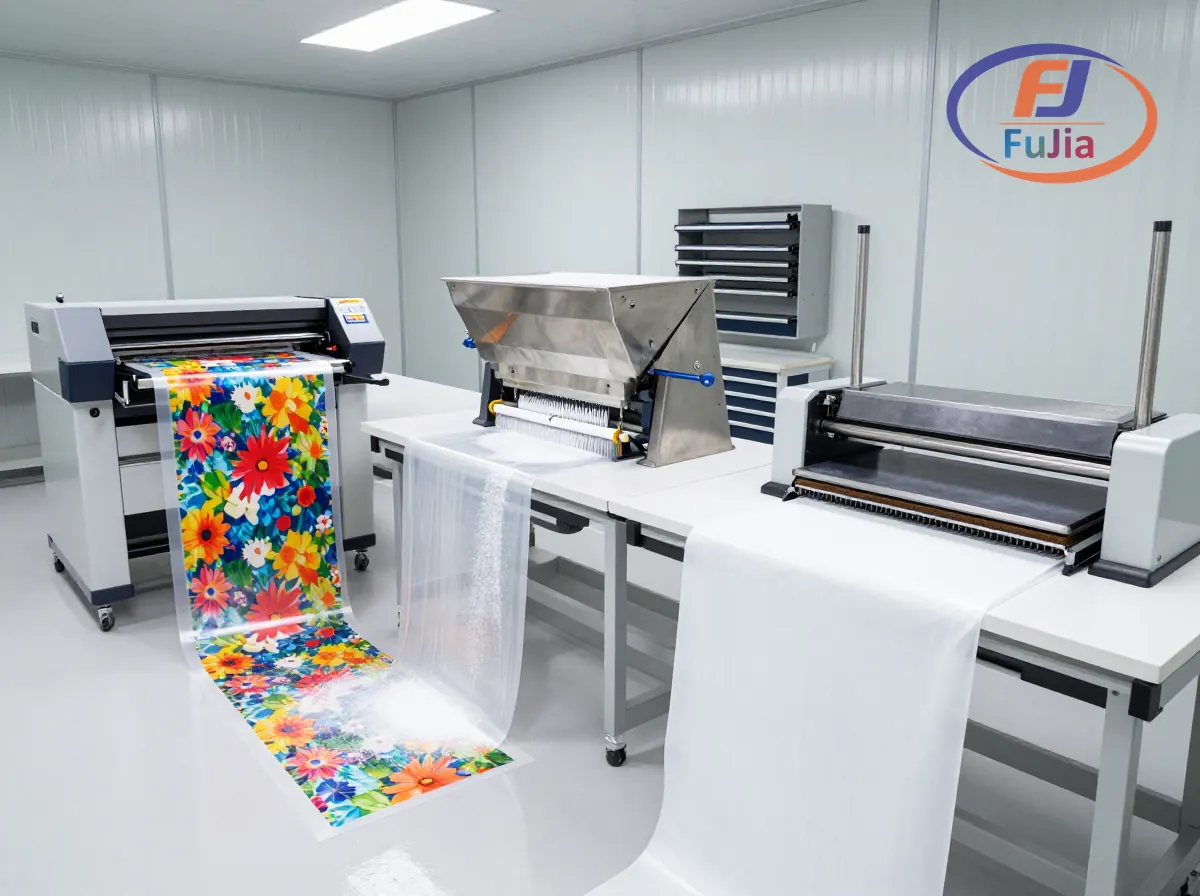
Step 1: Print the design.
Load DTF film into your DTF printer with the coated (matte) side facing the printheads. Print the design in mirror image using CMYK ink plus white underbase. The white layer prints last (on top) and serves as the adhesive powder receptor. Print at 720×1440 dpi or higher for photographic quality, and ensure white ink coverage exceeds 70% for opaque transfers on dark fabrics.
Step 2: Apply adhesive powder.
Immediately after printing, pass the film through a powder shaker or apply TPU adhesive powder manually. The wet white ink layer captures the powder. Remove excess powder by shaking or tapping the film. Powder that does not stick to wet ink will transfer to blank areas and cause unwanted specks on the garment.
Step 3: Cure the powder.
Pass the powder-coated film through a curing oven at 100-120 degrees Celsius for 2-3 minutes. The oven melts the TPU powder into a smooth, glossy layer that bonds with the white ink. The film surface temperature should reach 70-90 degrees Celsius during this process. Undercured powder will produce a grainy finish and poor adhesion; overcured powder will yellow the white layer.
Step 4: Heat press the transfer.
Place the cured film onto the garment with the printed side facing the fabric. Press at 150-160 degrees Celsius for 10-15 seconds with medium pressure (5-7 kg). For cold peel film, allow the transfer to cool completely before peeling. For hot peel film, peel immediately after opening the press. The transferred design is now permanently bonded to the fabric.
DTF Film Pricing and Bulk Buying
DTF film pricing scales dramatically with order volume and brand positioning. Based on aggregate data from our customers across 50+ countries, small print shops buying A4 sheets from Amazon pay $0.50-$1.50 per sheet, while production facilities importing 60cm rolls factory-direct from China reduce cost to $0.12-$0.25 per A4-equivalent transfer.
| Purchase Method | Format | Price | Per-Transfer Cost |
|---|---|---|---|
| Amazon retail | A4 sheets (50 pack) | $25-$75 | $0.50-$1.50 |
| Domestic wholesaler | A4 sheets (500 pack) | $100-$250 | $0.20-$0.50 |
| Factory-direct rolls | 60cm x 100m | $45-$150 | $0.12-$0.25 |
| OEM manufacturer | 120cm x 100m | $90-$300 | $0.08-$0.18 |
The Fujia Print factory in Guangzhou supplies DTF film in A1, A2, and A3 roll formats, paired with DTF ink in a 13-color system (CMYK + LC + LM + Orange + Red + Green + Blue + White) and DTF adhesive powder matched to the film’s coating formulation. For setup guidance, read our DTF film for inkjet printer guide.
Can you use DTF paper in a normal printer?
No, you cannot use DTF paper in a normal inkjet printer. Standard inkjet printers use dye-based or pigment inks that are not compatible with DTF film coating chemistry, and they lack the white ink channel required for DTF transfers. DTF printers are modified inkjet printers with specialized DTF ink systems (CMYK + White), upgraded ink delivery tubes that handle the thicker white pigment ink, and RIP software that manages the white underbase layer. A standard Epson or Canon printer loaded with DTF film will produce smeared, non-adherent ink that washes off immediately. To convert a standard inkjet for DTF, you need a DTF modification kit (ink tanks, dampers, RIP software) and DTF-specific ink sets. The minimum viable setup is an Epson L1800 or ET-15000 with a DTF conversion kit, though dedicated DTF printers like the Fujia Print A3 DTF 1-Head (FJ-A30) offer better reliability and warranty coverage at similar total cost.
Are DTF and sublimation paper the same?
No, DTF film and sublimation paper are completely different materials with different chemistries and transfer mechanisms. Sublimation paper carries sublimation ink that turns from solid to gas at 200 degrees Celsius and bonds molecularly with polyester fibers, meaning the paper itself is not transferred to the garment. DTF film carries a solid ink layer plus TPU adhesive powder that physically transfers from the film to the fabric surface, creating a polymer layer on top of the fibers. Key differences: sublimation paper works only on polyester (60% or higher) and light-colored fabrics, while DTF film works on cotton, polyester, blends, nylon, and dark fabrics. Sublimation produces zero hand feel (dye enters fibers), while DTF produces a slight rubbery feel (polymer layer sits on surface). DTF film is PET-based (75 micrometers thick), while sublimation paper is actual paper (80-120 gsm) with a sublimation-receptive coating.
Can I print my own DTF transfers?
Yes, you can print your own DTF transfers if you have a DTF-modified printer, DTF ink, DTF film, TPU adhesive powder, and a heat press. The minimum equipment investment is approximately $500-$2,000 for a converted Epson desktop printer with DTF ink system and manual powder application, or $2,000-$8,000 for a dedicated DTF printer with automated powder shaker. The workflow is: print design on DTF film (5-10 minutes), apply powder (30 seconds manual or automated), cure in oven (3 minutes), heat press onto garment (15 seconds). A Fujia Print A3 DTF 1-Head printer (FJ-A30) with single XP600 printhead produces 2-3 square meters per hour at 1440×1440 dpi, suitable for a startup producing 15-22 custom orders per week. A Brazilian creative studio using this exact setup reduced per-order cost from R$18 to R$6.50 (64% reduction) and achieved 96% profit per order with a projected 18-month payback period.
What is the difference between DTF film and DTF paper?
DTF film and DTF paper refer to the same product: PET transfer film used in DTF printing. The terms are used interchangeably in the industry, though “DTF film” is the technically accurate name since the material is polyethylene terephthalate film, not paper. Some products marketed as “DTF paper” are thinner (38-50 micrometers) versions of the same PET base material, while standard DTF film is 75 micrometers thick. Both terms describe the coated substrate that receives DTF ink, carries adhesive powder, and transfers the design to fabric through heat pressing. When purchasing, verify the thickness (75um is standard), peel type (cold or hot), and coating side (single or double sided) regardless of whether the seller calls it film or paper.
Conclusion
DTF printer paper is PET transfer film available in 75-micrometer thickness with cold peel or hot peel coatings, sizes from A4 sheets to 120cm rolls, and prices from $0.12 to $1.50 per transfer. Explore Fujia Print DTF film for factory-direct rolls matched to your DTF printer width, or read our DTF film for inkjet printer guide for conversion details.
