

Key Takeaways
- A 4-head DTF printer prints about twice as fast as a 2-head: roughly 27 m²/hr on a 650mm (25.5in) bed versus 8-13 m²/hr for a 2-head A1.
- The break-even point lands near 200 or more transfers per day. Below that, a 2-head or A3 model is the smarter buy.
- Fujia’s A1 4-head uses named Epson I3200 heads on a Honson mainboard, a Leadshine servo, and a THK guide rail for 12-hour runs.
- Moving from 2-head to 4-head is not a field upgrade. The chassis, ink system, and RIP are built for four heads.
- For confirmed bulk and wholesale volume, a 4-head pays for itself in months, not years, when paired with factory-direct pricing and a 12-month warranty.
What a 4-Head DTF Printer Brings to Production
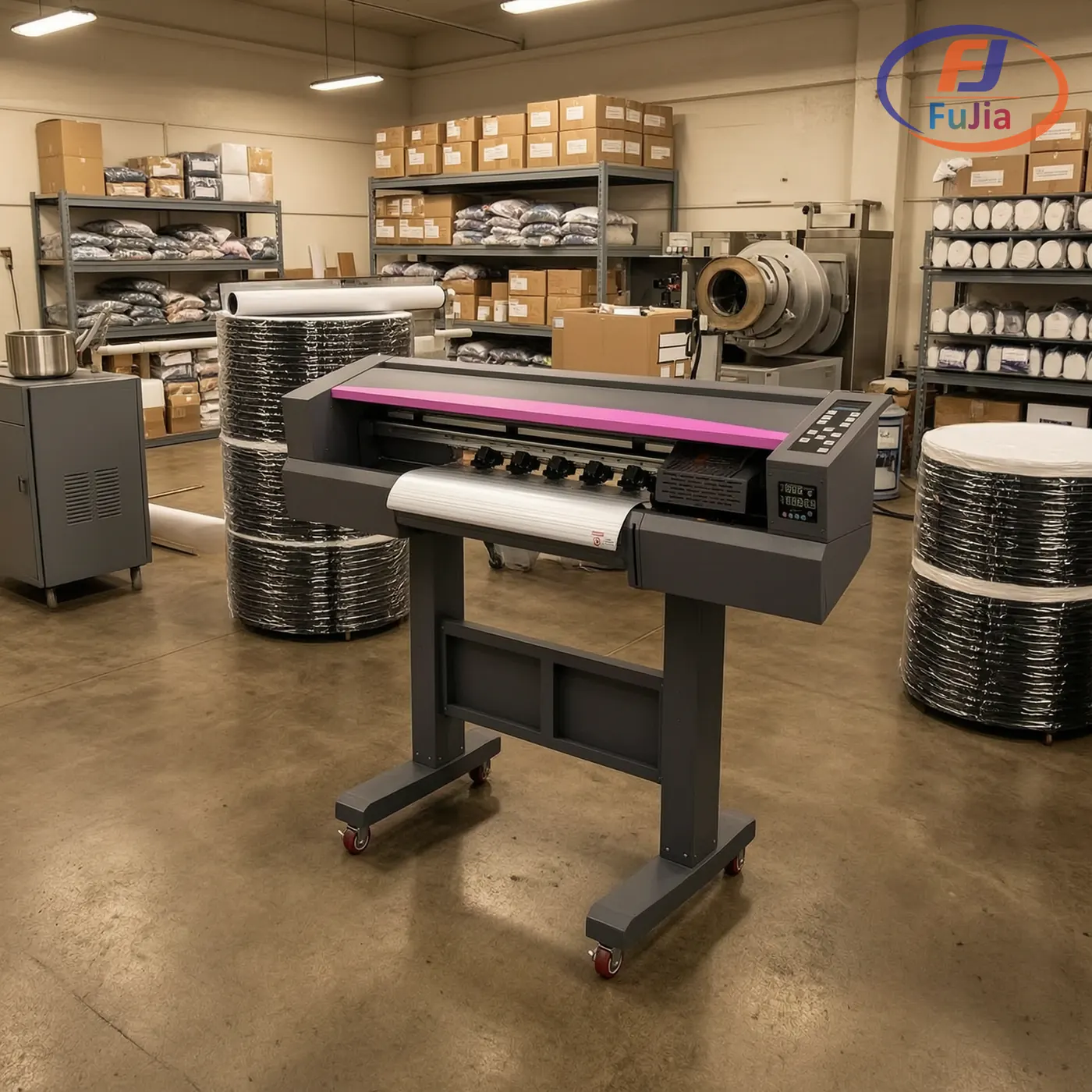
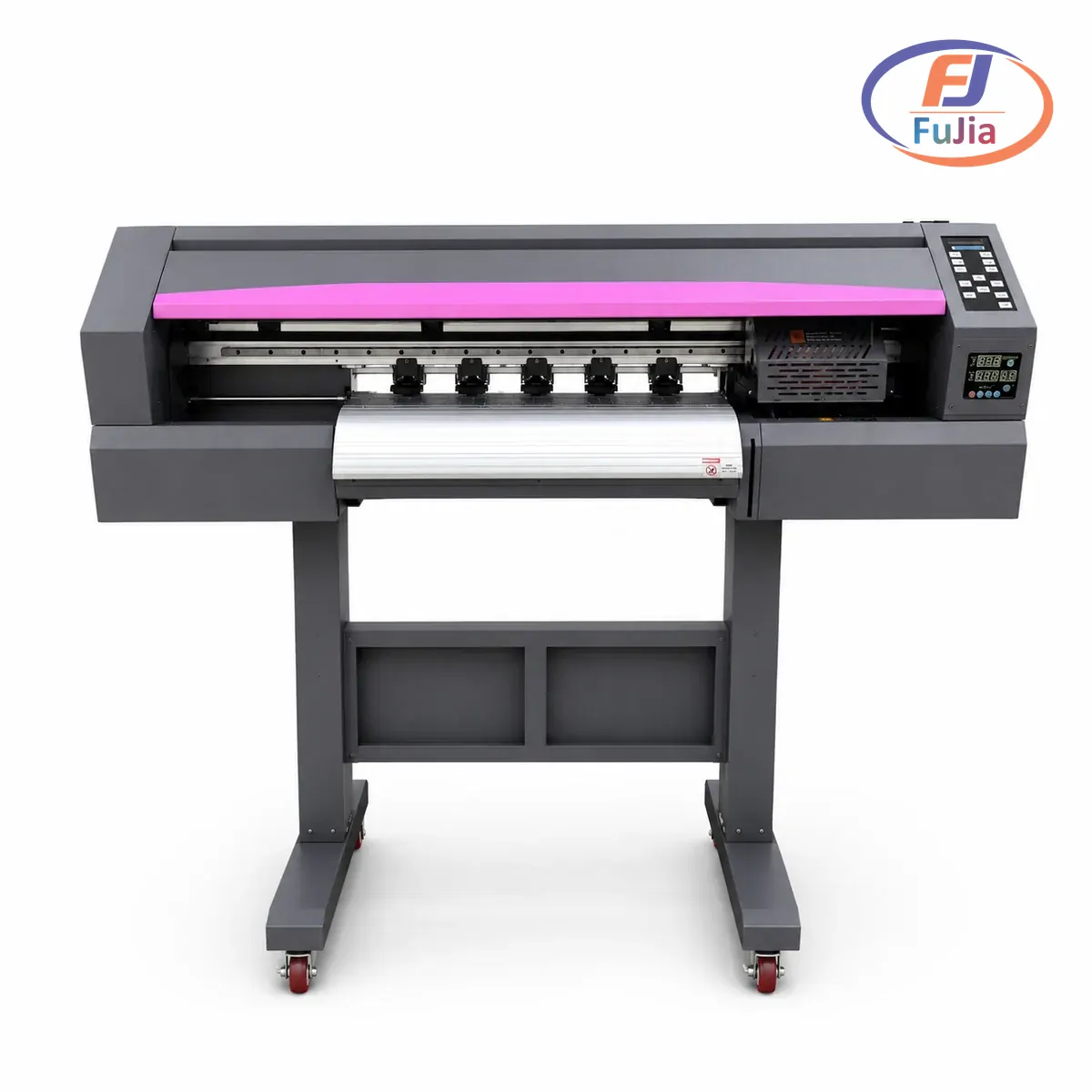
A 4-head DTF printer carries four Epson I3200 printheads instead of two. On Fujia’s A1 4-head (model DTF-A1-4H), that means a 650mm (25.5in) print bed running at 27 m²/hr in 4-pass mode, 22 m²/hr at 6-pass, and 17 m²/hr at 8-pass, with a top resolution of 720×2400 dpi. The printer body weighs 155kg and the shaker 230kg, drawing 35W at the print station and up to 2,300W at the shaker.
The transmission stack is the part most buyers never see. The DTF-A1-4H uses a Honson mainboard, a Leadshine servo motor, and a THK silent guide rail. Those three named components let the machine hold alignment through 12-hour continuous runs without quality drift, which is why Fujia quotes stable output for shift work.
Ink is where the 4-head pulls ahead on color. The system runs CMYK plus white, light cyan, and light magenta as standard, and expands to 8 or 13 colors with orange, red, green, and blue. Fujia’s DTF ink is a 13-color system built on imported resin and pigment, so multi-color gradients stay smooth instead of banding. White ink uses an auto power-off circulation system that keeps titanium dioxide from settling even during outages.
For daily operation, the A1 4-head holds noise below 32 dB at idle and under 65 dB at full load, with daily maintenance of about 3-5 minutes (wipe the capping station, run a nozzle check). For the full A1 DTF line and specifications, see Fujia’s DTF printer overview.
4-Head vs 2-Head: The Capacity Gap in Numbers
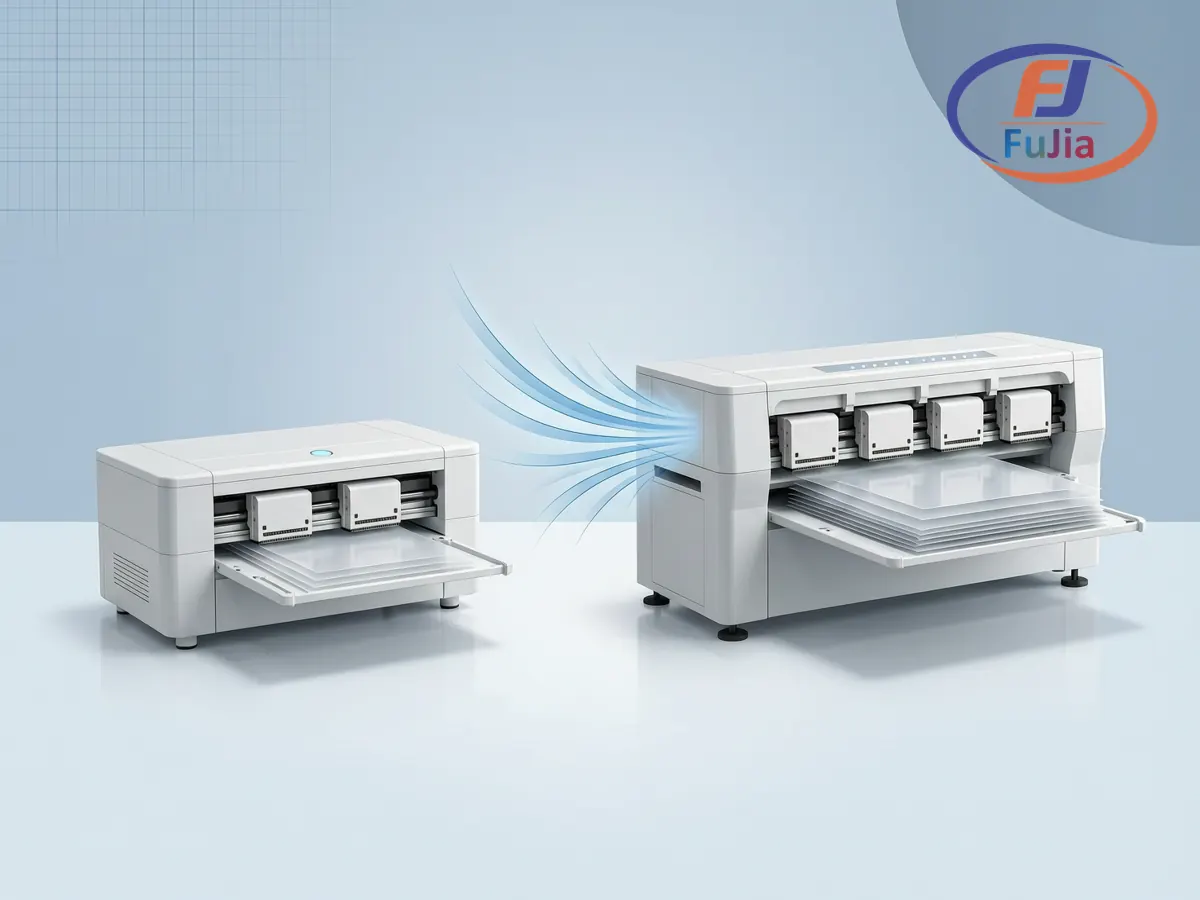
The headline difference is throughput. Independent spec sheets put a 4-head 60cm DTF printer at about 30 m²/hr and a 2-head at about 15 m²/hr, a clean 2x. Third-party ROI writeups land in the same place per transfer: a 4-head produces 100-120 A3 transfers an hour against 50-60 for a 2-head.
| Factor | 2-head DTF (A1) | 4-head DTF (A1) |
|---|---|---|
| Printheads | 2x Epson I3200 | 4x Epson I3200 |
| Max speed | 8-13 m²/hr | 27 m²/hr (4-pass) |
| Color set | CMYK + W (5-6) | Up to 13-color |
| Transfer output | 50-60 A3/hr | 100-120 A3/hr |
| White ink coverage | Moderate | Dense, even on dark fabric |
| Footprint | Smaller shaker | Longer shaker, more floor space |
| Best fit | Startups, part-time | Bulk, wholesale, contract |
The numbers track with what reviewers report in the field. One widely cited review notes 4-head units reach up to 145 linear feet per hour, nearly double a 2-head. The speed gap is real, not marketing.
What you give up is simplicity. A 4-head has more heads to maintain, a larger shaker, and higher power draw. It is not a field upgrade from a 2-head: the chassis, ink delivery, and RIP are designed around four heads, so moving up means buying a new machine.
Real Production Numbers: What 145 ft/hr Means for Your Shop
Translating speed into shop reality: at 100-120 A3 transfers an hour, a single 4-head covers a 500-transfer wholesale order in roughly 4-5 hours instead of a full 8-hour shift on a 2-head. That recovered time is where the machine earns its keep, because it lets you take a second job the same day or push due dates earlier.
Based on data from our customers across 50+ countries, shops that cross about 200 finished transfers per day are the ones that see a 4-head pay back fastest, typically inside 4-8 months when volume is steady. Below that line, the extra heads sit idle and the higher purchase price stretches the payback past a year. Region matters: markets with higher labor costs see faster payback because the saved labor hours are worth more.
The case for a 4-head is not speed alone. It is speed multiplied by consistency. Four heads spread the workload, so each head wears slower and color banding drops between passes. For contract decorators shipping daily bulk, that consistency is what protects repeat business, and it shows in the wash: DTF prints on the AATCC scale typically hold 4-5 grades and survive 50 or more industrial washes without cracking. A 4-head running steady, even color keeps that rating batch after batch, which is why wholesale buyers come back.
Who a 4-Head DTF Printer Pays Off For
Buy a 4-head if you recognize these signals:
- Confirmed bulk or wholesale orders that already max out your current machine.
- Tight turnaround contracts where a missed day costs the client.
- Plans to scale into retail fulfillment or multi-client decorating.
- Idle time on a 2-head because demand outruns 50-60 transfers an hour.
Hold off if you are part-time, space-limited, or still proving demand. A 2-head A1 or even an A3 desktop covers 2-3 m²/hr and 50-60 transfers an hour, which is enough until orders are real. Buying capacity you will not use is the fastest way to kill ROI. Buyers comparing live stock can review current DTF printers for sale before committing.
| Your situation | Recommendation |
|---|---|
| 200+ transfers/day, wholesale contracts | 4-head A1 (DTF-A1-4H) |
| 50-200 transfers/day, growing | 2-head A1 |
| Under 50 transfers/day, home-based | A3 desktop (FJ-A30) |
| Proving demand, no contracts yet | Start 2-head, scale later |
For buyers weighing the outlay, Fujia ships the A1 4-head from a 3,500 m² Guangzhou factory with a 12-month warranty, common parts dispatched within 48 hours, and a 3-day remote onboarding that ends with your first clean print. That support structure matters more at 4-head scale, where downtime on four heads costs more per hour than on two. If the upfront cost is the blocker, our DTF printer financing guide covers lease and low-down-payment options.
A Turkish Garment Factory Cut Delivery From 7 Days to 2.5
The numbers above are not theory. A garment factory in Istanbul running an A1 dual-head DTF (model 02) moved from screen printing’s 200-plus piece minimums to zero minimums and cut delivery from 7 days to 2.5. Throughput rose 40% and cost per piece dropped 30%, with small-batch work growing to 60% of revenue.
That line runs on the same Honson mainboard, Leadshine servo, and THK guide rail found in the 4-head, which is why it sustains 12-hour continuous runs without quality drift. The factory’s file-to-finished print time sits under 30 minutes. For a 4-head buyer, the lesson is direct: the same engineering at double the head count is what turns a busy shop into a contract-scale one.
Cost, Payback and ROI
The purchase price of a 4-head is higher than a 2-head, and the shaker’s 2,300W draw adds to the power bill. The offset is throughput. At 100-120 transfers an hour, a shop charging even a modest margin recovers the premium through volume, not through a higher price per transfer.
Based on data from our customers across 50+ countries, a 4-head DTF printer reaches break-even fastest when daily volume stays above roughly 200 transfers and the shop already has confirmed contracts. In those conditions, payback commonly lands in 4-8 months. The U.S. tax code helps. Under IRS rules, equipment such as a DTF printer can be recovered through depreciation, and Section 179 can let you expense part of the cost in the first year rather than spreading it out. That shifts the effective break-even earlier for profitable shops.
Fujia backs the machine with a 12-month warranty and a lifetime WhatsApp engineering group, so a 4-head buyer is not alone on maintenance. Daily upkeep is 3-5 minutes, and the white-ink circulation system reduces one of the most common DTF failure points. Before committing capital to equipment, the FTC small-business guidance on matching capacity to confirmed order volume is exactly the test a 4-head demands.
Is a DTF printer worth the money?
A DTF printer is worth the money when your order volume justifies the throughput. For a 4-head A1 unit, output reaches 27 m²/hr and 100-120 A3 transfers an hour, roughly double a 2-head. Based on data from our customers across 50+ countries, shops running above about 200 finished transfers per day typically recover the purchase in 4-8 months. Below that volume, a 2-head or A3 desktop is the better spend because idle heads do not pay back. The real saving is labor and turnaround: a 4-head clears a 500-transfer wholesale order in 4-5 hours instead of a full shift, freeing the day for a second job. Tax treatment helps too. Under IRS rules, equipment can be recovered through depreciation, and Section 179 can expense part of the cost in year one. With a 12-month warranty and 48-hour parts dispatch, the risk on a factory-direct 4-head is manageable for a confirmed order book.
What is the best print head for DTF printing?
The Epson I3200 is the industry-standard printhead for DTF and the one Fujia builds around. On the A1 4-head (model DTF-A1-4H), four Epson I3200 heads drive a 650mm bed at 27 m²/hr in 4-pass mode and up to 720×2400 dpi at 8-pass. The I3200 is preferred because it handles the CMYK plus white ink load that DTF demands and holds alignment through long runs. Fujia pairs it with a Honson mainboard, a Leadshine servo motor, and a THK silent guide rail, which is what lets the machine run 12 hours without quality drift. Cheaper heads such as the XP600 appear on entry A3 desktops (2-3 m²/hr) and wear faster under bulk load. For a 4-head built for wholesale, the I3200’s durability and consistent droplet size make it the safer long-term choice despite the higher head count to maintain.
What is the best DTF printer for home use?
For home use, a compact A3 desktop DTF printer is the practical choice, not a 4-head. An A3 unit such as Fujia’s FJ-A30 runs a single XP600 head at 2-3 m²/hr with a 300mm bed, fits a standard 120cm workbench, and needs far less power and floor space than a 4-head with its 230kg shaker. Home-based sellers typically handle 15-22 orders a week, well under the 50-60 transfers an hour a 2-head produces, so a desktop model matches real demand without idle capacity. The trade-off is speed and color depth: a desktop prints 5-6 colors while a 4-head reaches 13. If you outgrow the desktop, step up to a 2-head A1 before a 4-head. Start where your volume is, then scale the head count as confirmed orders climb.
What is the lifespan of a DTF print?
A properly cured DTF transfer lasts the life of the garment for normal wear. On the AATCC wash-fastness scale, DTF prints typically hold 4-5 grades, which means the design survives 50 or more heavy machine washes without cracking or fading. The result depends on correct curing: DTF transfers press at 160°C for 15 seconds with a cold peel, and the adhesive powder must melt fully. Fujia’s DTF film uses a proprietary cold and hot peel coating developed over five years of iteration, which is why adhesion stays consistent across batches. Color fastness also tracks ink quality; Fujia’s 13-color DTF ink uses imported resin and pigment for uniform particles. With the right heat-press settings and film, a 4-head print on a dark shirt keeps its opacity and edge sharpness through years of washing. Learn more from the AATCC textile standards body.
Ready to Size a 4-Head to Your Volume?
Explore Fujia’s A1 DTF printer line for factory-direct pricing, a 12-month warranty, and a 3-day remote onboarding plan matched to your order book.
