

A UV DTF printing machine prints full-color designs onto AB film, laminates them into crystal decals, and hand-applies them to any rigid surface in 10-15 seconds with no heat press and no powder, and the 2026 market sells the capability from $1,799 entry A4 units through $3,199-4,749 compact pro platforms to $6,399 dual-head 13-inch machines. This guide explains the AB film workflow that defines the process, prices the market with real listings, and maps what these machines print best against what belongs to other processes. UV DTF is the sticker technology that behaves like premium decoration.
\n\n\n\n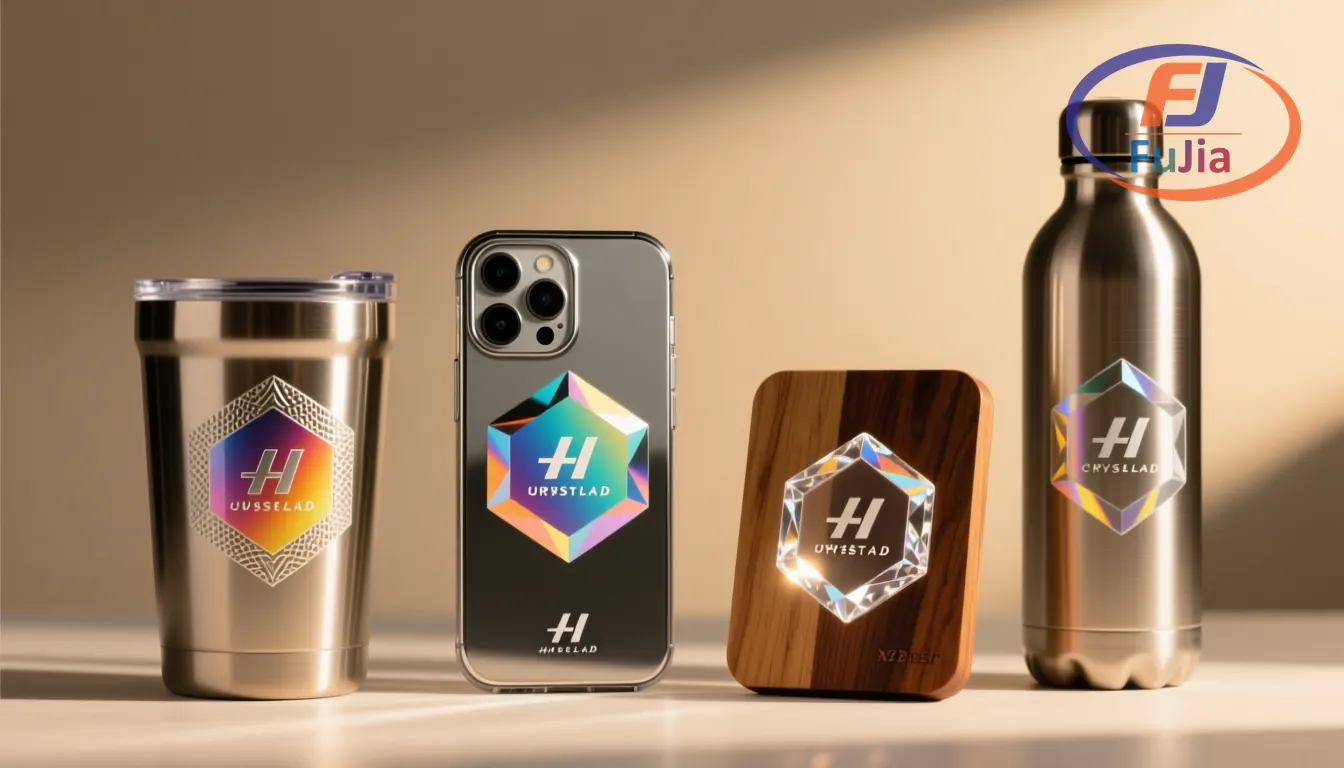
Key Takeaways
\n\n\n\n- \n\n\n
- The workflow in one pass: print CMYK plus white onto A film, laminate B film onto it, peel, and hand-apply the crystal decal to any rigid surface, tumblers, bottles, phone cases, wood, metal, glass, in 10-15 seconds at room temperature. \n\n\n
- Real 2026 pricing: entry A4 units at $1,799, eufyMake E1-class bundles with laminator and rotary at $3,199, InkSonic A3 at $4,749, and Procolored VF13 Pro dual-head at $6,399. \n\n\n
- The laminator is half the machine: standalone laminating units run $349.99, and integrated print-and-laminate platforms command the premium tiers. \n\n\n
- UV DTF owns the crystal-label lane, 3H-plus scratch hardness, any-shape hand application, and 100-plus-cycle durability, per the labeling economics documented across our product applications. \n\n\n
- The honest boundary: rigid objects only, because the cured decal does not stretch, and flexible fabrics belong to DTF and sublimation. \n\n\n
The AB Film Workflow Explained
\n\n\n\nUV DTF works as a two-film system. The printer lays CMYK color plus a white underbase onto the A film, and UV-LED light cures each layer instantly into a flexible ink slab. The B film, an adhesive laminate, presses onto the printed A film in a laminator, and the two films travel together as a decal sheet. Application is peel-and-press by hand: separate the films, place the crystal decal on any rigid surface, burnish it down, and peel the carrier, leaving a glossy, 3D-dimensional label bonded at room temperature with no heat press anywhere in the process.
\n\n\n\nThe workflow’s product is the crystal decal itself, and its properties explain the market. The cured ink stack carries a 3H-plus pencil scratch hardness that survives shipping, washing, and pocket abrasion; the white underbase keeps colors vivid on dark and clear surfaces alike; and the lamination gives every design a uniform gloss finish that reads as premium. Per the labeling workflows we document across promotional applications, crystal labels replaced screen-printed labeling for a small appliance brand at 4x daily output and cut per-label cost 60% for a 3C accessories maker, because a $0.02-0.05 decal hand-applies in seconds without fixtures or presses.
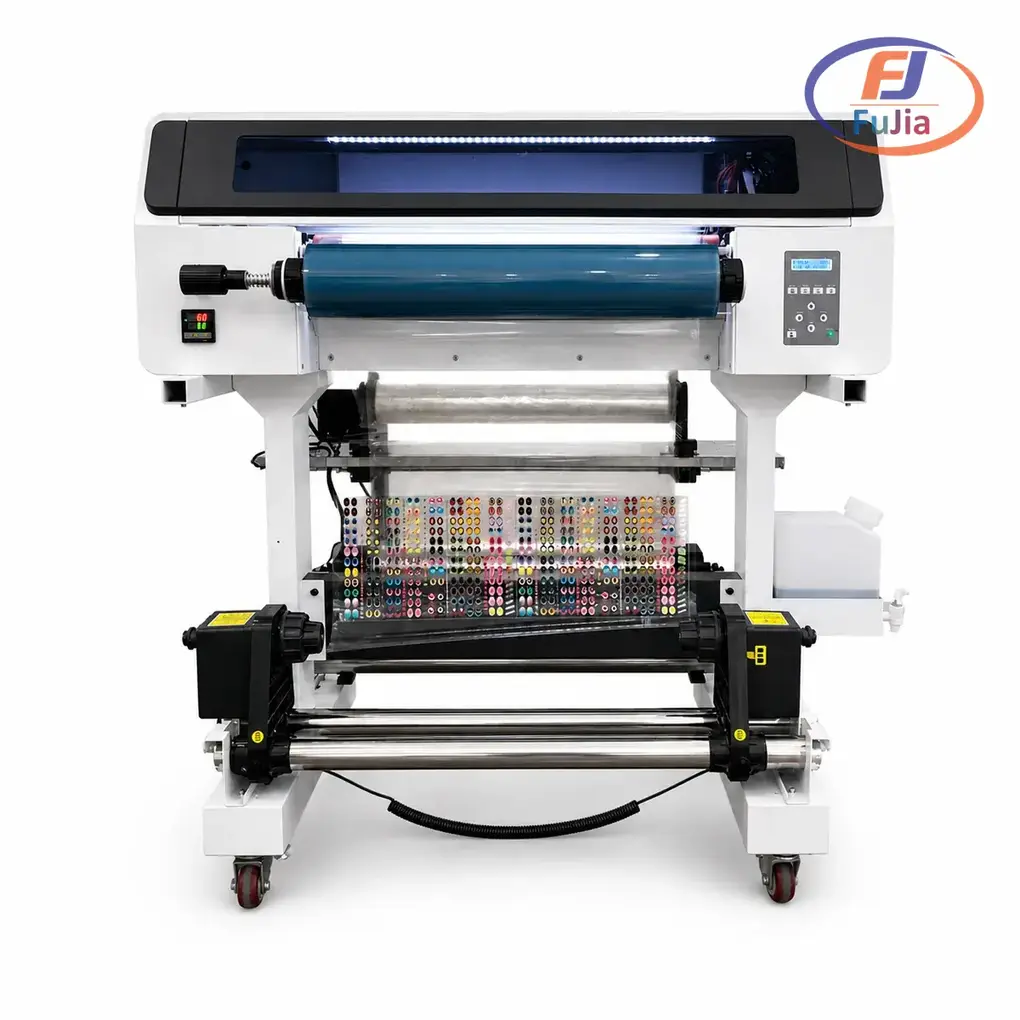
\n\n\n\nThe laminator half of the system deserves its own respect, because lamination quality decides decal success. The B film must bond to the ink stack without air entrapment, at consistent pressure across the sheet width, and the standalone laminating units at $349.99 exist precisely because that pressure discipline is a machine job. Integrated platforms laminate in-line with printing. That integration is where the $3,199-6,399 tiers earn their premium over the $1,799 entry units that assume you already own or will buy the laminating step.
\n\n\n\nReal 2026 Prices by Configuration
\n\n\n\n| Configuration | \n2026 price | \nWidth | \nIncluded | \nServes | \n
|---|---|---|---|---|
| Entry A4 + rotary | \n$1,799 | \nA4 | \nprinter, rotary fixture | \nhobby, proofing | \n
| Compact pro bundle | \n$3,199 | \nA3-class | \nprinter + laminator + rotary | \nworking studios | \n
| A3 pro | \n$4,749 | \nA3 | \nintegrated workflow | \nsmall business | \n
| Dual-head 13-inch | \n$6,399 | \n13 in | \nAB film workflow complete | \nproduction labels | \n
The entry tier at $1,799 is a real UV DTF printer with the asterisk that lamination arrives separately, and buyers should price the complete workflow, machine plus laminator plus film, rather than the chassis alone. The $3,199 compact-pro tier, the eufyMake E1-class bundle with laminator and rotary included, is where working studios land, because everything arrives integrated and the rotary fixture opens bottle and tumbler work on day one. The $4,749-6,399 tiers industrialize the format: wider film, dual heads for speed, and the throughput that label contracts demand.
\n\n\n\nA sports equipment brand we supply anchors the premium end of the format’s economics: UV DTF crystal labels on retail products commanded a 15% price increase over standard labeling, because the 3D gloss finish reads as premium at shelf and survives the handling chain that degrades ordinary stickers. That pricing power, not just cost savings, is the format’s business case, and it compounds wherever products compete on perceived quality.
\n\n\n\nWhat UV DTF Prints Best (and What It Does Not)
\n\n\n\n| Product | \nUV DTF fit | \nWhy | \n
|---|---|---|
| Tumblers, bottles, drinkware | \nexcellent | \nany curve, hand-applied, waterproof | \n
| Phone cases, hard goods | \nexcellent | \ncrystal finish, scratch-proof | \n
| Wood, metal, glass products | \nexcellent | \nbonds to any rigid surface | \n
| Promotional merchandise | \nexcellent | \n15-second application at MOQ 1 | \n
| Fabric, apparel | \nwrong process | \ndecal does not stretch, use DTF | \n
| Paper, cardboard | \nuneconomic | \nordinary labels serve better | \n
The table’s boundary row is the honest one: UV DTF decals are rigid ink stacks, and fabric flex cracks them, so apparel belongs to DTF transfers and polyester belongs to sublimation, full stop. Rigid and semi-rigid surfaces are the format’s entire kingdom, and within that kingdom nothing else matches its any-shape, no-press, room-temperature application, a substrate map the UV printers lineup and product labeling applications document from production data. We recommend UV DTF as the second machine for sublimation and DTF shops, because it completes the substrate matrix, every rigid product their existing processes cannot touch, with one purchase.
\n\n\n\nWhen it comes to UV DTF’s learning curve, it is the friendliest of the transfer processes, no powder handling, no press recipes, no pretreatment, but its quality lives in the laminator and the film system rather than the printer. Buyers comparing chassis specs miss that the decal quality is decided one step downstream of the print head. Buy the system, matched film and laminator included. The format delivers everything its listing pages promise.
\n\n\n\n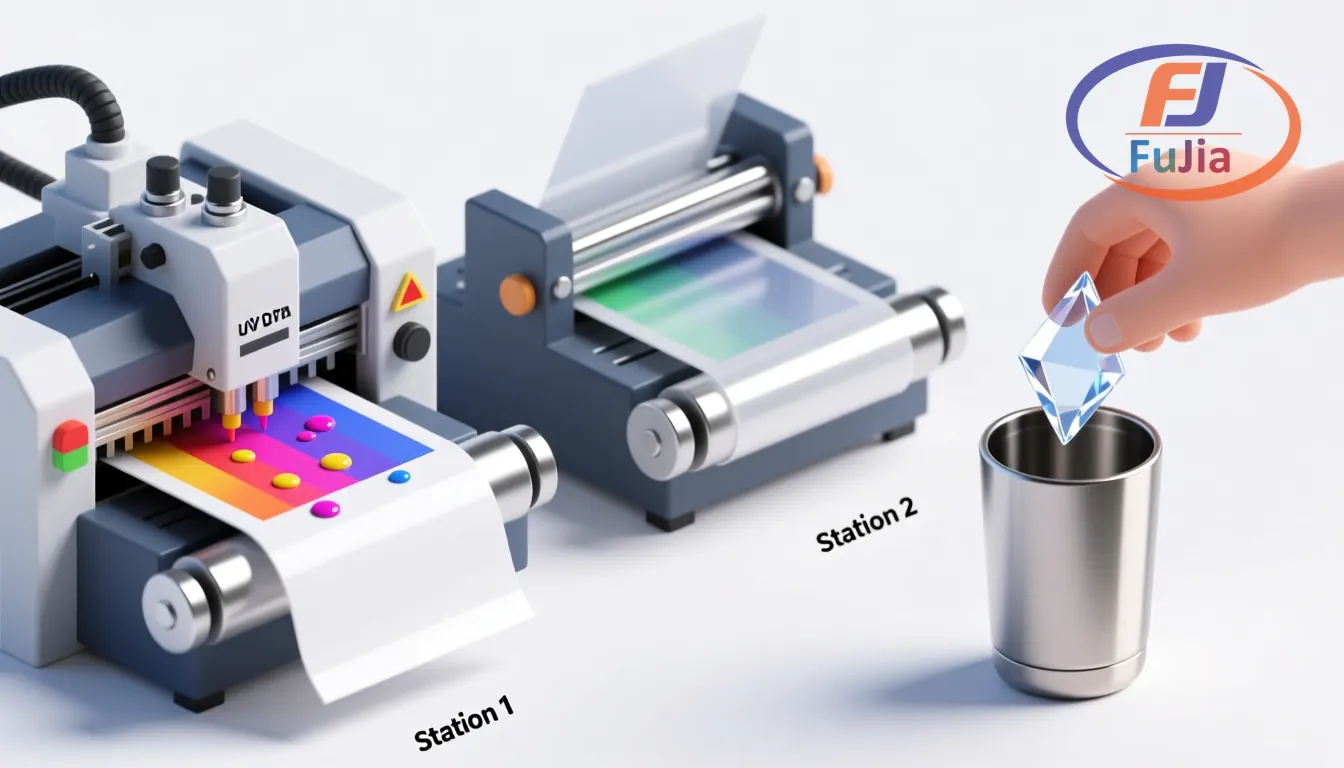
What kind of printer do I need for UV DTF?
\u003cp\u003eYou need a printer purpose-built for the AB film workflow, CMYK plus white ink onto A film with UV-LED curing, which in 2026 spans entry A4 units at $1,799, compact pro bundles with laminator at $3,199, A3 platforms at $4,749, and dual-head 13-inch machines at $6,399. Ordinary document printers, DTF film printers, and sublimation printers cannot run the process, because UV DTF ink, film, and curing are a dedicated chemistry. The laminator completes the requirement. It comes either integrated or as a $349.99 standalone unit, and it is not optional equipment.\u003c/p\u003e
How much does a UV DTF machine cost?
\u003cp\u003eComplete UV DTF machine pricing in 2026 runs $1,799 for entry A4 printers plus a $349.99 laminator, $3,199 for integrated compact-pro bundles with laminator and rotary included, $4,749 for A3 pro platforms, and $6,399 for dual-head 13-inch production machines. Price the complete workflow rather than the printer alone, because film and laminator are the other halves of the system. Against the labor and fixtures it replaces, the format pays back quickly at label and decal volumes, usually inside the first contract.\u003c/p\u003e
How much does a UV DTF printer cost?
\u003cp\u003eUV DTF printers alone run $1,799-6,399 in 2026 across the A4-to-dual-head ladder, with the practical difference between tiers being width, head count, and whether lamination is integrated or separate. The consumables run $0.02-0.05 per finished decal in AB film and ink, the cheapest decoration cost per unit in any transfer process. Compare complete configurations at your decal volume, not chassis stickers, because the sticker price hides the system price every time.\u003c/p\u003e
Is a UV DTF printer worth it?
\u003cp\u003eYes, for any shop selling personalized rigid products: the 10-15 second hand application, any-shape any-surface capability, 3H-plus scratch durability, and $0.02-0.05 per-decal cost replace heat presses, fixtures, and screen setups entirely, and documented cases show 15% retail price increases from the premium crystal finish. It is not worth it for fabric or paper products, where DTF and ordinary labeling serve better. Most buyers recover the machine cost within the first label contract or craft season. That payback speed is the format’s quietest selling point.\u003c/p\u003e
Verdict
\n\n\n\nA UV DTF printing machine is the completion of a decoration shop’s substrate matrix: $1,799-6,399 buys the AB film workflow that hand-applies crystal decals to any rigid surface in seconds, with the laminator deciding quality as much as the printer. Buy the complete matched system, respect the rigid-only boundary, and price the format’s premium finish into your product margins. To run your own products through a UV DTF cell before buying, contact Fujia Print for a sample decal run.
\n\n\n\nSources
\n\n\n\n- \n\n\n
- eufyMake E1 UV DTF: compact-pro bundle reference. \n\n\n
- Procolored VF13 Pro: dual-head pricing reference. \n\n\n
- Wikipedia: UV curing: ink chemistry. \n\n\n
- Wikipedia: Pressure-sensitive tape: adhesive laminate background. \n\n\n
