

A large DTF printer means one of three width classes, 24-inch dual-head stations from $13,495-19,955, 35-inch Epson-class platforms near $13,495, and 60-64 cm-and-wider production machines reaching $19,955-23,999 at 4-5 heads, and big pays when gang-sheet math compounds: wider film fits more designs per linear meter, fewer passes finish the same order, and oversized graphics that small machines tile become single prints. This guide prices the width ladder with real 2026 listings, runs the throughput and gang-sheet economics, and marks the order profiles where large is an investment versus an expensive trophy. Width is throughput you buy once and collect forever, or waste forever.
\n\n\n\n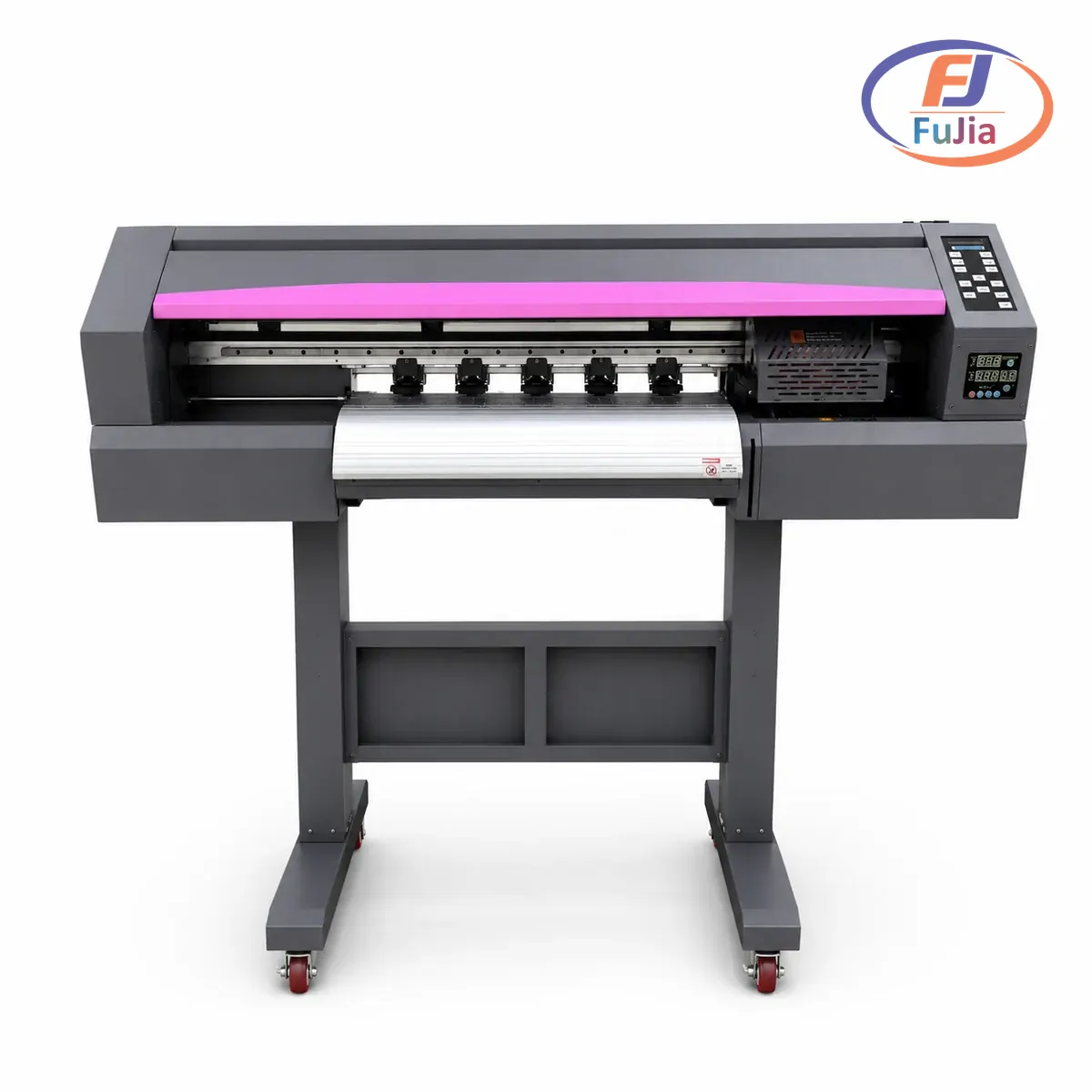
Key Takeaways
\n\n\n\n- \n\n\n
- The 2026 large-format ladder: 24-inch 4-head stations run $16,995-19,955, the Epson G6070 35-inch DTFilm printer runs $13,495, 5-head platforms reach $23,999, and 64-inch-wide models open the oversized-graphics tier. \n\n\n
- Width converts to throughput two ways: gang sheets, more designs per linear meter at the same pass count, and oversized capability, full prints that 60 cm machines must tile with seams. \n\n\n
- The production standard is the 60 cm (24-inch) class at 8-27 m²/h depending on head count, with 4-head platforms printing 27 m²/h at 4-pass for multi-shift duty. \n\n\n
- Large-format economics activate past roughly 200-300 transfers daily or any oversized-print product line: below that, a 60 cm machine outearns the wide chassis on dollars-per-capability. \n\n\n
- Floor requirements scale with width: 155 kg printers plus 118-230 kg shaker units, dedicated power, and powder-management space, so the building votes on the purchase alongside the order book. \n\n\n
The Width Ladder and What Each Class Is For
\n\n\n\n| Width class | \n2026 price | \nSpeed class | \nRealistic duty | \n
|---|---|---|---|
| 60 cm / 24-inch dual-head | \n$11,500-15,200 station | \n8-13 m²/h | \n200-400 pieces/day | \n
| 24-inch 4-head | \n$16,995-19,955 | \nup to 27 m²/h | \n500+ pieces/day | \n
| 35-inch (Epson G6070 class) | \n$13,495 | \nmid-volume film | \noversized + gang duty | \n
| 5-head platform | \n$19,955-23,999 | \ntop of DTF class | \nmulti-shift production | \n
| 64-inch wide | \nquote tier | \nwide-format film | \noversized graphics house | \n
The 60 cm class is the industry’s working standard because its capability-to-price ratio peaks: dual Epson i3200 heads, 8-13 m²/h, and a complete station with shaker, oven, and press inside $15,200 serves the 200-400-piece daily band where most custom apparel businesses live. The 4-head jump doubles throughput to 27 m²/h at 4-pass and exists for shops whose problem is no longer winning orders but finishing them, and the 5-head $23,999 platforms push head count where multi-shift schedules saturate anything smaller. Width beyond 60 cm serves a different master: oversized graphics, all-over prints, and gang-sheet density that narrow machines cannot reach, which is why the 35-inch and 64-inch classes concentrate in graphics houses rather than garment shops.
\n\n\n\nThe gang-sheet argument is the economic heart of width. A 60 cm roll fits roughly four adult-front designs per linear meter, while a 64-inch roll fits six to eight, and every gang sheet pressed whole saves the per-transfer handling that dominates labor in finishing. Oversized work pays even more directly: an all-over hoodie print on a narrow machine is two tiled transfers with a seam, and the same print on wide film is one press with zero seam geometry, the same single-press advantage that drives the 13×19 sheet format at craft scale, multiplied by production volume. Most shops moving wide cite gang density first and oversized capability second, because density pays weekly and oversized pays per catalog.
\n\n\n\nThroughput Math and Real 2026 Prices
\n\n\n\nSpeed classes translate to pieces with fixed assumptions: a 12×12-inch design occupies roughly 0.093 m², so an 8 m²/h dual-head prints the paper equivalent of 86 designs hourly at machine speed, and real-world finishing, powder, cure, press, lands the shop at 200-400 finished pieces across a shift. The 4-head’s 27 m²/h nearly triples the paper rate, which is why the class exists for shops whose press bench, not printer, becomes the constraint, and why the 4-head purchase usually precedes a second heat press in honest expansion plans. The pricing table rewards that reading: $16,995-19,955 for the 4-head buys finished-piece capacity that clears order backlogs, while the same dollars spent a tier too early buy idle width.
\n\n\n\n| Buyer profile | \nRight class | \nWhy | \n
|---|---|---|
| Under 200 pieces/day | \n60 cm dual-head | \nworking-tier standard | \n
| 200-500, backlog forming | \n24-inch 4-head | \n27 m²/h clears the queue | \n
| Oversized + all-over products | \n35-inch and wider | \nsingle-press oversized | \n
| Multi-shift production | \n5-head platform | \nsaturation duty | \n
| Graphics house, mixed media | \n64-inch wide | \noversized graphics line | \n
A Turkish garment factory we supply validates the production tier’s math from the inside: consolidating screen printing onto a 65 cm dual-i3200 platform, the factory dropped its 200-piece design minimum to zero, cut file-to-finished-print under 30 minutes, and now runs 12-hour shifts without quality drift on Honson mainboard, Leadshine servo, and THK guide rail transmission, the named-component stack that wide-format duty cycles demand. The factory’s next machine is a 4-head, and the reason is order count, not print quality. The same platforms anchor our DTF printers lineup, and the working-tier economics are detailed in the DTF printer wholesale walkthrough for buyers comparing factory-direct routes.
\n\n\n\nThe Floor Requirements That Veto Big
\n\n\n\nLarge DTF chassis are industrial equipment, and the building gets a vote before the order book does. A 4-head printer weighs 155 kg before its 230 kg shaker companion, needs dedicated power distribution, and expects a stable 18-25 °C, 35-65% RH environment, because wide film and long carriage travel amplify every environmental wobble a desktop machine shrugs off. Powder management scales too, with large-format powder stations moving real airflow, and a shop that has not solved powder containment at 60 cm has not earned the wider machine’s mess. Noise sits under 65 dB at full print on engineered platforms, which is conversation-adjacent rather than comfortable, and floor vibration isolation matters when the shaker and oven run beside the printer.
\n\n\n\nWhen it comes to large-printer regret, it is almost never about print quality, because every class prints beautifully. Almost always about utilization. A 24-inch 4-head printing 80 pieces daily is a $19,000 press bench with a printer attached. The same shop at 500 pieces daily cannot buy back the backlog it accumulates fast enough. We recommend buying the width class your next 90 days of orders justify, financing the gap if the orders are signed. Waiting if they are not, because width delivered early costs floor space, power. Maintenance on capability that compound interest only pays when fed. The machines are honest. The purchase timing is where buyers lie to themselves.
\n\n\n\n

How big can a DTF printer print?
\u003cp\u003ePrint width spans from 30 cm A3 desktops through the 60 cm production standard up to 64-inch wide-format film platforms, with 24-inch (60 cm) and 35-inch classes carrying the commercial middle. Design size within width is unlimited along the roll length, so a 60 cm machine prints any design up to 60 cm wide and meters long, and oversized graphics beyond width get tiled with seams or printed on the 64-inch class. Match the width to your largest recurring product, not your largest imaginable one, and the recurring product is usually smaller than buyers hope.\u003c/p\u003e
What is the largest DTF printer?
\u003cp\u003eThe wide end of the 2026 market reaches 64-inch film width, with 5-head platforms like the $19,955-23,999 class holding the head-count ceiling and the Epson G6070 at 35 inches ($13,495) anchoring the branded mid-wide tier. Above 64 inches, the work moves to dedicated wide-format textile processes rather than DTF film. The largest useful printer is the one whose width your order profile actually fills, and the 60 cm class fills more order profiles than everything wider combined. Honestly, most buyers asking this question need the 60 cm answer, not the ceiling number.\u003c/p\u003e
Is DTF good for large prints?
\u003cp\u003eYes, and width is where DTF’s advantages scale best: full-color photographic detail at 1440 dpi-class resolution with white ink on any fabric, wash durability at grade 4-5 colorfastness through 50-plus cycles, and no minimum order quantity, and all of it applies identically to a 60 cm all-over print as to a pocket logo. The seams that tiling introduces on oversized work are DTF’s one large-format weakness, and they are solved by wider film rather than better technique. Gang-sheet density on wide rolls adds the economics argument on top of the quality one, which is why large-format DTF shops rarely move back down.\u003c/p\u003e
What size DTF for a XL?
\u003cp\u003eAn adult XL full-front design runs roughly 12-14 inches wide, which fits the 60 cm (24-inch) class with room to gang two designs per pass, and an all-over XL print running 18-22 inches wide wants the 35-inch class or wider for single-press application, while standard XL placement work, chest and sleeve, fits even A3 desktops. The size decision is the largest print you sell repeatedly, not the largest garment in the catalog, and the honest test is order frequency: selling one all-over XL per month does not justify a wide machine, while selling forty weekly leaves no other honest choice.\u003c/p\u003e
Verdict
\n\n\n\nA large DTF printer pays when the order book feeds it: the 60 cm dual-head class serves the 200-400 piece standard brilliantly, 24-inch 4-heads at $16,995-19,955 clear forming backlogs at 27 m²/h, and the 35-to-64-inch classes serve oversized graphics and gang density that narrow film cannot reach. Buy the width your next 90 days justify, solve powder and power before the crane arrives, and let throughput, not prestige, pick the class. To configure a wide-format DTF cell against your actual order profile, contact Fujia Print for a gang-sheet layout analysis.
\n\n\n\nSources
\n\n\n\n- \n\n\n
- DTF Printer USA large-format DTF: 24-inch 4-head pricing reference. \n\n\n
- USCutter Epson G6070: 35-inch DTFilm platform pricing. \n\n\n
- Wikipedia: Wide-format printer: width class definitions. \n\n\n
- AATCC: durability standards behind wash claims. \n\n\n
