

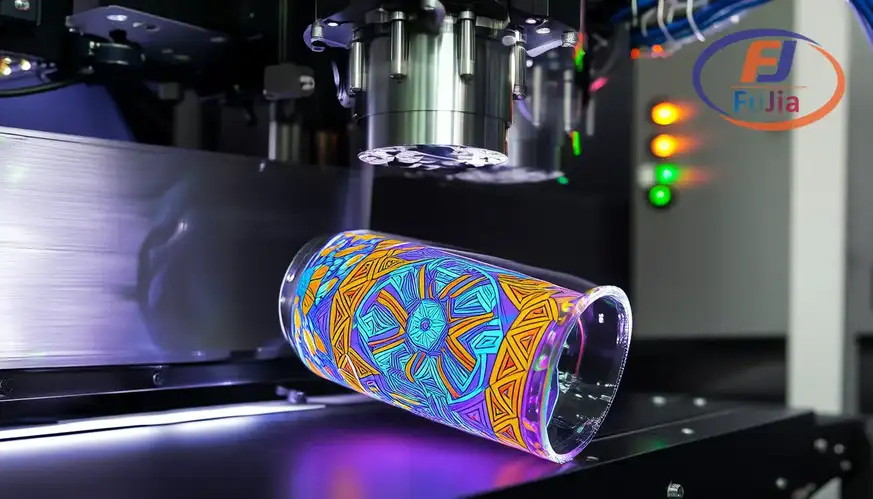
A cylindrical UV printer spins the object under the print head instead of moving a flat bed, wrapping 360 degree graphics onto bottles, glasses, candles, and tumblers in a single pass, with dedicated machines at $2,500-15,000 and flatbed-plus-rotary-jig combos from $2,300. The category serves the print-on-round-object market that flatbeds reach only awkwardly, and it lives or dies on cone handling and seam alignment, the two specs that separate production rotaries from toy-grade spinners. This guide maps the machine classes, the object canon, and the buying math for shops whose order book is round.
Key Takeaways
- Dedicated cylindrical UV machines run $2,500-15,000, while a desk flatbed with a $500-1,500 rotary jig covers occasional round work.
- Cone handling is the dividing spec: machines with adjustable cone adapters print tapered wine glasses and stemware, fixed rollers print straight walls only.
- Seam alignment within about 1-2 mm is the production standard, and it depends on roller concentricity more than printer resolution.
- The object canon covers bottles, wine glasses, candles, tumblers, jars, and aluminum bottles from 60-300 mm tall on most machines.
- We recommend the flatbed-plus-jig under 30 round objects weekly, and the dedicated rotary when cylinders become a product line.
How Rotary Printing Actually Works
| Stage | Action | Spec that matters |
|---|---|---|
| fixture | rollers or chucks grip the object | concentricity, taper adapters |
| head lays the wrap image as object spins | single-pass 360 coverage | |
| cure | LED follows the print zone inline | instant handling |
| rotate | object repositions for next band | seam overlap control |
The stage table is the whole mechanism, and the fixture row carries the quality burden: an object spinning on true concentric rollers presents a consistent focal distance to the head, while a wobbly blank smears its own wrap. Dedicated machines add chucks and tailstocks for tall objects and cone adapters that tilt the print axis for stemware, and the seam row is where designs close at the back of the object, with production machines holding 1-2 mm of overlap invisibility. The physics is identical to what our UV printers lineup documents for flat work, rotated 90 degrees, and the difference is entirely in the fixturing engineering.
Cone handling deserves its own spotlight because the gift market’s best sellers taper. Wine glasses, stemless tapered tumblers, and many candle vessels narrow toward the base, and a machine printing a straight-wall wrap on a tapered blank delivers stretched graphics at the small end, the tell-tale amateur finish. Adjustable cone adapters tilt or re-pace the rotation so the wrap stays proportional, and this one feature separates the $5,000-plus production class from entry spinners more reliably than any dpi figure does. If your catalog tapers, the cone adapter is the machine.
The Machine Classes and Their Buyers
| Class | Price | Objects per hour | Right buyer |
|---|---|---|---|
| flatbed + rotary jig | $2,300-4,300 | 10-20 | mixed flat and round work |
| entry dedicated rotary | $2,500-5,000 | 20-40 | straight-wall volume |
| production rotary with cones | $5,000-15,000 | 40-100+ | drinkware and candle lines |
The class table reads as a commitment ladder, and the honest entry point for most shops is the first row: a desk flatbed with a rotary jig covers round work at craft volume while keeping the flatbed earning on flat days, and the jig investment is a fraction of dedicated hardware. The entry dedicated rotary earns its keep when cylinders dominate the order book, offering faster changeovers and taller object capacity than jigs allow. The production class with cone adapters and multi-object fixtures serves the bottle and candle houses, where 100 objects an hour with seam invisibility is the quotation standard, per the volume logic our promotional products cases document for drinkware programs.
Fixturing breadth is the hidden spec in every class. Production rotaries ship with chuck sets spanning 40-120 mm diameters, tailstocks for 300 mm tall bottles, and quick-change adapters that make changeover a two-minute operation, while entry machines often lock to a narrow diameter band that turns every new product size into a fixture purchase. We recommend counting your object catalog before counting machine features, because the fixture set that covers your actual SKUs is the real price of the machine. A cheap machine with an expensive fixture habit is the classic cylindrical trap.
The Object Canon and Its Economics
| Object | Blank cost | Retail | Margin character |
|---|---|---|---|
| wine bottle, decanter | $2-6 | $25-60 | event and wedding volume |
| candle vessel | $1-4 | $15-35 | repeat seasonal lines |
| glass tumbler set | $3-7 | $20-45 | registry and gift |
| aluminum bottle | $3-8 | $25-50 | corporate and team |
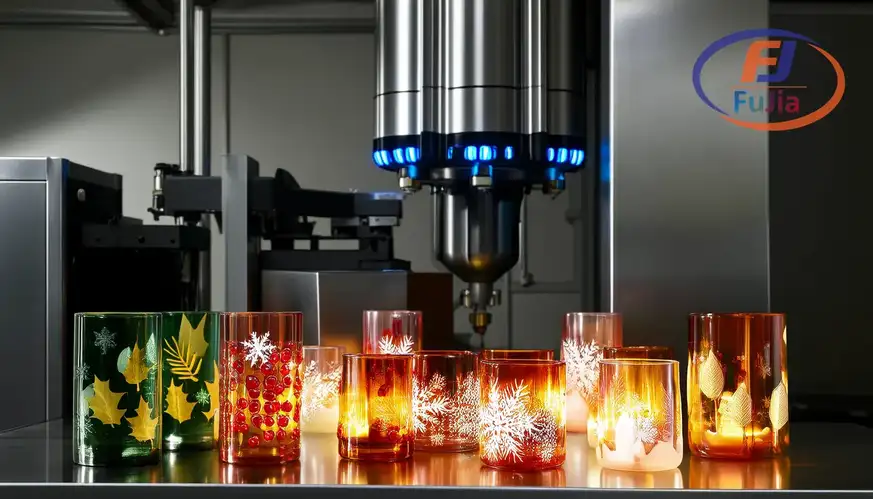
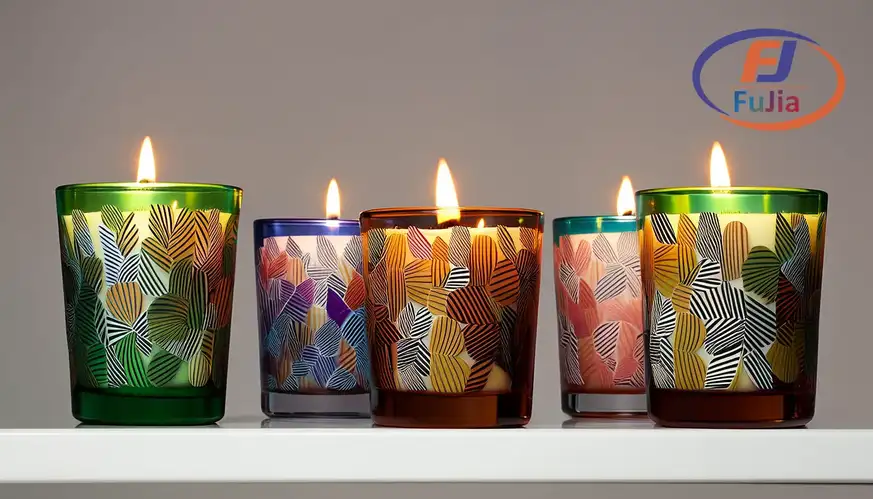
The canon table is the business case, and candles anchor the repeat side of it: vessels reprint every season with new scent-pairing designs, so the fixture amortizes across years of reorders. Bottles live on the event side, where weddings and corporate gifting pay premium prices for date-and-name personalization that no stock label matches, and glassware sets fill the registry channel between them. Ink consumables run $0.20-0.60 per object, LED cure makes each piece sellable on exit, and the margin structure mirrors the tumbler arithmetic our mug and drinkware cases document, with design velocity rather than print cost deciding who wins the channel.
Seam placement is a design decision that saves marginal machines: wrapping the design so its closure hides behind a handle, a seam line of the blank, or a deliberate band turns 3 mm overlap into invisible finish. Production artists design for the machine’s seam position from the start, and that habit is worth more than the next spec bump on the machine’s datasheet. When it comes to the round-object market, buyers cannot see dpi, but they can see a stretched graphic on a taper and a seam floating mid-front. Those two visible failures are the ones the buying decision should be engineered against.
Buying Checks Before the Deposit
The pre-purchase ritual for any rotary is a test print on your actual worst object, not the vendor’s demo blank. Bring the most tapered glass you sell and the tallest bottle you stock, and judge seam visibility, wrap proportion, and fixture changeover time on those, because demo blanks are chosen to flatter. White ink on glass objects follows the same circulation discipline as every UV machine, and a vendor who cannot explain their white-ink maintenance routine in two sentences is telling you their support depth. The worst blank in your catalog is the only demo that matters.
A drinkware case we supply anchors the class decision: a candle company running 200-400 vessels weekly on a production rotary with cone fixtures, reprinting seasonal designs on the same fixture set year-round, with changeover between vessel sizes taking under five minutes. That profile is the dedicated machine’s design customer, and the same company started years earlier on a flatbed jig at a tenth of the weekly volume, per the growth-path cases our applications pages document.
Is a cylindrical UV printer worth it?
A cylindrical UV printer is worth it when round objects are a product line rather than an occasional order, with the crossover sitting near 30 objects weekly between a flatbed jig and a dedicated rotary. Below that line, a $500-1,500 rotary jig on a desk flatbed delivers the same printed result while the flatbed earns on flat work, and above it, dedicated machines win on changeover speed, object height, and cone handling. The economics mirror any UV purchase: consumables run $0.20-0.60 per object against $15-60 retail, so margin is never the problem, and the machine decision is a volume question.The shops that outgrow jigs know it within a quarter of steady orders.
How much does a cylindrical UV printer cost?
A cylindrical UV printer costs $2,500-5,000 at the entry dedicated tier, $5,000-15,000 for production machines with cone adapters and multi-object fixtures, and $500-1,500 for a rotary jig that adds round capability to an existing desk flatbed at $1,799-2,800. The cone-handling feature is the main price driver inside the dedicated tiers, because tapered glassware is where the gift market concentrates. We recommend budgeting another $300-800 for fixture sets covering your object catalog, since diameters outside the shipped chucks become separate purchases. The jig route prices the experiment honestly before any dedicated commitment.
What are the downsides of UV printing on cylinders?
UV printing on cylinders carries four specific downsides: seam visibility where the wrap closes, taper distortion on machines without cone adapters, object-length limits set by fixture travel, and the same white-ink maintenance burden as any UV machine. Curved surfaces also punish fixturing errors harder than flatbeds do, since a wobbly blank smears its own graphics, and curved adhesion follows the same primer rules as flat work. None of these downsides is disqualifying, and each maps to a spec to verify: seam placement control, cone adapters, chuck diameter range, and a written maintenance routine. The vendor demo on your own worst blank surfaces every one of them before the deposit. Verify those four specs and the category’s risks are fully priced.
How much does a UV printer machine cost?
A UV printer machine costs $1,799-2,800 at the desk A3 flatbed tier, $3,500-8,000 in the mid flatbed class, $9,000-28,000 for production gantries, and $2,500-15,000 in the cylindrical specialty class that this guide covers. The right class follows the object canon rather than the spec sheet: flat goods buy flatbeds, round goods buy rotaries, and mixed shops pair a desk flatbed with a jig before committing to either specialty. Consumables sit near $0.10-0.80 per piece across all classes, so the machine choice is about fixturing and throughput, never about ink economics. The full ladder sits in our flatbed pricing guide for cross-reference.
Verdict
The cylindrical UV printer turns round objects into a product line, with the flatbed-plus-jig covering craft volume at $2,300-4,300 combined, entry dedicated machines at $2,500-5,000, and cone-equipped production rotaries at $5,000-15,000 serving the bottle and candle houses at 100 objects an hour. Cone handling and seam placement are the two specs that decide visible quality, and a test print on your own worst blank is the entire pre-purchase ritual. Start on the jig, graduate to the dedicated rotary when cylinders claim a weekly product line, and design wraps for the seam from the start. To see your artwork wrapped on your own bottle or vessel, contact Fujia Print for a rotary sample run.
Sources
- Wikipedia: UV curing: LED ink chemistry.
- Wikipedia: Rotary printing press: rotary principle context.
- AATCC: durability testing standards.
- Fujia Print drinkware cases: rotary production examples.
