

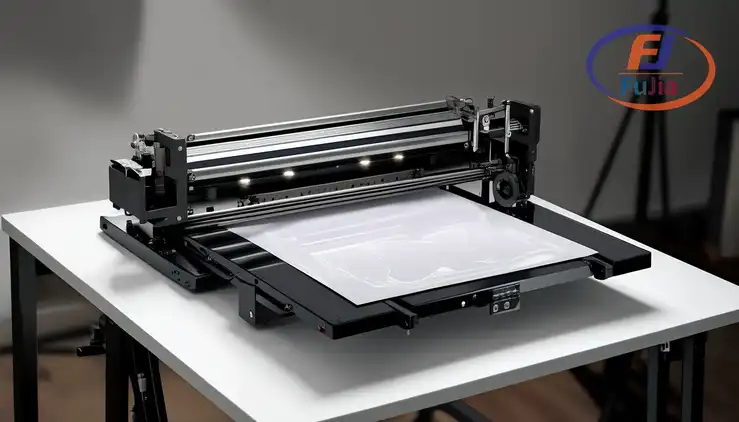
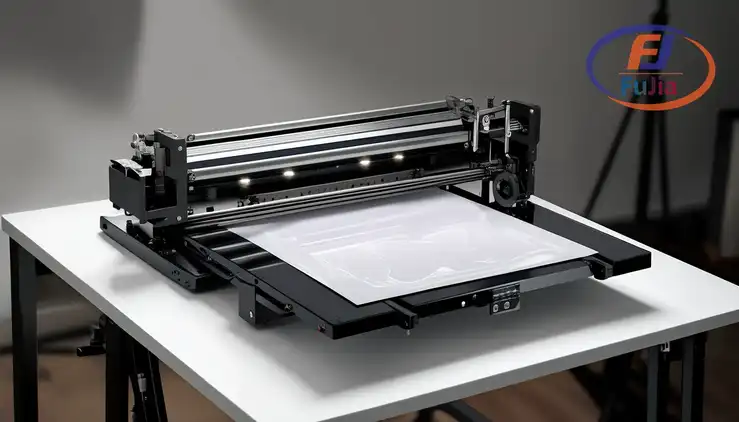
An A3 size UV flatbed printer carries a 297×420 mm bed at $1,799-2,800, and the class is the category’s honest entry point: full LED-cure physics, white ink circulation, and a product canon that covers phone cases, awards, signage samples, and decorated objects at desk scale. A3 is a size decision rather than a capability compromise, because the heads, ink system, and cure technology match larger machines, and the class prices the throughput and media capacity it does not carry. This guide maps what A3 fits, what it costs to run, and when A3 is the right ceiling versus the right start.
Key Takeaways
- A3 beds run 297×420 mm at $1,799-2,800, carrying the same XP600-class heads, white circulation, and LED curing as larger tiers.
- The A3 canon covers phone cases, awards, signage samples, leather goods, decor tiles, and UV DTF film output.
- Throughput runs 1-1.5 m2 per hour, making A3 a product machine for 20-50 objects daily rather than a production machine.
- The class earns its keep in 6-10 weeks at craft and marketplace velocity, and its skills transfer unchanged up the ladder.
- We recommend A3 for product-line startups and as the first rung, with the 60×90 mid class waiting for volume evidence.
What an A3 Bed Actually Fits
| Product | Fits A3 bed? | Notes |
|---|---|---|
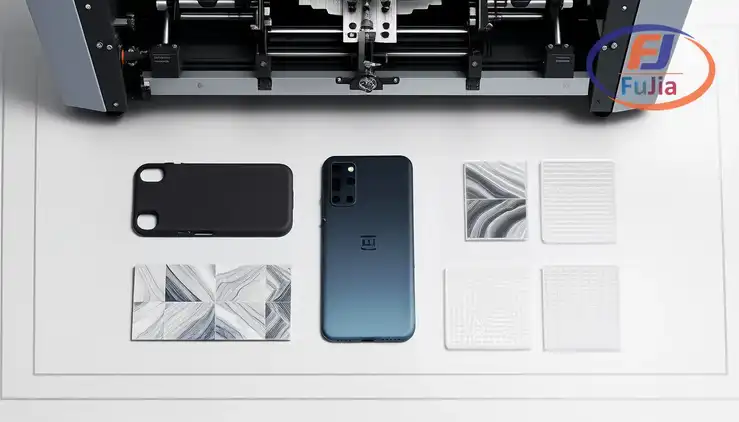
| phone cases, multiple-up | yes, 6-12 per pass | the class’s volume workhorse |
| awards and plaques | yes, standard sizes | full-bed single pieces |
| signage samples | yes, presentation sizes | client-proof scale |
| leather goods, wallets | yes | flat personalization |
| ceramic and decor tiles | yes, up to 20 cm tiles | multi-up per pass |
| 4×8 signage panels | no, tiled in sections | mid-class territory |
| full doors, furniture faces | no | large class territory |
The fit table is the A3 canon, and its yes rows describe a complete personalization business: phone cases print multi-up at the class’s best economics, awards and plaques fit standard dimensions whole, signage samples prove concepts to clients at presentation scale, and decor tiles run six or more per pass. The no rows are equally informative, because 4×8 panels and furniture faces belong to the 1.2 m and larger classes, and a buyer whose canon lives in the no rows should price those classes directly, per the canon-matching logic our UV printers guides apply across the size ladder.
The A3 canon in one view:
The A3 bed’s secret product is UV DTF film output, because the class prints A3 sticker and wrap sheets that feed an entire decal business, and many A3 owners run rigid objects and film output as two product lines on one machine. The dual-role capability is why the class anchors so many startups: the same bed serves the object canon by day and the sticker line between orders, and the same head and ink system serve both without changeover beyond the film path, per the dual-mode logic our sticker machine guides document at the station tier.The film line is what makes A3 economics work in year one.
The Class Specs and Running Costs
| Spec | A3 class typical | Notes |
|---|---|---|
| bed | 297×420 mm vacuum | flatness is the quality spec |
| head | single XP600-class | 1-1.5 m2/hour |
| ink system | CMYK+W with circulation | the survival spec |
| cure | LED, instant | prints exit finished |
| price | $1,799-2,800 | the honest floor |
The spec table is the class’s engineering statement, and each row matches larger machines rather than miniaturizing them: the same head class prints the same dpi, the same circulation loop keeps white alive over weekends, and the same LED cures instantly. Running costs run $0.10-0.50 per object in ink, maintenance at $50-150 monthly in consumables and cleaning, and the total first-year budget adds $200-500 of fixtures, blanks, and power protection beyond the sticker, per the true-budget arithmetic our affordable printer guide prices line by line.
Throughput is the class’s honest ceiling: 1-1.5 m2 per hour serves 20-50 objects daily depending on size, and a business whose orders outgrow that count belongs in the 60×90 mid class at $3,500-8,000, whose twin heads and larger bed double or triple the daily output. The step up is a capacity purchase rather than a capability purchase, and the A3 skills of RIP settings, fixtures, and ink discipline transfer unchanged, per the class-ladder logic our pricing guide documents across the whole range.
When A3 Is the Right Ceiling
A3 is the right ceiling for product businesses whose objects fit the yes rows and whose growth comes from design velocity rather than from throughput. The personalization seller whose catalog rotates seasonally, the awards shop serving local teams, the decor studio testing tile lines, all live comfortably inside A3’s daily count, and the money not spent on capacity funds the design and marketing assets that actually grow those businesses. We recommend A3 as a ceiling for any shop whose order book fits the canon and whose queue never becomes the constraint, per the ceiling-honesty logic our sizing guides apply across equipment classes.
A3 is the right start for every business heading upward, because the class teaches the complete workflow on the cheapest engineering that works: fixture thinking, ink discipline, the white-ink ritual, and the QC habits that scale unchanged to mid and production machines. The first machine at the honest floor is tuition that the second machine inherits, and the A3-to-mid progression is the category’s standard growth path, per the fleet-development cases our guides document across growing shops.
The buyer who should skip A3 is the one whose very first order book contains 4×8 panels or daily m2 that the class cannot serve, because no amount of fixture cleverness fits a panel to a smaller bed, and the mid or large classes serve that canon from day one, per the canon-first logic our sizing guides run before every budget conversation. Buyers whose canon fits should not apologize for the class: A3 is where most successful UV businesses actually started.
How much does an A3 size UV flatbed printer cost?
An A3 size UV flatbed printer costs $1,799-2,800 at the honest floor, carrying a 297×420 mm vacuum bed, a single XP600-class head, white ink circulation, and LED curing, with the true first-year budget adding $200-500 of fixtures, blanks, and power protection. Listings below about $1,500 delete the circulation and bed engineering that year one bills back, and the full cost ladder sits in our flatbed pricing guide. The A3 class is the category’s entry point, and its price buys the same physics larger machines carry at the throughput and media capacity the class honestly carries.
What can you print with an A3 UV flatbed printer?
An A3 UV flatbed printer prints phone cases six to twelve per pass, awards and plaques at standard sizes, signage samples at presentation scale, leather goods, ceramic tiles up to 20 cm, and UV DTF sticker and wrap sheets that feed a decal line, with the no rows being 4×8 panels and furniture faces that belong to larger beds. The yes rows describe a complete personalization business, and the dual-role object-plus-film capability is why the class anchors so many startups. The canon table in this guide maps every fit honestly, and the buyer’s own product list against it is the sizing answer. Run your list down the table before reading any spec sheet.
Is an A3 UV printer worth it?
An A3 UV printer is worth it for product businesses whose objects fit the A3 canon and whose daily count runs 20-50 pieces, because the class repays inside 6-10 weeks at craft and marketplace velocity while teaching the complete workflow that scales up the ladder. Worth-it fails for buyers whose canon includes wide panels, whose volume demands production throughput, or whose budget falls below the honest floor, because the cheap tier bills its deletions back within the year. The A3-to-mid progression is the standard growth path, and starting at A3 with proven demand is the class’s designed use, per the crossover logic our sizing guides run everywhere. Worth-it is a canon question before it is a price question.
What is the best A3 UV flatbed printer?
The best A3 UV flatbed printer is the machine that passes three checks: visible white ink circulation engineering, a true vacuum bed proven on a full-bed demo, and a warrantied name-brand head backed by a vendor who answers technical questions in writing within a day. Machines within the class share the XP600 head and LED architecture, and the vendor’s support is the differentiator that year one measures. Run the four-print demo on your own objects, judge white opacity on your darkest piece, and let the verification rather than the badge close the choice, per the demo logic our reviews guide prescribes across every tier.
Verdict
The A3 size UV flatbed printer is the category’s honest entry: a 297×420 mm bed at $1,799-2,800 carrying full-class physics, a product canon that covers the personalization business plus UV DTF film output, and a throughput ceiling of 20-50 objects daily that defines who it serves. Fit your product list against the canon table, run the three checks before any deposit, and treat A3 as either the ceiling your order book allows or the first rung your growth plans need, because both are legitimate and the job log tells you which. To see A3-class output printed on your own products, contact Fujia Print with your product list.
Sources
- Epson print heads: XP600 specifications.
- Wikipedia: UV curing: LED ink chemistry.
- AATCC: durability testing standards.
- Fujia Print applications: production cases.
