

Sublimation printing on ceramic works through a polyester coating baked onto the blank: the dye converts to gas at 385-400 °F under press pressure and bonds with that coating, because raw ceramic accepts no sublimation dye at any temperature. The coated-ceramic category spans the most durable products in personalized gifting, from 11 oz mugs that survive thousands of wash cycles to tiles and coasters that serve as trivets and wall decor, and the workflow is mature enough that a single mug press plus coated blanks runs a complete product line. This page walks the press settings per product, the coating requirements that decide everything, and the product economics of the ceramic lineup.
\n\n\n\n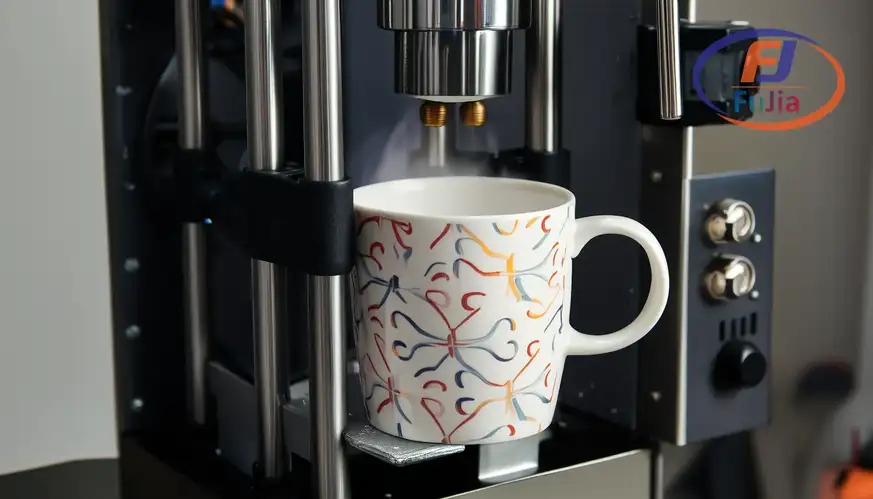
Key Takeaways
\n\n\n\n- \n\n\n
- Coating is the entire chemistry: only polyester-coated ceramic accepts sublimation dye, and uncoated blanks stay blank at any press setting. \n\n\n
- Mug settings run 385-400 °F for 150-210 seconds in a convection mug press, with 11 oz standard mugs at 180 seconds as the production default. \n\n\n
- Tiles and coasters press flat at 385-400 °F for 4-7 minutes with medium-heavy pressure, and their durability suits trivets and wall decor. \n\n\n
- Dishwasher durability on coated mugs reaches thousands of cycles because the dye lives inside the coating rather than on its surface. \n\n\n
- We recommend buying coated blanks from documented suppliers, because coating quality varies more between blank makers than press technique ever will. \n\n\n
The Product Table and Press Settings
\n\n\n\nThe product table specs the ceramic lineup with its press parameters, and every setting assumes a coated blank and sublimation transfer:
\n\n\n\n| Product | \nPress temperature | \nTime | \nPressure | \n
|---|---|---|---|
| 11 oz mug | \n385-400 °F | \n150-210 s | \nlight-medium | \n
| 15 oz mug | \n385-400 °F | \n180-210 s | \nlight-medium | \n
| 4.25 in tile | \n385-400 °F | \n4-7 min | \nmedium-heavy | \n
| Coaster | \n385-400 °F | \n4-5 min | \nmedium-heavy | \n
The mug press in action:
\n\n\n\nThe mug times look long against flat pressing because the mug press wraps heat around a curve, and convection inside the cylinder takes longer to drive the dye conversion than a flat platen, per the pressing physics our mug and drinkware guides document across cylindrical products.The 180-second default at 400 °F serves most 11 oz coated mugs, and the tolerance window is wide enough that production rhythm matters more than stopwatch precision, though under-pressing by 30 seconds shows as pale edges that no repress fully repairs.
\n\n\n\nThe Coating Requirement and Wash Durability
\n\n\n\nThe coating table explains the chemistry that makes ceramic sublimation possible, and the wash data shows why the category anchors durable-gift businesses:
\n\n\n\n| Coating aspect | \nRequirement | \nFailure when wrong | \n
|---|---|---|
| Polymer type | \npolyester-based ceramic coat | \ndye washes off entirely | \n
| Coat uniformity | \neven across print zone | \npatchy fading | \n
| Coat thickness | \nproduction standard | \nyellowing at high heat | \n
| Cure quality | \nfactory-baked | \npeeling after cycles | \n
The wash durability in view:
\n\n\n\nWhen it comes to the coating, it is the entire product decision compressed into one word, because sublimation dye bonds with polyester chemistry and ceramic itself is invisible to the dye, which is why an uncoated mug presses into nothing no matter the settings. Blank quality varies more between coating suppliers than press technique varies between operators. A mug whose coating thins at the handle seam fades exactly there by cycle 50, per the blank qualification our drinkware sourcing cases document across ceramic programs. We recommend running a 5-cycle test wash on any new blank batch before committing production, because the test converts coating doubt into measured evidence for a couple of dollars in blanks.
\n\n\n\nThe Product Economics and Line Building
\n\n\n\nThe economics table prices the ceramic lineup from blank to retail, and the margins explain why mugs anchor so many personalized-gift businesses:
\n\n\n\n| Product | \nBlank cost | \nProduction cost | \nRetail price | \nMargin | \n
|---|---|---|---|---|
| 11 oz personalized mug | \n$1.2-2.5 | \n$2.5-4 | \n$12-25 | \n70-85% | \n
| 15 oz mug | \n$2-3.5 | \n$3.5-5 | \n$15-30 | \n70-85% | \n
| Decorative tile | \n$1-3 | \n$2-4.5 | \n$10-25 | \n65-80% | \n
| Coaster set | \n$2-4 | \n$3-5.5 | \n$12-24 | \n65-80% | \n
The product line in one frame:
\n\n\n\nA gift studio we supply built its mug trade on team rosters and bridal parties that reorder seasonally, and its $3.20 production cost against a $22 team price left margin enough to fund a second press within a quarter, per the product-line economics our drinkware cases document across ceramic programs. We recommend building the line around one press and one blank supplier first, because mug volume teaches the workflow that tiles and coasters reuse almost entirely, and the ceramic family shares transfers, settings discipline, and packaging across its products. The lineup decision deserves a demand check before a second press, because the first press idling is a cheaper teacher than the second one.
\n\n\n\n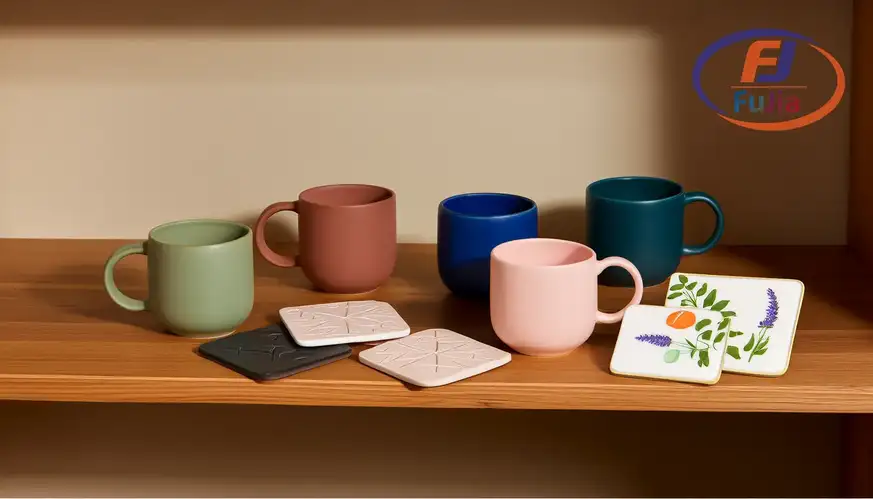
Can you sublimate on regular ceramic mugs?
No, sublimation does not work on regular uncoated ceramic mugs, because sublimation dye bonds only with polyester-based chemistry and raw ceramic has none, so the transfer presses into a blank surface regardless of temperature or time. Sublimation mugs are ceramic blanks factory-coated with a polyester layer that accepts the dye at 385-400 °F, and those coated blanks cost $1.20-3.50 versus under a dollar for uncoated equivalents. The coating is the product decision. Buy coated blanks from documented suppliers, and the same press that failed on regular mugs produces thousands-of-wash durability on coated ones.
How long do you press a sublimation mug?
A sublimation mug presses for 150-210 seconds at 385-400 °F in a convection mug press, with 180 seconds at 400 °F as the production default for standard 11 oz coated mugs and 15 oz formats adding 15-30 seconds. The long cycle exists because the mug press wraps heat around a curve rather than pressing flat, and under-pressing shows as pale edges while over-pressing yellows the coating. Light-to-medium pressure completes the recipe, and test-pressing one mug per new blank batch tunes the exact time for that coating.
Are sublimation mugs dishwasher safe?
Sublimation mugs are dishwasher safe for thousands of cycles when the blank’s coating quality is production grade, because the dye lives inside the polyester coating rather than sitting on its surface like paint or vinyl. The failures that do occur trace to thin or poorly cured coatings from budget blank suppliers, which is why a 5-cycle test wash on any new blank batch is the qualification step. Top-rack washing extends life further. Coating quality rather than washing method is the variable that separates mugs that fade at cycle 50 from mugs that outlast the cupboard, and that fact belongs in every blank purchase decision.
What blank do I need for ceramic sublimation?
Ceramic sublimation requires blanks with a factory-baked polyester coating, available as mugs in 11 and 15 ounce sizes, tiles in standard square formats, coasters, and ornaments, with coated blanks costing $1-4 depending on product and quality tier. The coating must be uniform across the print zone and cured at the factory, because hand-applied or thin coatings fade, patch, or yellow under production pressing. Buy coated blanks from suppliers who document their coating process, and test-press plus wash one blank from every new batch before production commits.
Verdict
\n\n\n\nSublimation printing on ceramic is a coated-blank business: mugs press at 385-400 °F for 150-210 seconds, tiles and coasters at 4-7 minutes flat, and the polyester coating that makes any of it possible is the variable that decides wash durability more than technique ever will. The economics run 70-85 percent margins on mugs retailing $12-30, the lineup shares one press and one workflow across its products, and the 5-cycle test wash qualifies every new blank batch before production commits. Buy documented coatings, press the default recipe, and let the mug trade fund the tile and coaster expansion. For coated ceramic blanks with documented coating processes, contact Fujia Print with your product list.
\n\n\n\nSources
\n\n\n\n- \n\n\n
- Wikipedia: Dye-sublimation printing: dye conversion chemistry. \n\n\n
- Wikipedia: Ceramic glaze: glaze and coating fundamentals. \n\n\n
- ASTM International standards: durability testing methods. \n\n\n
- Fujia Print drinkware cases: ceramic program economics. \n\n\n
