
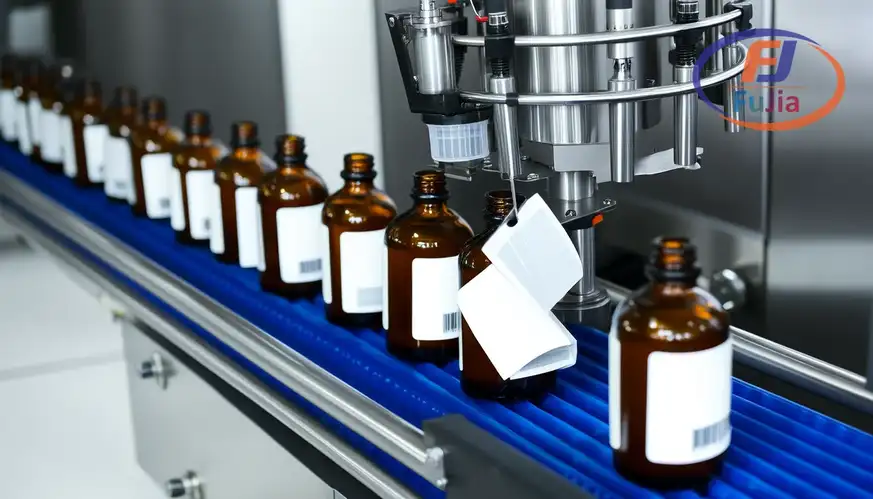
Print and apply labeling machines supply automated label placement on production lines, with applicator classes priced from $8,000-15,000 for wipe-on units handling 30-60 products per minute to $25,000-60,000 for blow-on and tamp-blow systems serving 150-300 per minute lines. The machine pairs a print engine that prints variable data onto blank labels with an applicator head that places each label at line speed, and the sourcing decision balances throughput class, product geometry, and the service reality of whichever channel supplies it. This page maps the applicator classes, prices them honestly, and lists the sourcing criteria that keep a labeling line running after installation.
Key Takeaways
- Applicator classes: wipe-on at $8,000-15,000 for flat surfaces at 30-60 ppm, tamp at $12,000-25,000 for 60-150 ppm, blow-on at $25,000-60,000 for irregular or delicate products.
- Print engines add $3,000-12,000: thermal transfer at 300 dpi is the standard, and print-and-apply runs blank label stock at $0.01-0.04 per label against preprinted at $0.02-0.08.
- Throughput sizing follows the line peak rather than the average, because a labeling head that lags the filler creates the bottleneck every production manager dreads.
- Sourcing splits between Western brands at list price with local service and Chinese OEM lines at 40-60 percent less with remote support, and the choice tracks downtime cost.
- We recommend demanding a live demo on your actual product before any deposit, because product geometry is where spec-sheet machines fail in real rooms.
The Applicator Class Table
The class table sorts the market by placement method, and the method follows product geometry before it follows budget. Prices are machine-only, before print engines and integration:
| Class | Placement method | Speed | Price band | Product fit |
|---|---|---|---|---|
| Wipe-on | roller presses label | 30-60 ppm | $8,000-15,000 | flat uniform surfaces |
| Tamp | pad picks and places | 60-150 ppm | $12,000-25,000 | cartons, cases |
| Tamp-blow | air blows after pick | 100-250 ppm | $20,000-40,000 | delicate, uneven |
| Blow-on | pure air placement | 150-300 ppm | $25,000-60,000 | irregular, fragile |
The classes on the line:
Wipe-on is the workhorse where products present a flat face at a consistent height, and its roller press method delivers the simplest mechanics and the lowest cost of ownership in the table, per the automation tiers our product labeling operations document across packaging lines. Blow-on earns its premium on geometry: the air jet floats the label onto curved, fragile, or irregular surfaces without touching them, which solves placement problems wipe-on physics cannot, and that capability is why cosmetic and glass-line buyers pay the multiple without negotiating.The sizing error runs one direction: buyers spec the applicator to average line speed and discover that fillers surge, so the head must clear peak throughput with 20-30 percent headroom to avoid becoming the line’s governor.
The Economics: Engine, Labels, and Throughput Math
The economics table prices a working labeling cell beyond the applicator sticker, and the label-cost line is where print-and-apply earns its keep over preprinted stock:
| Cost line | Range | Notes |
|---|---|---|
| Applicator | $8,000-60,000 | by class above |
| Print engine | $3,000-12,000 | thermal transfer 300 dpi |
| Integration and guarding | $2,000-8,000 | line fit varies |
| Blank label stock | $0.01-0.04 per label | vs preprinted $0.02-0.08 |
| Ribbon | $0.003-0.008 per label | thermal transfer |
The variable-data advantage:
When it comes to the label economics, preprinted labels carry every SKU as separate inventory with separate minimum orders, while blank stock plus a print engine carries infinite SKUs as one roll, which collapses warehouse complexity at exactly the moment product variety grows. A condiment producer we supply cut 14 label SKUs to 2 blank stocks when it moved its date-coding and variant labeling to print-and-apply. The stockroom simplification repaid the engine inside 8 months before counting the changeover labor it eliminated, per the inventory math our consumables guides apply to packaging programs. The economics need volume: lines running under 2,000-3,000 products daily rarely amortize the automation. Hand labeling remains honest economics below that line.
Sourcing Channels and the Service Question
The sourcing table compares the supply channels, and the service column prices the real difference between them. The comparison assumes equivalent machine class:
| Channel | Price vs list | Service model | Spare parts lead |
|---|---|---|---|
| Western OEM | list | local tech network | days |
| Chinese OEM direct | 40-60% less | remote video + courier | 1-3 weeks |
| Regional integrator | list +15-30% | turnkey installation | days |
| Used-refurbished | 40-70% of new | as-is or shop warranty | varies |
The sourcing decision in one frame:
We recommend buyers price their downtime before their machine: a line stopping for labeling failures costs $200-2,000 per hour by industry, and that number converts the 40-60 percent Chinese OEM discount into a calculated bet rather than a sticker win, because a two-week spare-part wait prices the discount away inside one serious failure. The middle path many buyers miss is the regional integrator at list-plus margin, which buys turnkey installation, local response, and someone whose phone answers at 7 am when the line stalls, per the sourcing logic our packaging automation cases document across food and cosmetic lines. We recommend the live-demo gate regardless of channel. Run your actual product through the candidate machine, because applicator physics meet product geometry in ways no catalog predicts, and the demo converts an unknown into a schedule.
What is a print and apply labeling machine?
A print and apply labeling machine is an automated system that prints variable data onto blank labels and applies each label to products moving on a production line, combining a thermal transfer print engine with an applicator head in one unit. The applicator classes run from wipe-on rollers at 30-60 products per minute through tamp and tamp-blow systems to pure blow-on heads reaching 300 per minute on irregular surfaces. Machines price from $8,000-15,000 for wipe-on class up to $25,000-60,000 for blow-on systems, plus $3,000-12,000 for the print engine and integration.
How much does a labeling machine cost?
A labeling machine costs $8,000-15,000 for wipe-on applicators, $12,000-25,000 for tamp systems, and $25,000-60,000 for blow-on class machines, with print engines adding $3,000-12,000 and integration adding $2,000-8,000. Chinese OEM directs price 40-60 percent under Western list prices with remote support models, and regional integrators charge list plus 15-30 percent for turnkey installation and local service. A working labeling cell totals $13,000-80,000 depending on class, and lines under 2,000-3,000 products daily rarely amortize automation against hand labeling.
What is the difference between wipe-on and blow-on labelers?
Wipe-on labelers press the label onto the product with a roller as it passes, which suits flat surfaces at consistent heights and delivers the lowest cost at 30-60 products per minute. Blow-on labelers pick the label then float it onto the product with an air jet, touching neither the product nor the label face, which handles curved, fragile, and irregular surfaces at 150-300 products per minute and prices 2-4x higher. The choice follows product geometry before budget. Uniform cartons take wipe-on economics happily, and cosmetic bottles or glass jars justify blow-on because contact placement damages either product or label.
Is print and apply labeling worth it for small production?
Print and apply labeling pays for itself when daily volume clears roughly 2,000-3,000 products, when SKU variety makes preprinted label inventory complex, or when variable data like batch codes and dates must reach every unit. Below that volume, hand labeling with preprinted or desktop-printed labels remains honest economics, and the automation becomes a growth purchase rather than a launch one. The variable-data case strengthens the math: one blank stock replacing a dozen preprinted SKUs saves warehouse space, minimum-order waste, and changeover time, which is why growing food and cosmetic brands adopt print-and-apply before their volume strictly requires it.
Verdict
Print and apply labeling machine supply resolves into an applicator class matched to product geometry, a print engine that converts label inventory into one blank roll, and a sourcing channel priced against your own downtime cost: wipe-on at $8,000-15,000 for flat lines, blow-on at $25,000-60,000 for fragile or irregular products, and Western, Chinese, or integrator channels each carrying a different service bet. Size heads to line peak with 20-30 percent headroom, demand a live demo on your actual product, and let daily volume justify the automation rather than aspiration. Price your downtime honestly, choose the channel that answers its phone, and the labeling line runs years after the invoice fades. For labeling line equipment quotes and blank stock supply, contact Fujia Print with your line spec.
Sources
- Wikipedia: Label printer applicator: applicator class overview.
- PMMI packaging resources: packaging automation standards.
- Fujia Print product labeling guide: labeling program cases.
- OSHA machine guarding: integration safety requirements.
